Promotional messages on WhatsApp are read far more often than email, which is exactly why they are easy to get wrong: the same list that opens everything will also block you faster than any other channel. The examples below are built around the two things that separate a campaign that pays for itself from one that costs you reach — a reason the reader believes, and a message specific enough that it could not have been sent to everybody.
RReputoo Editorial TeamUpdated September 20266 min read
Give the offer a reason. "20% off because we are overstocked on winter lines" outperforms "20% off" because it is believable.
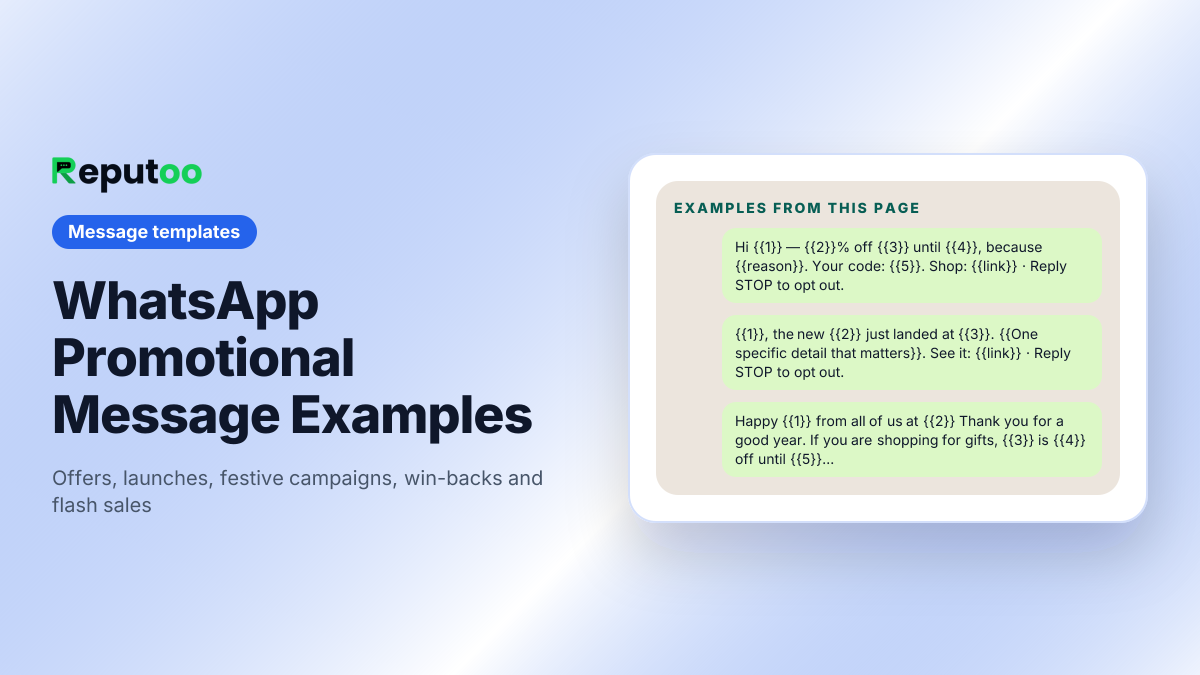
Hi {{1}} — {{2}}% off {{3}} until {{4}}, because {{reason}}. Your code: {{5}}. Shop: {{link}} · Reply STOP to opt out.
{{1}}, you have {{2}} in your {{3}}. Here is {{4}} off to finish it, valid {{5}}: {{link}} · Reply STOP to opt out.
Hello {{1}} — our {{2}} sale opens for WhatsApp customers a day early. {{3}} off everything until {{4}}: {{link}} · Reply STOP to opt out.
Chapter 02
New arrivals and launches
Send to the segment that bought the adjacent thing, not the whole list. Relevance is what protects the quality rating.
{{1}}, the new {{2}} just landed at {{3}}. {{One specific detail that matters}}. See it: {{link}} · Reply STOP to opt out.
Hi {{1}} — you bought {{2}} from us in {{3}}. The {{4}} that goes with it is now in: {{link}} · Reply STOP to opt out.
{{1}}, {{2}} is back in stock after {{3}}. {{4}} pieces only this time: {{link}} · Reply STOP to opt out.
Chapter 03
Festive and seasonal
Lead with the wish, not the discount. A festive message that is only a coupon reads as opportunism.
Happy {{1}} from all of us at {{2}} 🪔 Thank you for a good year. If you are shopping for gifts, {{3}} is {{4}} off until {{5}}: {{link}} · Reply STOP to opt out.
{{1}}, wishing you and your family a wonderful {{2}}. Our {{3}} collection is live, and we are open {{4}} through the holiday: {{link}} · Reply STOP to opt out.
Chapter 04
Win-back for lapsed customers
Acknowledge the gap honestly and make the return easy. Ask what went wrong — the replies are worth more than the sales.
Hi {{1}}, it has been {{2}} since your last order at {{3}}. If we got something wrong, tell us — we would like to know. If not, here is {{4}} off to come back: {{link}} · Reply STOP to opt out.
{{1}}, we have changed a fair bit since {{2}} — {{3}}. Worth another look? {{link}} · Reply STOP to opt out.
Chapter 05
Flash sales and low stock
Only use urgency that is true. A countdown that resets teaches the list to ignore every future one.
{{1}}, {{2}} hours left on {{3}}. {{4}} remaining at this price: {{link}} · Reply STOP to opt out.
Hi {{1}} — {{2}} sold out in {{3}} last time. It is back today only: {{link}} · Reply STOP to opt out.
Chapter 06
Before you send
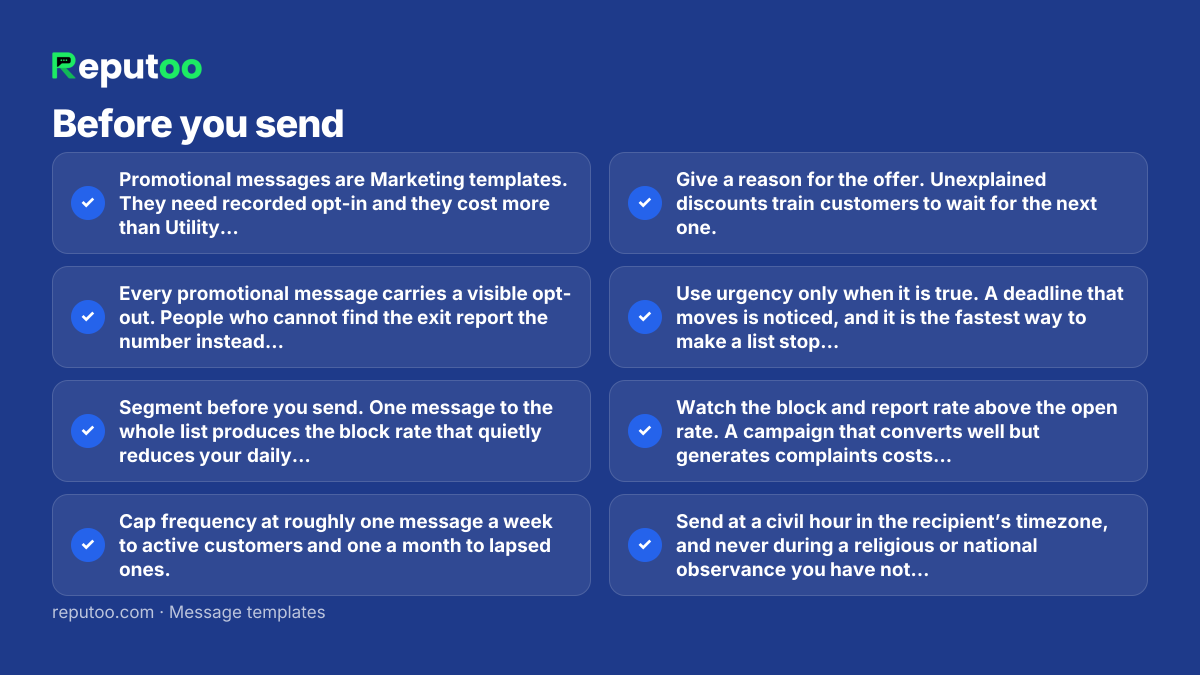
Promotional messages are Marketing templates. They need recorded opt-in and they cost more than Utility — categorising one as Utility to save money is the commonest rejection there is.
Every promotional message carries a visible opt-out. People who cannot find the exit report the number instead, and reports cost more than unsubscribes.
Segment before you send. One message to the whole list produces the block rate that quietly reduces your daily messaging limit.
Cap frequency at roughly one message a week to active customers and one a month to lapsed ones.
Give a reason for the offer. Unexplained discounts train customers to wait for the next one.
Use urgency only when it is true. A deadline that moves is noticed, and it is the fastest way to make a list stop reading.
Watch the block and report rate above the open rate. A campaign that converts well but generates complaints costs you future reach.
Send at a civil hour in the recipient’s timezone, and never during a religious or national observance you have not thought about.
What makes these work, and where Meta's rules bite.
Chapter 07
Frequently asked questions
What is a good promotional message for WhatsApp?
One with a reason the reader believes and a detail that could not apply to everybody. "20% off winter stock because we over-ordered, until Sunday" works where "20% off, shop now" does not, because the first is a business explaining itself and the second is noise. Add the opt-out line and keep it under about 60 words.
Are promotional WhatsApp messages allowed?
Yes, on the WhatsApp Business Platform using approved Marketing templates sent to people who opted in. What is not allowed is messaging people who never consented, or automating the consumer app with sender software. The free WhatsApp Business app can send to broadcast lists, but only to contacts who have saved your number.
How often should I send promotional messages?
About once a week to active customers and once a month to lapsed ones, as a starting point. WhatsApp tolerates less frequency than email because it sits in a personal space — the cost of over-sending is not a lower open rate, it is blocks, and blocks reduce how many customers you are allowed to message per day.
Do promotional messages cost more than order updates?
Yes. Meta prices Marketing conversations above Utility ones, and the gap varies by country. That difference is exactly why promotional wording gets submitted under Utility, and why Meta reviews and re-categorises templates that try it.
What is a good WhatsApp marketing message?
The same thing that makes a good promotional message: a reason the reader believes and a detail that could not have been sent to everybody. Marketing messages on WhatsApp are read far more reliably than email, so the constraint is not attention — it is tolerance. A message that is obviously mass-sent costs you a subscriber; one that references what they bought or looked at earns a reply.
Where can I find WhatsApp marketing samples to copy?
The sets on this page are written to be copied and edited — offers, launches, festive, win-back and flash sales, each with the variable slots marked. Change the reason, the specifics and the opt-out line rather than sending them as-is, because the specificity is the part that works, not the sentence structure.
What makes a WhatsApp campaign get blocked?
Irrelevance and frequency, more than content. Sending one message to an unsegmented list, sending too often, and sending to people whose opt-in you cannot evidence all drive blocks and reports, which feed the quality rating. A poorly written message to the right segment survives; a well-written one to everybody does not.
R
Written by Reputoo Editorial Team. Ready-to-use WhatsApp messages, written to pass Meta’s template review and read like a person wrote them.