
Glossary·Updated September 2026

What Are Transactional Messages?

Definition

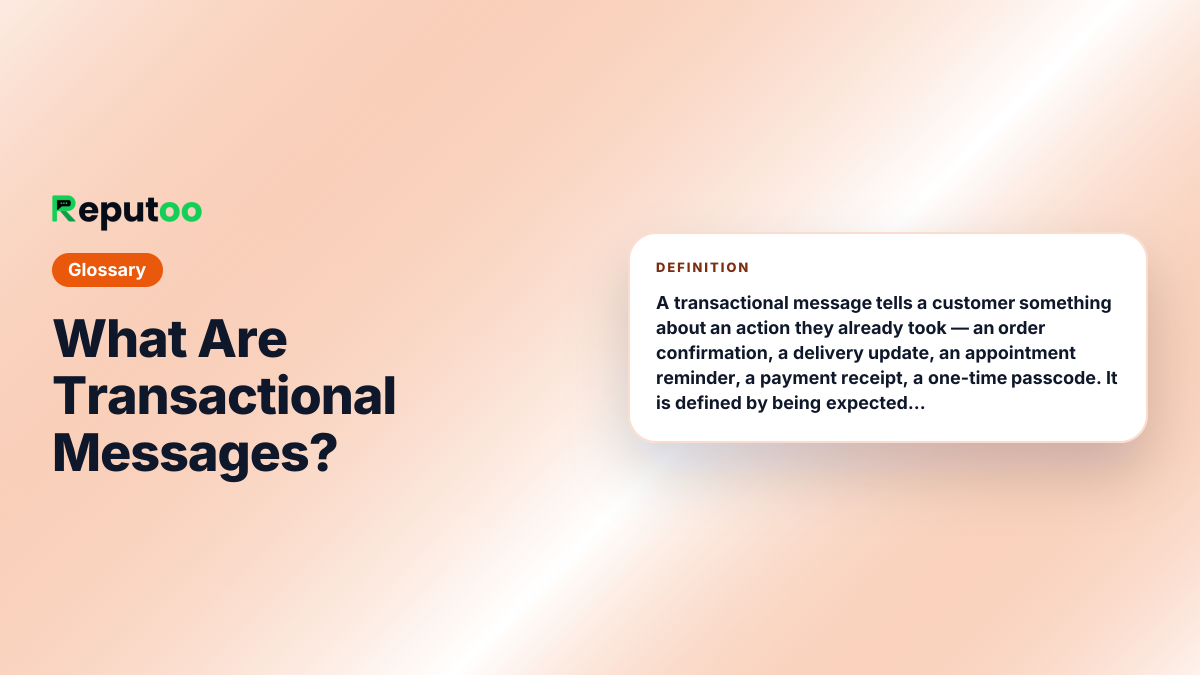
A transactional message tells a customer something about an action they already took — an order confirmation, a delivery update, an appointment reminder, a payment receipt, a one-time passcode. It is defined by being expected rather than promotional, which is why it is treated differently from marketing on every channel including WhatsApp.

Key Points

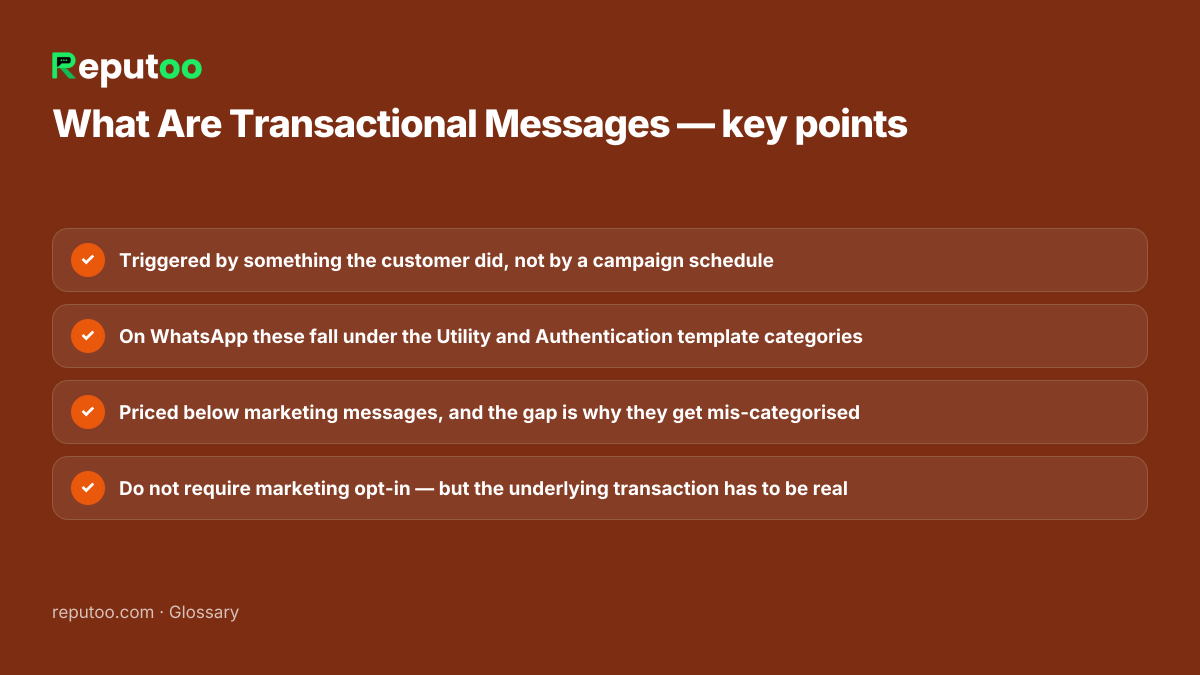
  • Triggered by something the customer did, not by a campaign schedule
  • On WhatsApp these fall under the Utility and Authentication template categories
  • Priced below marketing messages, and the gap is why they get mis-categorised
  • Do not require marketing opt-in — but the underlying transaction has to be real

Transactional versus marketing

The test is whether the customer would expect the message because of something they did. An order confirmation, a shipping notice, a booking reminder and a password reset all pass. A discount code, a new-arrivals announcement and a win-back offer all fail, however carefully they are worded. The distinction is not about tone — a transactional message can be friendly and a marketing message can be dry — it is about what triggered it.
Why the categories matter on WhatsApp

On the WhatsApp Business Platform every business-initiated message uses an approved template in a category, and the category sets the price. Utility covers transactional messages about something the customer already did. Authentication covers one-time codes. Marketing covers anything selling, and costs meaningfully more in every market. Because the gap is real money, promotional messages get submitted as Utility routinely — and it is the single commonest reason templates are rejected or re-categorised by Meta after approval.

What tips a message from Utility into Marketing

Adding an offer is the obvious one — an order confirmation carrying a discount code for next time is a marketing message wearing a receipt. Less obvious: cross-sell suggestions, loyalty-point promotions, and calls to action that point somewhere other than the transaction. The safe rule is that a Utility message should be about that order, that booking or that payment, and nothing else. Sell in a separate message under the right category.

Why transactional messages perform

They are read at rates marketing never reaches, because the customer is waiting for them. That makes them the highest-value messages most businesses send and the ones worth building first — a reliable delivery-update flow removes the "where is my order" support load, and an appointment reminder recovers bookings that would have been no-shows. The value comes from the reliability, not the persuasion.

When they fail to deliver

A transactional message that does not arrive is worse than a marketing one that does not, because someone was expecting it. The usual causes on WhatsApp are a paused template, a number whose quality rating has dropped, or a recipient who never opted in at all. Watching template status and quality rating in WhatsApp Manager is the practical safeguard, since both change after approval rather than at it.

How Reputoo Helps

Put this into practice with Reputoo

  • Fires transactional messages from real business events — order placed, booking made, payment due, appointment tomorrow — rather than from a schedule someone maintains
  • Keeps Utility and Marketing templates separate so a promotion never rides along on a receipt
  • Shows per-category conversation cost before sending, since Utility and Marketing are priced differently
  • Surfaces template status so a paused template is noticed before customers stop receiving updates

Frequently Asked Questions

What is a transactional message?

A message about something the customer already did — an order confirmation, a delivery update, an appointment reminder, a receipt, a one-time code. It is defined by being triggered by the customer’s own action rather than by a campaign, which is what separates it from marketing.

What is the difference between transactional and marketing messages?

Whether the customer would expect it because of something they did. A shipping notice is transactional; a discount code is marketing, however it is worded. On WhatsApp this maps to the Utility and Marketing template categories, and Marketing costs more in every market.

Do transactional messages need opt-in?

Not marketing opt-in, but the transaction has to be genuine — you can message someone about the order they placed without them subscribing to anything. What you cannot do is treat a past purchase as consent to promote, which is where businesses get into trouble.

Why was my Utility template re-categorised as Marketing?

Almost always because it contains something promotional: a discount for next time, a cross-sell, or a call to action pointing away from the transaction. Meta reviews category claims and moves templates it disagrees with. Keep a Utility message about that order and nothing else.

Are transactional messages cheaper on WhatsApp?

Yes. Utility and Authentication conversations are priced below Marketing in every market, and the gap can be substantial. That difference is exactly why promotional content gets submitted as Utility, and why Meta polices the categories after approval as well as at it.