
What Is Sentiment Analysis? How Businesses Use It
Definition
Sentiment analysis is an AI technique that automatically identifies whether text — a customer message, review, survey response, or social media post — expresses a positive, negative, or neutral attitude. Businesses use it to understand customer satisfaction at scale and make smarter decisions.
Key Points
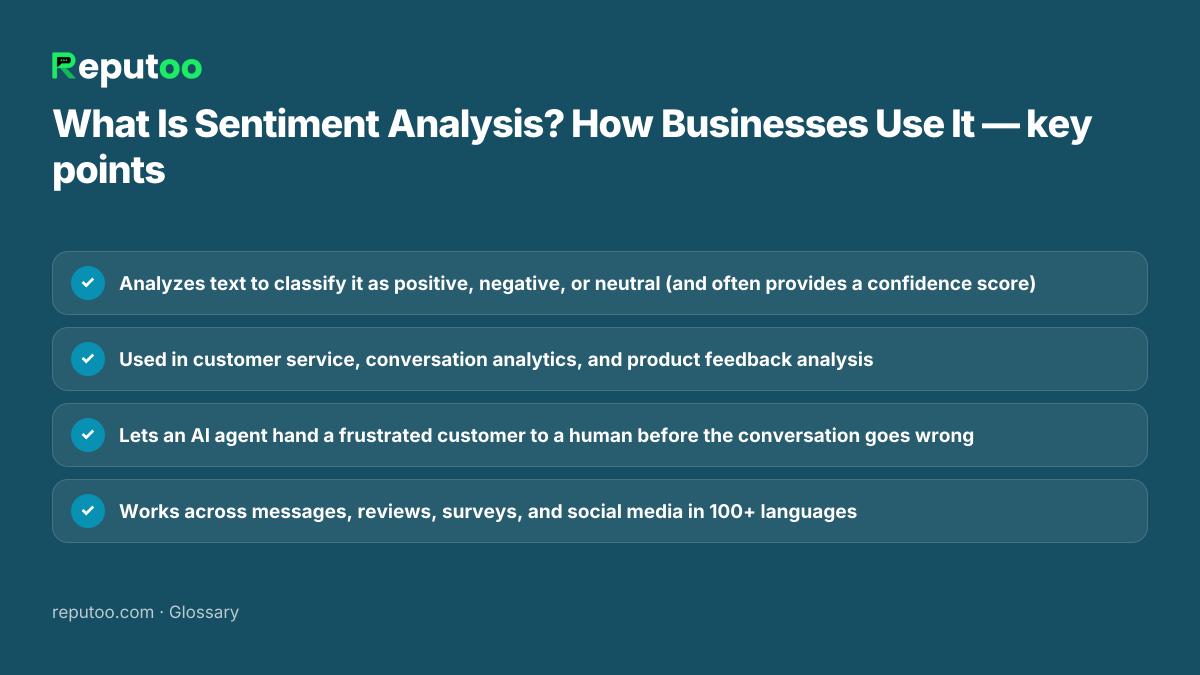
- Analyzes text to classify it as positive, negative, or neutral (and often provides a confidence score)
- Used in customer service, conversation analytics, and product feedback analysis
- Lets an AI agent hand a frustrated customer to a human before the conversation goes wrong
- Works across messages, reviews, surveys, and social media in 100+ languages
How Sentiment Analysis Works
Traditional sentiment analysis used keyword matching (words like "terrible" = negative, "great" = positive). Modern AI-powered sentiment analysis uses deep learning to understand context, sarcasm, and nuance. A sentence like "I waited an hour and the food was cold — amazing experience!" is correctly identified as negative despite containing the word "amazing". Accuracy on business text typically ranges from 85–95%.
Sentiment Analysis in Conversation Analytics
For a business running AI agents on chat and calls, the practical value of sentiment analysis is knowing when the AI should stop and a human should take over. Scoring each incoming message means a conversation that turns frustrated ("this is the third time I am asking") can be escalated to a person immediately, rather than after the customer gives up. Aggregated across every conversation, the same scores show which topics, agents and times of day produce the worst experiences — which is what conversation analytics reports on.
Other Business Uses of Sentiment Analysis
Customer service triage: automatically route negative sentiment messages to senior agents. Escalation: get alerted the moment a conversation turns negative. Product feedback: analyze what customers love vs. dislike about specific products. Campaign performance: measure whether a marketing campaign created positive or negative customer reactions. Coaching: compare sentiment across agents and shifts to find where service slips.
Multilingual Sentiment Analysis
For businesses serving diverse markets, sentiment analysis must work across languages. Modern LLM-based sentiment analysis handles 100+ languages with similar accuracy to English — critical for businesses in India (Hindi, Tamil, Telugu), UAE (Arabic), Brazil (Portuguese), and other multilingual markets. Reputoo scores sentiment across all 36 supported languages.
How Reputoo Helps
Put this into practice with Reputoo
- Sentiment scoring on every conversation, so a frustrated customer reaches a human instead of a bot
- Real-time sentiment alerts: get notified when customers express negative sentiment in WhatsApp chats
- Conversation monitoring with sentiment scoring — see trends in customer happiness over time
- Post-conversation sentiment triggers: if a customer rates a chat interaction negatively, flag it for follow-up by a human
- Multilingual: sentiment analysis works across all 36 supported languages
Every term in the glossary
Frequently Asked Questions
How does sentiment analysis decide when a human should take over?
Each incoming message is scored as positive, negative or neutral. When a conversation crosses into sustained negative sentiment — repeated complaints, escalating language, an unresolved request — it is flagged for handoff so a person can step in, rather than leaving the customer with an AI agent that is not resolving the problem.
How accurate is AI sentiment analysis?
Modern AI sentiment analysis achieves 85–95% accuracy on business text. It handles context and nuance well but can struggle with highly complex sarcasm or ambiguous phrasing. In practice, this accuracy is more than sufficient for business decisions like routing a conversation to a human — the occasional misclassification has minimal impact on overall results.
Can sentiment analysis work in Hindi, Arabic, or other non-English languages?
Yes. Large language model-based sentiment analysis (which Reputoo uses) handles 100+ languages with similar accuracy to English. This is critical for businesses in India, UAE, Brazil, Indonesia, and other markets where customers communicate in local languages.
Is sentiment analysis the same as NPS (Net Promoter Score)?
No. NPS is a structured survey metric (0–10 scale: would you recommend us?). Sentiment analysis works on unstructured text — analyzing the tone of natural messages, reviews, and comments without requiring customers to fill in a form. They complement each other: NPS gives you a score, sentiment analysis gives you the "why" behind it.
How do businesses use sentiment analysis to improve Google ratings?
The primary use case is escalation: a conversation that turns negative is handed to a person instead of left with the agent. Businesses using this approach typically see fewer conversations end badly, because a human steps in before the customer gives up.