
What Is a WhatsApp Newsletter?
Definition
A WhatsApp newsletter is a recurring message sent to a list of people who asked to receive it — the same idea as an email newsletter, delivered as an ordinary private WhatsApp chat. WhatsApp has no feature called "newsletter"; what businesses mean by the term is a scheduled broadcast sent on a regular cadence to an opted-in segment.
Key Points
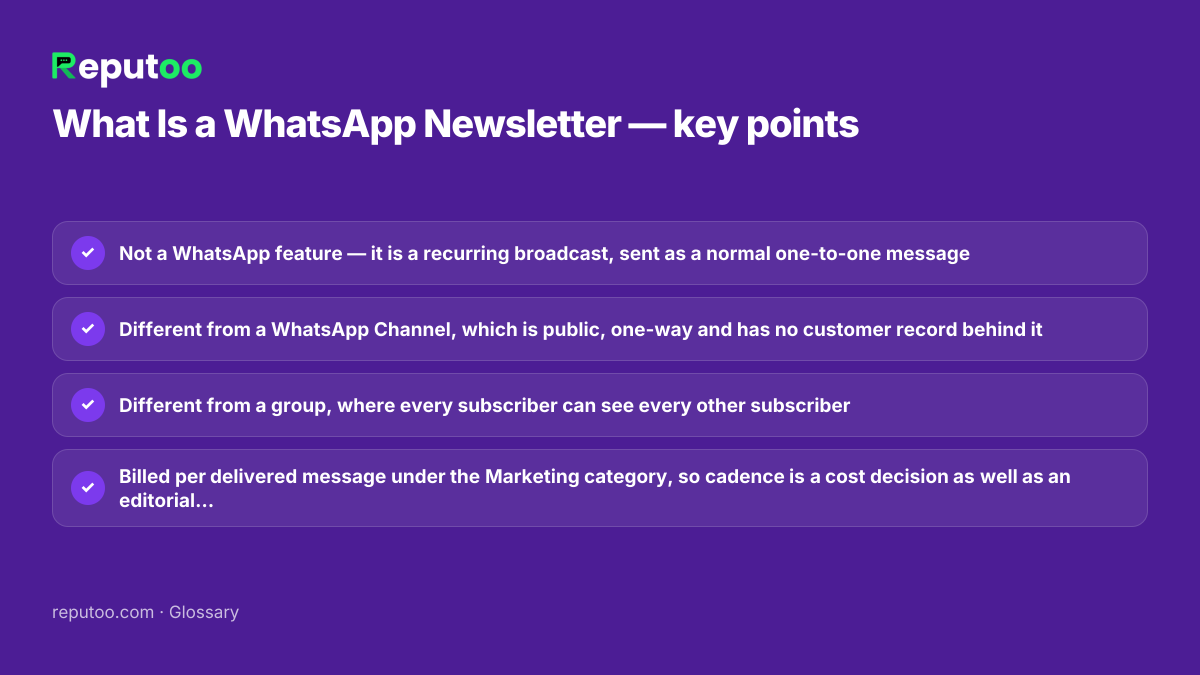
- Not a WhatsApp feature — it is a recurring broadcast, sent as a normal one-to-one message
- Different from a WhatsApp Channel, which is public, one-way and has no customer record behind it
- Different from a group, where every subscriber can see every other subscriber
- Billed per conversation under the Marketing category, so cadence is a cost decision as well as an editorial one
Newsletter, Channel or group — three different things
A newsletter in the sense businesses mean is a broadcast: each recipient gets a private message from your business and cannot see anyone else on the list. A WhatsApp Channel is a separate product — public, one-way, anyone can follow it, and you learn almost nothing about who did. A group puts every subscriber in one conversation where they see each other’s numbers, which for a customer list is usually a mistake rather than a feature. Only the broadcast keeps the message private, the list private, and replies coming back to you as individual conversations you can act on.
Why it outperforms email, and why that cuts both ways
WhatsApp newsletters are opened far more reliably than email, because they arrive in the same list as messages from friends and family. That is the entire advantage and also the entire risk. An email nobody wants is ignored; a WhatsApp message nobody wants gets the sender blocked, and blocks feed the quality rating that governs how many customers you are allowed to message per day. The channel does not tolerate the send-more-and-see approach that email does.
What a newsletter actually needs to work
Four things. Recorded consent for every recipient, with a note of when and how they gave it. A cadence you can hold — weekly or monthly, decided in advance, not whenever there is news. Segmentation, so that the message going to people who bought last month is not the one going to people who have never bought. And a visible opt-out on every send, because a subscriber who cannot find the exit reports the number instead.
What it costs
Newsletter sends are Marketing-category messages on the WhatsApp Business Platform, which is the more expensive of the categories, and the rate depends on the recipient’s country. That makes cadence a budget decision: doubling from monthly to fortnightly doubles the bill. It also makes segmentation pay for itself — sending a relevant message to a quarter of the list often earns more than a generic one to all of it, at a quarter of the cost.
Building the list
The subscriber has to opt in, and the routes that work are the ones where the person is already engaged: a checkbox at checkout, a website chat widget, a QR code on a receipt or a table, a keyword opt-in, and click-to-WhatsApp ads. Imported lists and bought numbers are the fastest way to lose a number that customers have saved. Five hundred people who asked for it will outperform five thousand who did not, and they will keep the account healthy enough to keep sending.
How Reputoo Helps
Put this into practice with Reputoo
- Sends recurring broadcasts on the official WhatsApp Business Platform, delivered to everyone who opted in whether or not they saved your number
- Segments the list by tag, purchase history or attribute so each send goes to the people it is relevant to
- Keeps the opt-in record on the contact, and honours opt-outs automatically
- Shows the per-country conversation cost before a send, so cadence can be budgeted rather than discovered
Every term in the glossary
Frequently Asked Questions
What is a WhatsApp newsletter?
A recurring message sent to people who asked to receive it — the WhatsApp equivalent of an email newsletter. WhatsApp itself has no feature by that name; in practice it is a scheduled broadcast to an opted-in segment, delivered as a normal private chat so recipients cannot see each other.
Is a WhatsApp newsletter the same as a Channel?
No. A Channel is public and one-way — anyone can follow it and you learn very little about who did. A newsletter is a broadcast to your own opted-in list, arriving as a private message, with replies coming back as individual conversations you can act on. For selling to existing customers the broadcast is the useful one.
How do I start a WhatsApp newsletter?
Collect opt-ins where people are already engaged — checkout, a website widget, a QR on a receipt, click-to-WhatsApp ads — then pick a cadence you can hold, segment the list, and send an approved Marketing template with a visible opt-out. The order matters: cadence and segmentation decided before the first send, not after the first complaint.
How often should I send one?
Weekly to active customers and monthly to lapsed ones is a workable starting point. WhatsApp tolerates less frequency than email because it sits in a personal space — the penalty for over-sending is not a lower open rate, it is blocks, and blocks reduce how many customers you may message per day.
What does a WhatsApp newsletter cost?
It is billed per conversation under the Marketing category, which is the most expensive one, at a rate that varies by the recipient’s country. Cadence is therefore a budget decision as much as an editorial one, and segmentation genuinely pays — a relevant send to a quarter of the list often earns more than a generic send to all of it.
Can subscribers unsubscribe?
They must be able to, and it should be visible in the message rather than buried. A reply keyword such as STOP is the norm. This protects you more than it protects them: a subscriber who cannot find the exit reports the number instead, and a report costs far more than an unsubscribe.