
What Is Conversational AI? A Business Leader's Guide
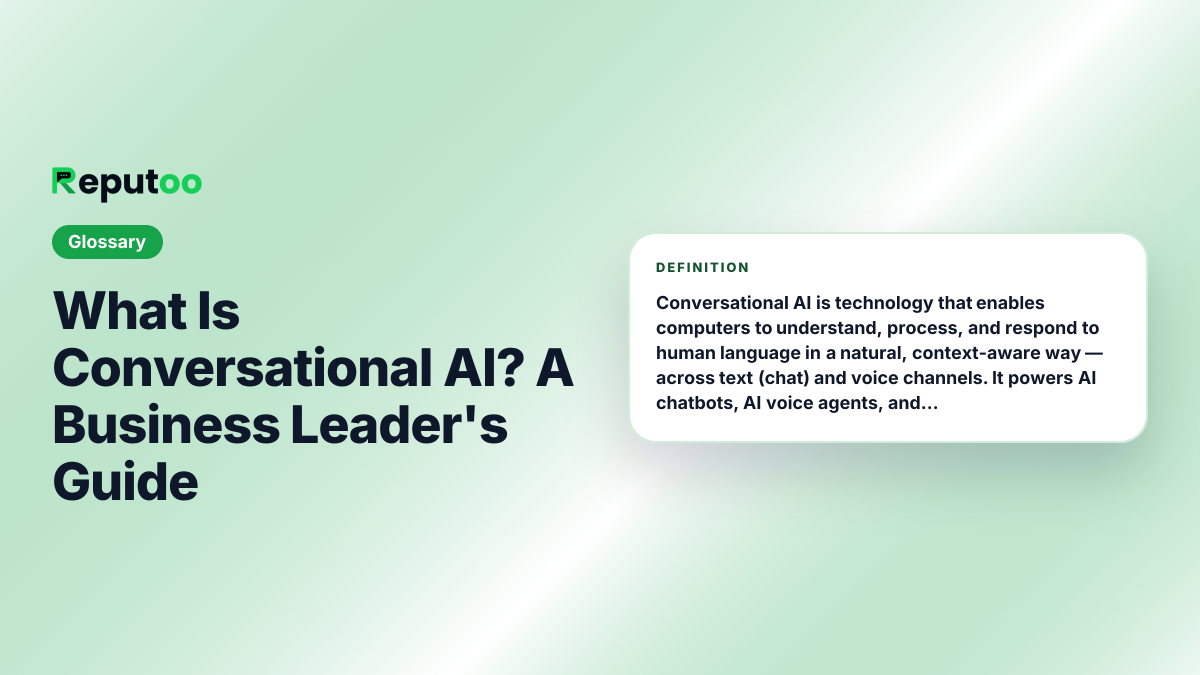
Definition
Conversational AI is technology that enables computers to understand, process, and respond to human language in a natural, context-aware way — across text (chat) and voice channels. It powers AI chatbots, AI voice agents, and virtual assistants that can hold meaningful conversations with customers without human involvement.
Key Points
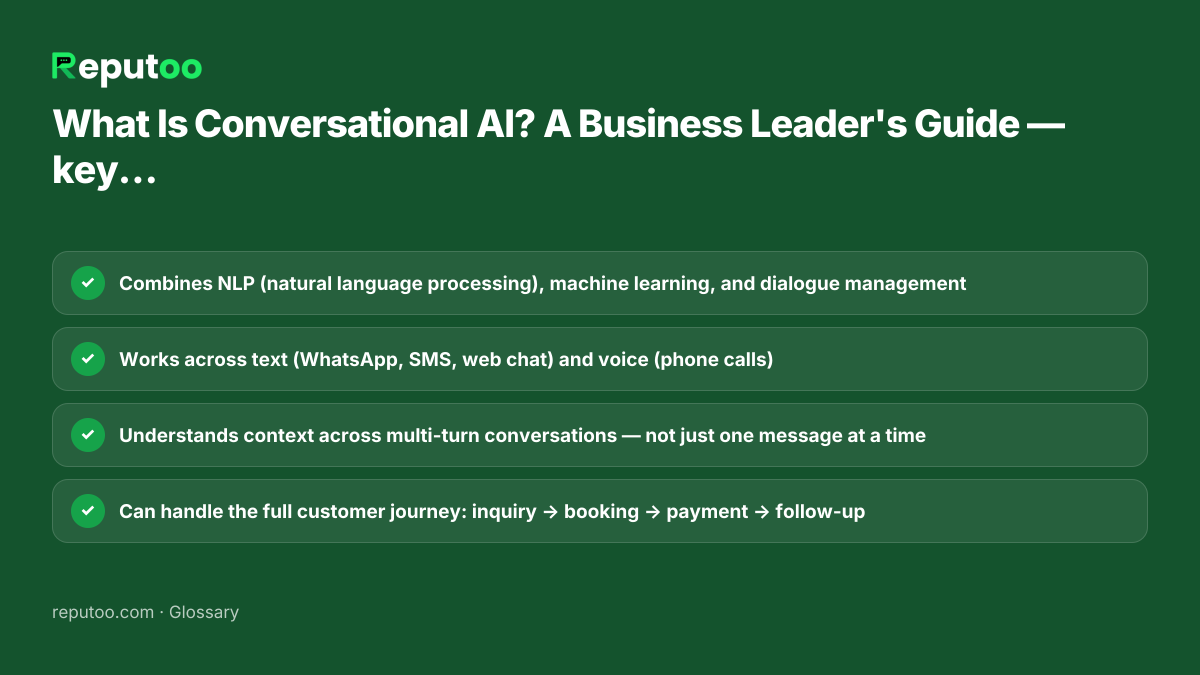
- Combines NLP (natural language processing), machine learning, and dialogue management
- Works across text (WhatsApp, SMS, web chat) and voice (phone calls)
- Understands context across multi-turn conversations — not just one message at a time
- Can handle the full customer journey: inquiry → booking → payment → follow-up
How Conversational AI Works
Conversational AI processes language through four layers: (1) Natural Language Understanding — interpreting what the user means, not just what they said. (2) Context management — tracking conversation history to understand follow-up questions. (3) Dialogue management — deciding the best next response or action. (4) Natural Language Generation — producing a human-like response. Modern conversational AI is powered by large language models (LLMs) like GPT-4 and Claude, which dramatically improved conversational quality compared to earlier rule-based systems.
Text vs. Voice Conversational AI
Text-based conversational AI handles WhatsApp, SMS, web chat, and email conversations. Voice conversational AI handles phone calls — understanding spoken language through speech-to-text, processing the query, generating a response, and converting it back to speech through text-to-speech. Voice conversational AI (like Reputoo's AI voice agent) is significantly more complex but enables 24/7 phone answering without human receptionists.
Business Use Cases
Customer service: handling FAQs, complaints, and follow-ups without agents. Sales: qualifying leads, scheduling demos, answering pricing questions. Operations: appointment booking, payment reminders, delivery notifications. Retention: win-back and re-order messages after service. Any repetitive, structured conversation is a candidate for conversational AI automation.
Conversational AI vs. Traditional Automation
Traditional automation is rigid: if a customer doesn't follow the exact expected path, it fails. Conversational AI is flexible: it understands intent across varied phrasing, handles interruptions, recovers from misunderstandings, and escalates appropriately when it reaches its limits. This difference in robustness is why businesses replacing rule-based IVR with conversational AI typically see 40–60% improvement in task completion rates.
How Reputoo Helps
Put this into practice with Reputoo
- WhatsApp conversational AI: handles customer queries, bookings, and follow-ups via chat
- Voice conversational AI: AI receptionist answers every call 24/7 in 36 languages
- Unified platform: same AI knowledge base powers both text and voice channels
- Human handoff: AI escalates to your team seamlessly when needed
- Analytics: see which conversations convert, which escalate, and where the AI can improve
Every term in the glossary
Frequently Asked Questions
What is the difference between conversational AI and a chatbot?
A basic chatbot follows fixed scripts (rule-based). Conversational AI uses machine learning and NLP to understand natural language and context — it can handle unexpected questions, multi-turn conversations, and varied phrasing. All modern AI chatbots are conversational AI, but not all chatbots are conversational AI.
Is Siri or Alexa conversational AI?
Yes, Siri, Alexa, and Google Assistant are early examples of voice-based conversational AI. However, they're designed for personal consumer use. Business conversational AI platforms like Reputoo are optimized for customer service, sales, and operations — with business-specific knowledge bases, CRM integration, and multi-channel deployment.
How accurate is conversational AI?
Modern conversational AI built on large language models handles routine business queries with 85–95% accuracy. The remaining cases are escalated to human agents. Accuracy improves over time as you add more business-specific context and the AI learns from conversation patterns.
Can conversational AI work in multiple languages?
Yes. Large language model-based conversational AI naturally handles multiple languages. Reputoo supports 36 languages, allowing businesses in multilingual markets to serve customers in their preferred language without separate AI setups for each language.
What is the ROI of conversational AI for small businesses?
Businesses using conversational AI typically save 20–40 hours of staff time per week on customer service. Combined with 24/7 availability (capturing queries that would otherwise be missed), the average ROI is 5–8× the platform cost within 6 months. Answering calls that would otherwise be missed is usually the single largest contributor.