Check the WhatsApp Business API Price for Your Country
Work out the WhatsApp Business API price for your own country and volume. See Meta's per-message rates for marketing, utility and authentication messages — India in rupees — free, no signup.
WhatsApp API Cost Calculator
Per Message
₹0.8631
Meta rate, October 1, 2026 · + 18% GST
Monthly Total
₹863.10
1,000 msgs
Yearly
₹10357
estimate
Important
These are Meta's per-message list rates before volume tiers — paid directly to Meta from your Meta Business account. Reputoo charges a separate flat monthly subscription with zero per-message markup.
How to Use
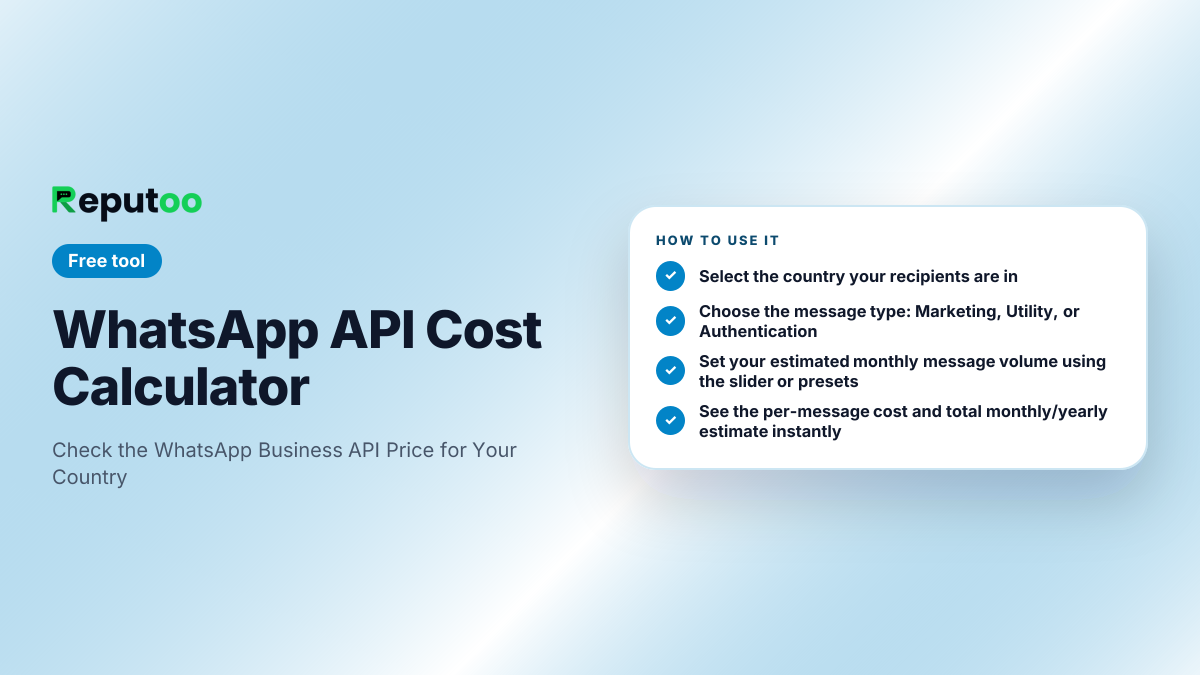
- 1
Select the country your recipients are in
- 2
Choose the message type: Marketing, Utility, or Authentication
- 3
Set your estimated monthly message volume using the slider or presets
- 4
See the per-message cost and total monthly/yearly estimate instantly
Automate This with Reputoo
Send WhatsApp campaigns, answer chats and calls with an AI agent, and book appointments automatically — zero manual work.
Get StartedOther Free Tools
How WhatsApp Business API pricing actually works
There are two separate bills and almost every surprise about WhatsApp costs comes from confusing them. The first is Meta's, charged for the messaging itself and billed to the payment method on your Meta Business account. The second is your provider's software fee. Meta's portion is broadly the same whichever provider you buy through, so when vendors compete on price they are competing on the second bill only.
Meta's side was historically charged per conversation — a 24-hour window opened by the first message, inside which any number of further messages cost nothing extra. Through 2025 and 2026 Meta has been reshaping this toward per-message charging for template categories, which changes the arithmetic for businesses that send several messages inside one window. Because that transition has moved more than once, treat any specific figure you read anywhere — including a vendor page — as needing confirmation against Meta's own current rate card before you budget from it.
What has stayed constant is the shape: you pay by category, and you pay by the country your recipient is in. Those two variables drive nearly all the variance in a WhatsApp bill, which is why the calculator above asks for exactly them.
The four categories, and why one of them costs you far more
Marketing covers promotions, offers, abandoned-cart nudges, re-engagement — anything selling something. It is the most expensive category everywhere and the only one Meta rate-limits on quality grounds.
Utility covers transactional messages about something the customer already did: order confirmations, delivery updates, appointment reminders, payment receipts. It is priced substantially below marketing in every market.
Authentication covers one-time passcodes and login verification, and is priced close to utility in most countries.
Service covers your free-form replies when a customer messages you first. They were free from November 2024, but from 1 October 2026 Meta charges them per message at the utility rate for the market — ₹0.115 in India — with no volume tiers, and utility templates sent inside the 24-hour customer service window are charged from the same date.
The practical consequence is that two businesses sending identical message volumes can have bills differing several times over, purely on category mix. A retailer sending mostly order updates pays utility rates; the same retailer running weekly promotions pays marketing rates on that traffic. Before you compare providers, work out your own split — it will tell you more about your future bill than any vendor quote.
Is the WhatsApp Business API free?
The API access is free; the messages are not. Meta does not charge a platform fee for Cloud API access, and there is no licence to buy from Meta to connect a number. What you pay for is conversations, and those are billed from your first one.
From 1 October 2026 there is one genuinely free component left: messages inside the 72-hour window opened when a customer starts a chat from a Click-to-WhatsApp ad or a Facebook Page call-to-action. Replies to customers who message you directly are charged at the utility rate from that date. The free window is a real reason to route paid social traffic into WhatsApp rather than a landing page. And most providers offer a free trial or a free tier of their own software.
What is not free, and what the phrase "free WhatsApp API" usually turns out to mean, is a tool that avoids Meta's charges by avoiding Meta. Desktop applications and browser extensions that automate WhatsApp Web send nothing through the official platform, which is exactly why they cost nothing per message and need no template approval. They also get numbers banned. If a vendor is offering unlimited free sending on what they call the WhatsApp API, that is the product you are being shown.
The second bill: what providers charge on top
Provider pricing comes in three shapes and they suit very different operations. Per-seat pricing charges by the number of people answering, which rewards a small team and penalises support-heavy businesses — and it rises precisely when your campaigns succeed and replies flood in. Flat platform fees per number favour high volume and predictable budgeting. Pure usage-based pricing is cheapest at low volume and hardest to forecast once traffic is steady.
The detail worth asking about directly is markup. Some providers pass Meta's conversation charges through at cost; others mark them up, or bundle an allowance into a plan so the underlying rate is not visible. At any real volume that margin is larger than the platform fee, and it is rarely disclosed prominently. Ask the question in writing before signing.
For Indian businesses there is a further one: whether billing is in rupees against your GSTIN. A tax invoice makes the spend claimable as input credit, and several international providers billing in dollars issue nothing of the kind — which can make an apparently cheaper subscription meaningfully more expensive after tax treatment.
Five ways to cut a WhatsApp API bill
Send utility rather than marketing wherever the message is genuinely transactional. An appointment reminder is a utility message; writing it as a promotion moves it into the expensive category for no benefit.
Let customers open the conversation. Service windows started by the customer are the cheapest traffic on the platform, so a click-to-WhatsApp ad or a QR code on a receipt often costs less per conversation than messaging the same person outbound.
Segment before you broadcast. Sending to everyone is not only more expensive, it damages the quality rating that governs how much you are allowed to send at all — so poor targeting costs twice.
Consolidate messages inside the same window rather than spreading them across days, which under the conversation model avoids opening a new billable window for each one.
Count your subscriptions, not just your rate. A cheap messaging tool alongside a separate scheduling tool and a separate call-tracking tool is frequently more expensive in total than one platform that covers the workflow, before counting the staff time spent reconciling all three.
Frequently Asked Questions
How does WhatsApp API pricing work?
Meta charges per delivered template message. The rate depends on the message category (marketing, utility or authentication) and on the country of the person receiving it. Meta replaced the old per-conversation model with per-message pricing on 1 July 2025, and from 1 October 2026 it also charges for service messages — free-form replies to customers — at the utility rate for the recipient's market, with no volume tiers. Utility templates sent inside the 24-hour customer service window stop being free on the same date. Messages inside the 72-hour window opened by a Click-to-WhatsApp ad or Facebook Page button stay free.
What is the difference between marketing and utility messages?
Marketing messages promote your products/services. Utility messages are transactional — order confirmations, shipping updates, appointment reminders. Utility rates are significantly lower than marketing rates.
Why are some countries more expensive?
Meta prices each market separately. On the July 2026 rate card a marketing message costs $0.0118 in India, $0.0250 in North America, $0.0635 in the UK and $0.1365 in Germany. India is among the cheapest markets in the world for every category.
Are these costs charged by Reputoo?
No. These are Meta's conversation charges, billed directly by Meta to your Meta Business account (via your payment method on Meta). Reputoo charges a separate flat monthly subscription — zero per-message markup.
What is an authentication message?
Authentication templates deliver one-time passcodes (OTPs) for login or verification. In most markets they cost the same as utility messages. Some markets, India included, also have a higher authentication-international rate, which applies when a business outside that country sends the OTP.
Is the WhatsApp Business API free?
API access is free — Meta charges no platform fee for Cloud API and there is no licence to buy. Messages are billed from the first one, and from 1 October 2026 that includes replies to customers, charged at the utility rate. The one free window left is the 72 hours after a customer starts a chat from a Click-to-WhatsApp ad or a Facebook Page button. Anything marketed as unlimited free WhatsApp API sending is almost certainly automating WhatsApp Web rather than using the official platform, and gets numbers banned.
How much does the WhatsApp Business API cost per month?
It depends entirely on your category mix and your recipients' countries, which is what the calculator above works out. Marketing conversations cost several times more than utility ones, and rates vary widely by country — India and South Asia are among the cheapest, Germany and the UAE among the most expensive. On top of Meta's charges, expect a provider software fee that is either per seat, flat per number, or usage-based.
How can I reduce my WhatsApp API costs?
Send transactional messages as utility templates rather than marketing — in India utility costs about an eighth of marketing. Route paid ads into Click-to-WhatsApp, which opens a 72-hour window in which messages are free — from 1 October 2026 the only free window left. Resolve a customer's question in fewer replies, since each reply is now billed at the utility rate. And segment campaigns, so you pay only for the people likely to act.
Ready to automate your
WhatsApp marketing?
Reputoo automates everything this tool does — at scale, for every customer, automatically.
Get Started with ReputooCancel anytime · No hidden costs