WhatsApp Business charges are one of the most misunderstood costs in Indian business messaging. Search results still quote the old per-conversation model, "1,000 free conversations a month" and prices from two years ago — none of which apply today.
This guide sets out what WhatsApp actually charges in 2026, straight from Meta's October 1, 2026 rate card: what the free WhatsApp Business app costs (nothing), how the WhatsApp Business API is billed per message, the price of each message category in India and other countries, what is still free, what changed on 1 October 2026, and worked monthly bills for typical businesses.
Chapter 01
WhatsApp Business App vs API: Who Pays What
WhatsApp Business app — free. No subscription and no charge per message. Its limits are practical: one phone plus a few linked devices, broadcast lists of up to 256 contacts who saved your number, and no automation beyond greeting and away messages.
WhatsApp Business API — charged per message by Meta. Creating the account and registering numbers is free; Meta charges for each delivered template message, and since October 2026 for replies too. If you use a platform on top of the API, it adds its own subscription.
So the question "what are WhatsApp Business charges?" really means "what does the API charge?" — the rest of this page answers that. The difference between the two is covered in WhatsApp vs WhatsApp Business.
Chapter 02
How the WhatsApp Business API Is Billed
Since 1 July 2025, Meta charges per delivered template message. It replaced the earlier per-conversation model, so any figure quoted "per conversation" is out of date. Two things set the price of a message:
The template category — marketing, utility or authentication — chosen when the template is created and checked by Meta.
The recipient's country — the customer's number decides the rate, not your business's location.
Messages that are not delivered — for example to a number not on WhatsApp — are not charged.
Chapter 03
WhatsApp Business Charges in India
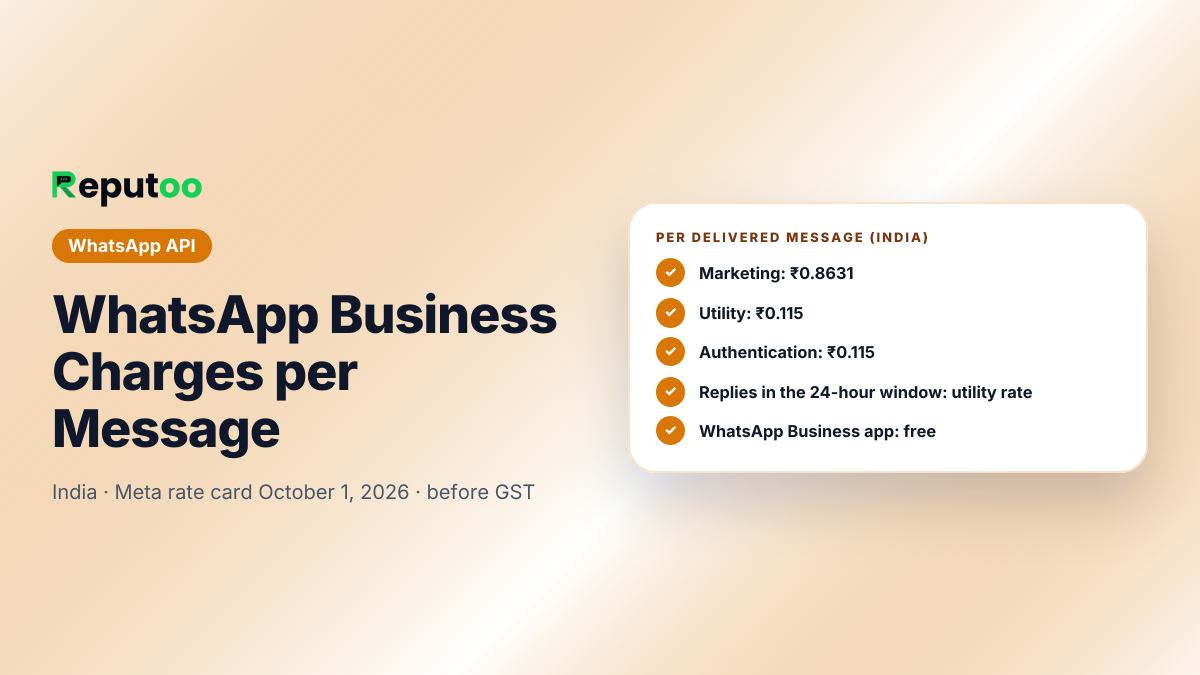
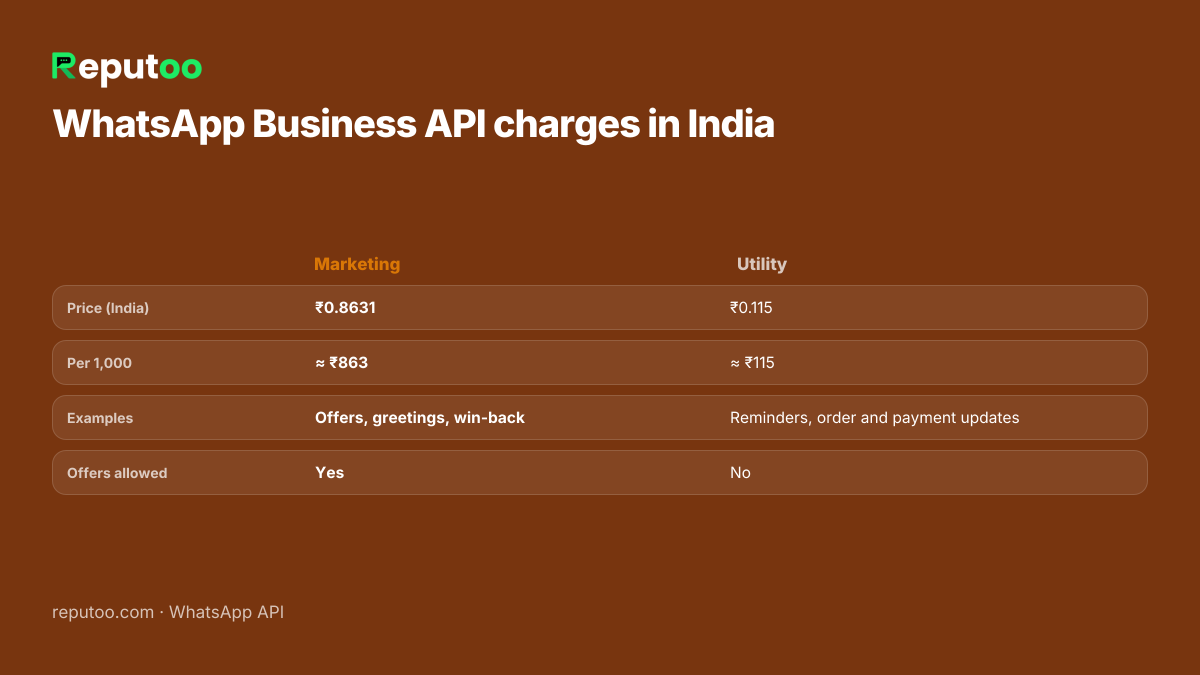
Meta publishes an INR rate card for India. On the October 1, 2026 card, before 18% GST:
Category
Typical messages
Per message
Per 1,000
Marketing
Offers, launches, festival greetings, win-back, newsletters
₹0.8631
≈ ₹863
Utility
Order and booking confirmations, reminders, payment and delivery updates
₹0.115
≈ ₹115
Authentication
One-time passwords
₹0.115
≈ ₹115
Marketing messages cost several times more than utility messages, which is why keeping reminders and updates purely informational matters: a "utility" template that includes an offer is re-filed as marketing and charged accordingly. Meta began billing eligible Indian businesses in INR on 1 January 2026, and says every eligible WhatsApp Business Account must be on INR by 31 December 2026 — ask your provider for a GST invoice in rupees.
Marketing costs several times more than utility.
Chapter 04
What Changed on 1 October 2026
Until October 2026, replies to customers inside the 24-hour customer-service window were free. Since 1 October 2026, Meta charges for them: free-form replies inside the window — and utility templates sent inside it — are billed at the utility rate for the customer's country, with no volume tiers. In India that is ₹0.115 per reply.
For most businesses this adds a small amount per conversation, but it changes two habits: very long back-and-forth chats now cost a little each, and chatbots that send many short messages should combine them into fewer, fuller replies.
Chapter 05
What Is Still Free
The WhatsApp Business app — entirely free.
Access to the API — no licence fee for Meta's Cloud API, and no charge to create the account or register numbers.
Click-to-WhatsApp ad and Facebook Page conversations — when a customer opens a chat from a click-to-WhatsApp ad or a Facebook Page call-to-action, the conversation is free for 72 hours.
Undelivered messages — not charged.
Incoming messages — customers messaging you costs you nothing; your replies are what is charged.
Note what is not on this list: the "first 1,000 conversations free each month" allowance that many older articles still mention no longer applies under per-message pricing.
Chapter 06
Charges in Other Countries
If you message customers abroad, their country's rate applies. Meta's October 1, 2026 card in US dollars per message:
Recipient's country
Marketing
Utility
Authentication
India
$0.0118
$0.0014
$0.0014
UAE
$0.0576
$0.0157
$0.0157
Saudi Arabia
$0.0576
$0.0107
$0.0107
United Kingdom
$0.0635
$0.0220
$0.0220
United States
$0.0250
$0.0034
$0.0034
Indonesia
$0.0411
$0.0250
$0.0250
Brazil
$0.0625
$0.0068
$0.0068
Germany
$0.1365
$0.0550
$0.0550
India is among the cheapest markets on the card; Western Europe is among the most expensive. Every country is in the WhatsApp API cost calculator.
Chapter 07
Worked Monthly Bills
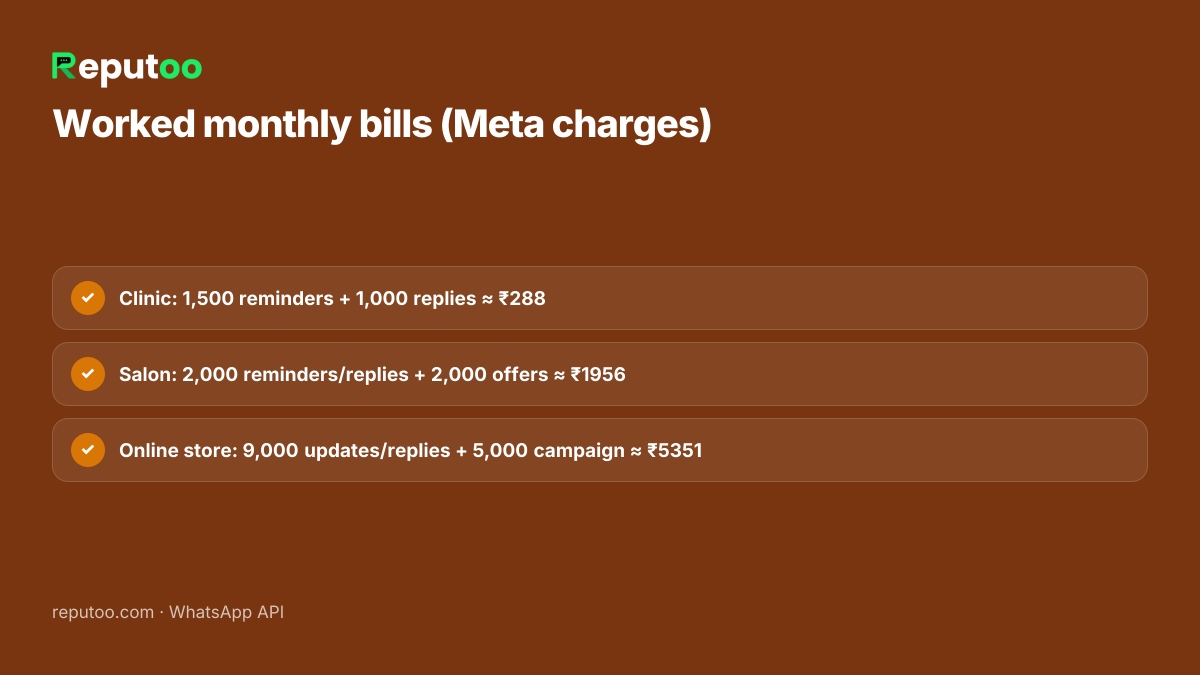
Three typical Indian businesses, Meta charges only, before GST:
The pattern is clear: transactional messages are cheap; marketing volume is what moves the bill. Sending campaigns to the segments most likely to act — rather than everyone — is the biggest saving available. See WhatsApp audience segmentation.
Marketing volume is what moves the bill.
Chapter 08
Provider Charges on Top of Meta's
If you use a platform rather than building on the API yourself, there is a second bill. Providers charge in different ways:
Monthly subscription — by plan, sometimes by number of users or contacts.
A margin on each message — the provider bills Meta's rate plus a few paise. On large volumes this can cost more than the subscription.
Add-ons — AI agents, extra seats, integrations.
Always ask for the per-message price in writing and compare it with Meta's rate card. Reputoo plans start at ₹999 a month and pass Meta's charges through with no markup. More on choosing a provider in WhatsApp Business Solution Provider (BSP).
Chapter 09
How to Keep WhatsApp Charges Down
Use the right category. Keep confirmations, reminders and updates informational so they stay utility.
Segment marketing sends. Fewer, better-targeted marketing messages cost less and get blocked less.
Invite customers to message you. Click-to-WhatsApp ads and Facebook Page buttons open free 72-hour conversations.
Write fuller replies. Since October 2026 every reply is charged; one complete answer beats three fragments.
Clean your list. Numbers not on WhatsApp are not charged, but they distort your reports; opted-out customers must be removed.
Avoid per-message markups from providers.
Chapter 10
Marketing or Utility? Examples
Because marketing messages cost several times more than utility ones, the category of each template matters. Meta decides the category from the content, so it helps to know where the line sits:
Utility (cheaper)
Marketing
"Your order #10482 has shipped. Track it here."
"New arrivals are here — 20% off this weekend."
"Reminder: your appointment is tomorrow at 4 pm."
"It's been a while! Book again and get a free add-on."
"Payment of ₹500 received. Your receipt is attached."
"Happy Diwali! Here's a gift for you."
"Your class moves to 7 pm tomorrow."
"Refer a friend and you both get a discount."
The rule of thumb: utility messages are about something the customer already did or agreed to, and contain no offer. The moment a message promotes, upsells or greets for its own sake, it is marketing. Check a template before you submit it with the template checker.
Chapter 11
Where to See Your Charges
Meta shows what you are spending in WhatsApp Manager, broken down by category and country, and bills it to the payment method on your WhatsApp Business Account (or through your provider, if they bill you for it). Your provider's dashboard should show the same messages with their delivery status. If the two do not match — or your provider's per-message price is higher than the rate card — ask why.
Check three things each month: the split between marketing and utility (a sudden rise in marketing may mean templates were re-categorised), messages per customer (a sign of over-messaging), and the cost of the campaigns that drove the most replies or orders.
Chapter 12
Authentication Messages and OTPs
One-time passwords and login codes sent on WhatsApp use the authentication category — ₹0.115 per message in India on the October 1, 2026 card. Authentication templates have a fixed format set by Meta (the code, an optional security line and a copy-code button), so they cannot carry marketing content. For apps and services with many logins, they are a reliable channel that customers read, and they are priced per delivered message like every other category.
Chapter 13
WhatsApp Charges for Small Businesses
For a small business, the realistic choice is between the free WhatsApp Business app and a paid platform on the API. The app costs nothing and is enough while one person handles the chats and broadcast lists stay small. The API adds Meta's per-message charges and a platform subscription, and in return gives you campaigns to your whole opted-in list, automatic reminders, a shared inbox and AI agents.
A quick way to decide: add up the hours your team spends sending reminders and replies by hand, and the bookings lost to slow replies. If those cost more than a few thousand rupees a month in Meta charges and a subscription, the API is the cheaper option. See how to create a WhatsApp Business account for both routes.
Chapter 14
FAQs
How much does WhatsApp Business charge per message in India?
On Meta's October 1, 2026 rate card: ₹0.8631 per marketing message and ₹0.115 per utility or authentication message, before 18% GST.
Is the WhatsApp Business app free?
Yes. The WhatsApp Business app has no subscription and no per-message charge. Charges apply only to the WhatsApp Business API.
Are WhatsApp replies free?
Not any more. Since 1 October 2026, replies inside the 24-hour window are charged at the utility rate for the customer's country (₹0.115 in India). Conversations opened from click-to-WhatsApp ads or Facebook Page buttons are free for 72 hours.
Does WhatsApp still give 1,000 free conversations a month?
No. That allowance belonged to the old per-conversation model. Under per-message pricing, which Meta introduced on 1 July 2025, there is no monthly free allowance.
Is there a charge to create a WhatsApp Business API account?
No. Creating the account and registering numbers is free; Meta charges per delivered message. A platform may add its own subscription.
Do I pay GST on WhatsApp charges?
Yes, 18% GST applies in India. Ask your provider for a GST invoice in rupees so you can claim input tax credit.
Are WhatsApp charges the same with every provider?
Meta's charges are the same on every route. What differs is the provider's subscription and whether they add a margin to each message, so compare the per-message price you are quoted with Meta's rate card.
What is the cheapest way to send WhatsApp messages to customers?
Keep transactional messages as utility templates, target marketing sends to the segments most likely to act, invite customers to message you through click-to-WhatsApp ads (free for 72 hours), and use a provider with no per-message markup.
Do I pay for messages customers send me?
No. Incoming messages are free. You pay for the messages you send: templates you start, and since 1 October 2026, your replies inside the 24-hour window at the utility rate.
How do I estimate my monthly WhatsApp bill?
Multiply your expected marketing, utility and reply volumes by the rate for your customers' country, then add GST and your provider's subscription. The WhatsApp API cost calculator does this for every country on Meta's card.
Chapter 15
Final Thoughts
WhatsApp Business charges are simpler than they look once you drop the old conversation-based numbers: the app is free, and the API costs a small, published amount per delivered message by category and country — now including replies.
Budget from the rate card, keep utility messages informational, target your marketing sends, and choose a provider that passes Meta's price through without a margin.
Rates change when Meta publishes a new card, so check the effective date before you budget for the next quarter.
R
Written by Riya · Reputoo. Riya writes Reputoo’s guides on WhatsApp for business, AI agents and voice AI for Indian businesses.