
WhatsApp Audience Segmentation: How to Send Better Messages and Drive More Sales
If you use WhatsApp for marketing, one of the biggest mistakes you can make is sending the same message to everyone. A first-time visitor, a repeat customer, and an inactive buyer are all very different audiences. That is why WhatsApp audience segmentation is so important.
Segmentation helps you divide your audience into smaller groups based on behavior, interests, purchase history, or engagement. When you send more relevant messages, people are more likely to open, read, and respond. For e-commerce brands, that often means better conversions, stronger engagement, and less wasted effort.
WhatsApp works best when the message feels personal. Segmentation is what makes that possible at scale.
On this page (21 sections)
- 1.What Is WhatsApp Audience Segmentation?
- 2.Why Segmentation Matters for E-commerce
- 3.Common WhatsApp Segments for E-commerce
- 4.Benefits of WhatsApp Audience Segmentation
- 5.How to Build a Segmentation Strategy
- 6.Why Reputoo Helps with Segmentation
- 7.Best Practices for WhatsApp Segmentation
- 8.Common Mistakes to Avoid
- 9.Where Segment Data Comes From
- 10.Building Segments in Reputoo
- 11.Segments and What They Cost
- 12.A Starter Segment Plan for an Online Store
- 13.Consent Is a Segment Too
- 14.Personalising Within a Segment
- 15.Measuring Segment Performance
- 16.Segments for Automations, Not Just Campaigns
- 17.Keeping Your Contact Data Clean
- 18.How Big Should a Segment Be?
- 19.A Segmentation Example
- 20.FAQs
- 21.Final Thoughts
What Is WhatsApp Audience Segmentation?
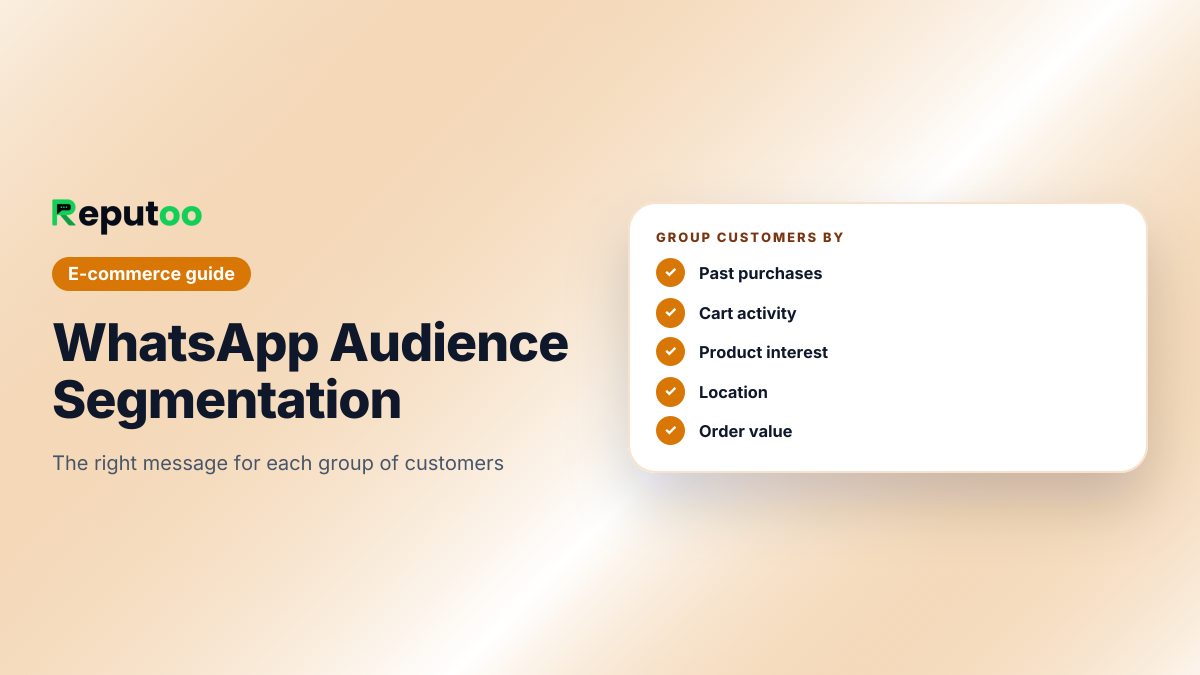
WhatsApp audience segmentation is the process of grouping customers into categories so you can send them more targeted messages. Instead of broadcasting the same content to everyone, you tailor the message to a specific audience segment.
For example, you might create groups based on:
- Past purchases
- Cart activity
- Product interest
- Location
- Order value
- Engagement level
- Customer lifecycle stage
This lets you send more useful messages and avoid overwhelming people with irrelevant promotions.
Why Segmentation Matters for E-commerce
E-commerce customers are not all at the same stage. Some are ready to buy, some are browsing, and some have already purchased. If you treat them all the same, your campaigns lose relevance.
Segmentation helps you:
- Improve open and response rates
- Increase conversion rates
- Reduce message fatigue
- Send more relevant offers
- Build stronger customer relationships
Instead of one generic message, you can send one message that actually matches what the customer cares about.
Common WhatsApp Segments for E-commerce
There are many ways to segment your WhatsApp audience, but these are some of the most useful for online stores.
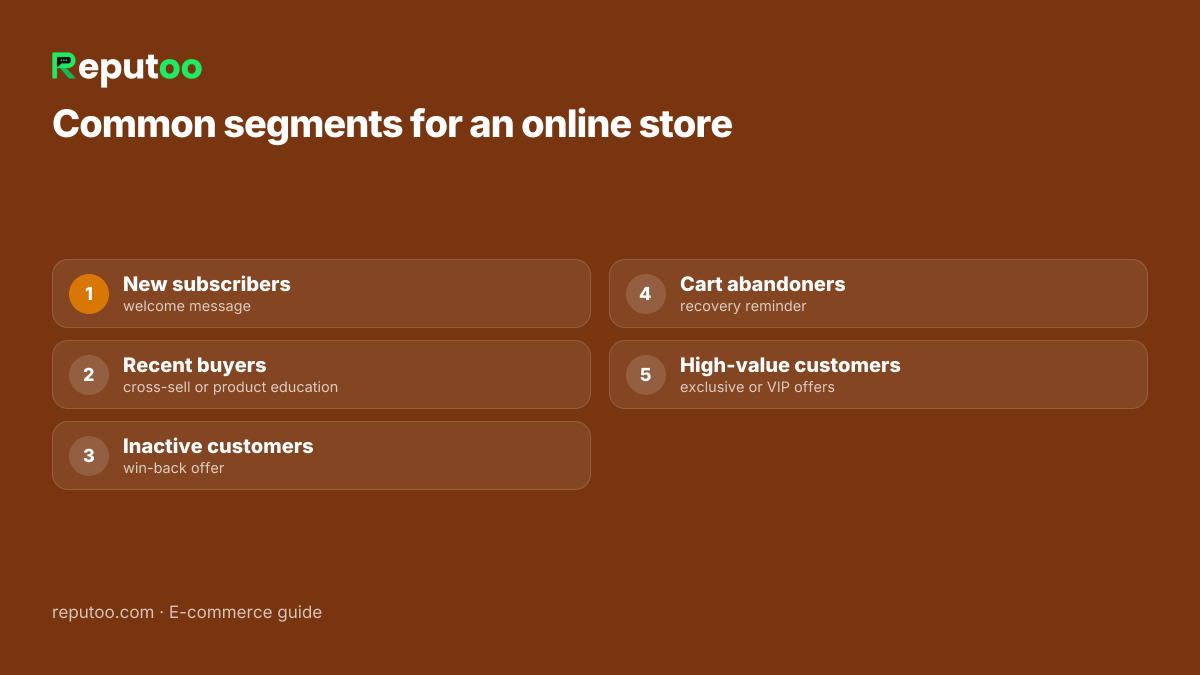
1. New subscribers
People who just joined your list may need a welcome message or introduction offer.
2. Recent buyers
These customers may respond well to cross-sells, upsells, or product education.
3. Inactive customers
Customers who have not purchased in a while can be re-engaged with a special offer.
4. Cart abandoners
These shoppers already showed buying intent and are ideal for recovery campaigns.
5. High-value customers
Repeat or high-spending customers may respond to exclusive offers or VIP campaigns.
6. Product interest groups
Customers interested in a specific product category should get messages related to that category.
7. Location-based segments
If shipping, delivery, or local promotions matter, location-based targeting can be useful.
Benefits of WhatsApp Audience Segmentation
Segmenting your audience helps you do more with less effort.
More relevant messaging
Customers receive content that matches their needs or behavior.
Better engagement
Relevant messages are more likely to be read and acted on.
Higher conversions
People are more likely to buy when the offer feels timely and personal.
Less spam feeling
Segmentation helps prevent over-messaging and message fatigue.
Better campaign results
You can measure performance more clearly by audience group.
How to Build a Segmentation Strategy
A simple segmentation strategy can make a big difference.
Start with:
- Customer behavior
- Purchase history
- Cart status
- Engagement level
- Product interest
Then create messaging for each group. For example:
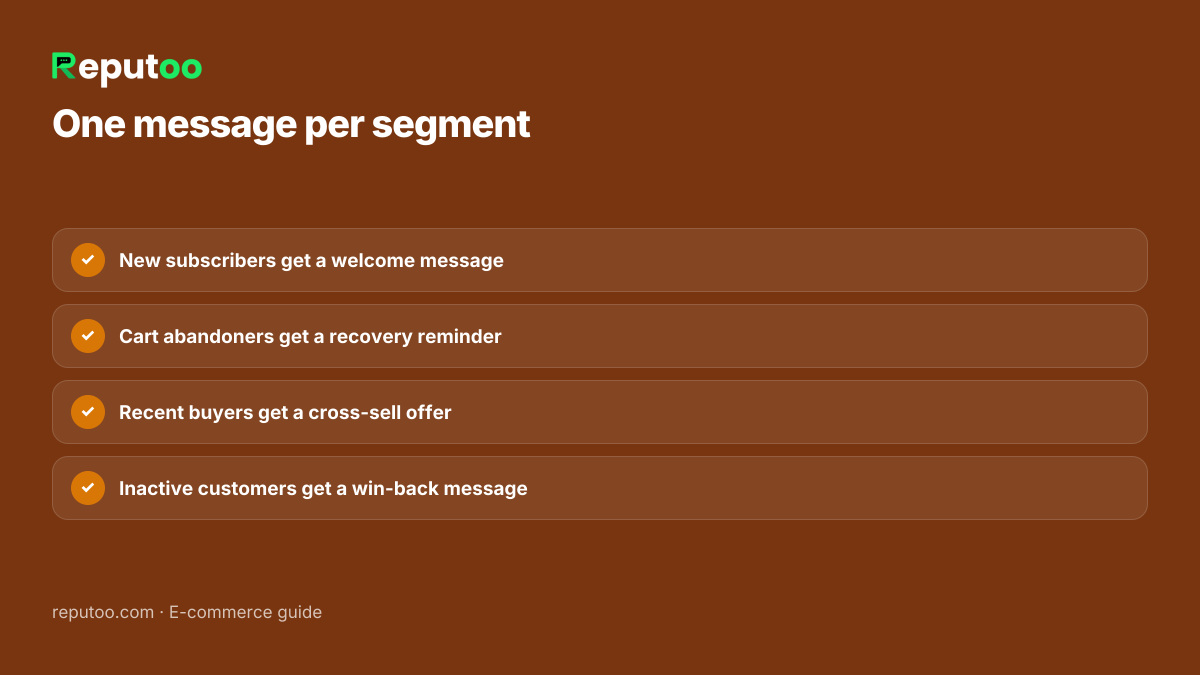
- New subscribers get a welcome message
- Cart abandoners get a recovery reminder
- Recent buyers get a cross-sell offer
- Inactive customers get a win-back message
The more refined your audience groups are, the better your campaigns will perform.
Why Reputoo Helps with Segmentation
Reputoo helps e-commerce brands segment audiences and run more targeted WhatsApp campaigns without making the process complicated.
With Reputoo, you can:
- Group contacts based on behavior
- Send targeted campaigns to each segment
- Automate follow-up flows
- Improve engagement and conversions
- Manage customer communication more effectively
That makes it easier to avoid generic messaging and build more effective WhatsApp marketing.
Best Practices for WhatsApp Segmentation
If you want stronger results, keep these best practices in mind:
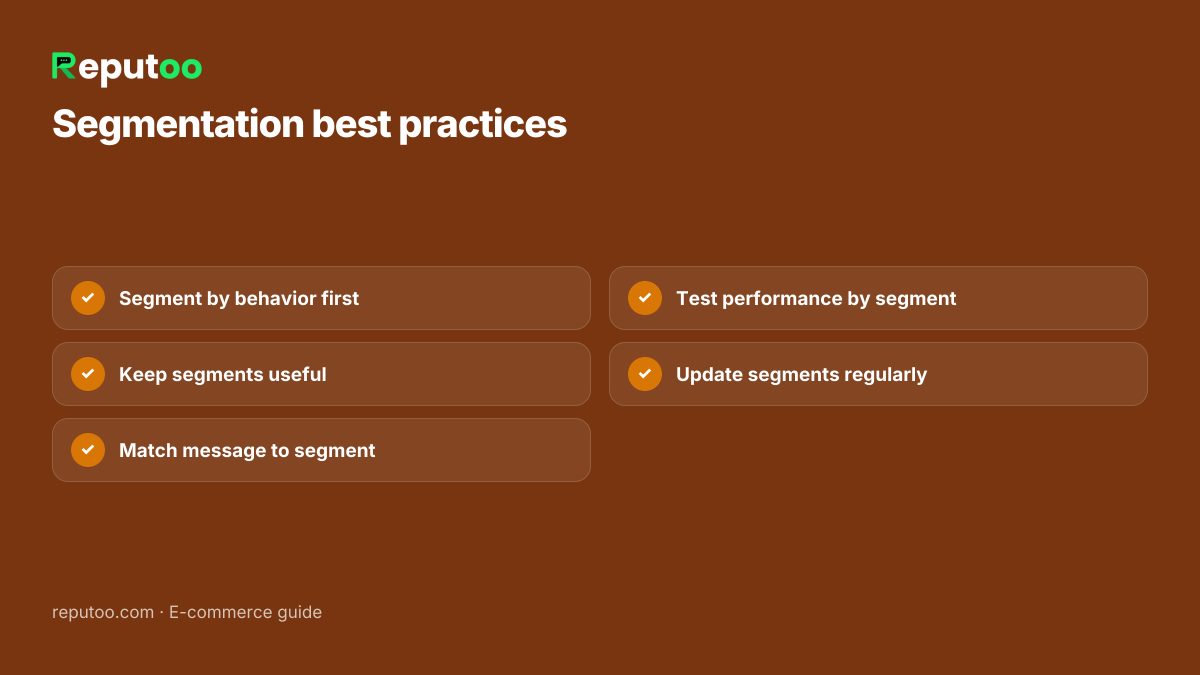
Segment by behavior first
Behavior usually tells you more than basic demographics.
Keep segments useful
Do not create too many tiny segments that are hard to manage.
Match message to segment
The content should clearly fit the group receiving it.
Test performance by segment
Track which audiences respond best to which offers.
Update segments regularly
Customer behavior changes over time, so your lists should too.
Common Mistakes to Avoid
Segmentation can improve results, but only if it is done well.
Avoid these mistakes:
- Using only one broad audience
- Creating segments that are too small
- Sending irrelevant offers
- Not updating groups over time
- Overcomplicating the system
The best segmentation strategy is simple enough to manage but specific enough to be useful.
Where Segment Data Comes From
A segment is only as good as the data behind it. For an online store, that data usually comes from four places:
- Your store. Orders, products bought, order value and cart activity from Shopify; buyers from WooCommerce.
- How the contact arrived. A click-to-WhatsApp ad, a website widget, a QR code in a parcel or a checkout opt-in — each tells you something about intent.
- The conversation. What the customer asked about, which product they enquired on, whether they replied to the last campaign.
- Tags your team adds. “Wholesale”, “Bridal”, “Prefers Hindi” — the things only a person notices.
Keep this data with the contact, not in spreadsheets. A segment built from a spreadsheet goes stale the day after you export it.
Building Segments in Reputoo
In Reputoo, a segment is a saved set of filters on your contacts, recounted every time you use it:
- Tag — any tag your team or an automation applied, such as a product interest or “high value”.
- Source — where the contact came from: ads, website, store, import.
- Country — for stores shipping to more than one country.
- Opt-in status — so a marketing campaign only goes to people who agreed to receive marketing.
- Signup date — new subscribers this week, or customers who joined before a date.
- Last seen — everyone who has not been active since a given date, the starting point for any win-back.
You see how many contacts match before saving, then pick the segment when you create a campaign. Tags can also be added automatically by your automations as customers act, so behaviour-based segments stay up to date without manual list work.
Segments and What They Cost
Segmentation is not only about relevance; it is also the simplest way to spend less. Every promotional message is a marketing message, charged per delivery — ₹0.8631 to an Indian number on the October 1, 2026 rate card, before 18% GST.
Sending a new-arrivals message to all 20,000 contacts costs 20,000 × ₹0.8631 = ₹17,262. Sending it only to the 3,000 who bought from that category in the last six months costs ₹2,589 — and those 3,000 are the people most likely to buy. Fewer, better-targeted messages also protect your number’s quality rating, because people who find a message useful do not block it.
Run your own numbers in the WhatsApp API cost calculator.
A Starter Segment Plan for an Online Store
If you are starting from nothing, these six segments cover most of what a store needs, with the message each one gets:
- Opted in this week → a welcome message with your best-sellers.
- Bought in the last 30 days → care tips for what they bought, then a related product.
- Cart abandoned, no order → the automated cart recovery flow, not a broadcast.
- Two or more orders → early access to launches and sales.
- Not active for 90 days → a re-engagement campaign.
- Opted out of marketing → order updates only, never promotions.
Run one campaign per segment for a month, compare the results, and only then split further. For the campaigns themselves, see WhatsApp broadcast campaigns; for the full toolkit, WhatsApp marketing software for e-commerce.
Consent Is a Segment Too
The first split in any WhatsApp audience is not behaviour but permission. Every contact falls into one of three groups:
- Opted in to marketing — can receive offers, launches and win-backs.
- Opted in to updates only — order confirmations and shipping messages, never promotions.
- Opted out — no outbound messages, though they can still start a conversation with you.
Build every other segment inside the first group. It keeps you within Meta’s rules and India’s DPDP Act, 2023, and it protects your number’s quality rating, because people who agreed to hear from you rarely block you.
Personalising Within a Segment
A segment decides who gets a message; variables decide how personal it feels. Approved templates can carry placeholders filled in for each customer:
- The customer’s first name
- The product they bought or left in the cart
- Their city, for delivery promises
- A link that opens the right product or checkout
Use what the customer would expect you to know. Mentioning the product they bought last month feels helpful; mentioning pages they browsed late at night does not.
Measuring Segment Performance
The point of segmenting is to learn which groups respond. After each campaign, compare segments on the same four numbers: delivered, read, clicked and orders. A segment that reads but does not click needs a better offer; one that does not read needs a better time or a rest. Write the result next to the segment name, so the next campaign starts from what you learned instead of from scratch.
Segments for Automations, Not Just Campaigns
Segmentation is usually discussed for broadcasts, but it matters just as much for automated flows. A cart reminder to a first-time visitor and to a loyal repeat buyer can say different things: the first may need reassurance about delivery and returns, the second just a nudge. A win-back flow can treat customers who bought once differently from those who bought five times. Start with one automation and one split — new versus returning customers is the simplest — and only add more when you can see the difference in results.
Keeping Your Contact Data Clean
Segments break when the data underneath is messy. A few habits keep it usable:
- Store numbers in full international format, with the country code, so the same customer does not appear twice.
- Use a short, agreed list of tags. “VIP”, “vip” and “high value” as three separate tags make three broken segments.
- Record where each contact came from — ad, website, store, import — at the moment they arrive.
- Remove numbers that keep failing. Numbers that are not on WhatsApp only distort your delivery rates.
How Big Should a Segment Be?
The owner’s warning against tiny segments is worth a number. A segment needs to be large enough that its results mean something: a campaign to 40 people that produces two orders tells you very little, while the same rate across 2,000 people is a real signal. As a rough guide, keep campaign segments in the hundreds or more, and merge small groups that would get a similar message anyway. Very small groups — your top 20 wholesale buyers, for example — are better served by a personal message from your team than by a campaign.
A Segmentation Example
Picture a fashion store launching a winter collection. Instead of one message to everyone, it sends three: customers who bought jackets last winter see the new jackets first; customers who only bought summer wear get a short note about the collection with a size guide; and inactive customers get the launch with free shipping. Same launch, three relevant messages — and three sets of results to learn from.
FAQs
What is WhatsApp audience segmentation?
It is the process of dividing your WhatsApp contacts into smaller groups so you can send more relevant messages.
Why is segmentation important for WhatsApp marketing?
It improves engagement, makes campaigns more relevant, and can increase conversions.
What segments should e-commerce brands use?
Common segments include new subscribers, recent buyers, inactive customers, cart abandoners, and high-value customers.
Can segmentation improve cart recovery?
Yes. Cart recovery messages become more effective when sent to the right audience with the right timing.
Can Reputoo help with WhatsApp segmentation?
Yes. Reputoo helps brands organize audiences and send targeted WhatsApp campaigns.
Final Thoughts
WhatsApp audience segmentation is one of the most important parts of an effective messaging strategy. If you send better-targeted messages, you will almost always get better results.
For e-commerce brands, segmentation helps turn WhatsApp into a channel that is more relevant, more efficient, and more profitable.
Segment Your WhatsApp Audience with Reputoo
1,000+ businesses onboarded · Member of NVIDIA Inception · Official WhatsApp Business API, no per-message markup.