
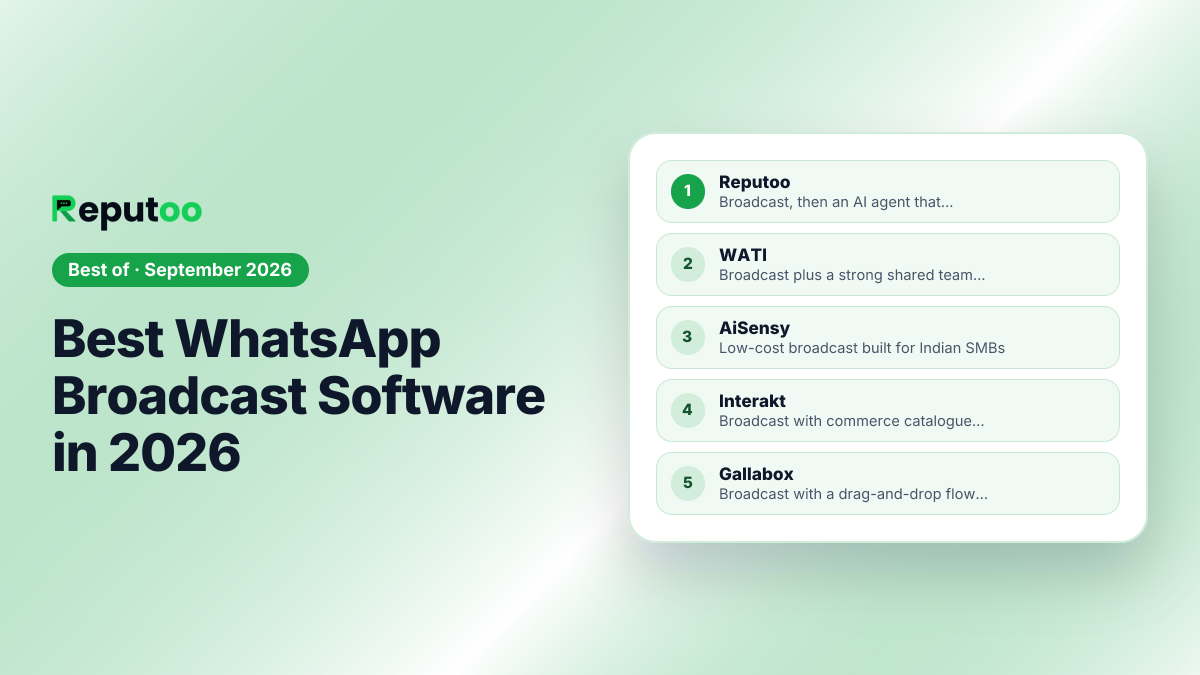
Updated September 2026 · 6 tools reviewed

Best WhatsApp Broadcast Software in 2026

Broadcast software, bulk message sender, mass messaging tool, blast software — four names for one category. Every tool here sends. The difference is what happens in the ninety seconds after it lands, when a few hundred people reply at once. Updated September 2026.

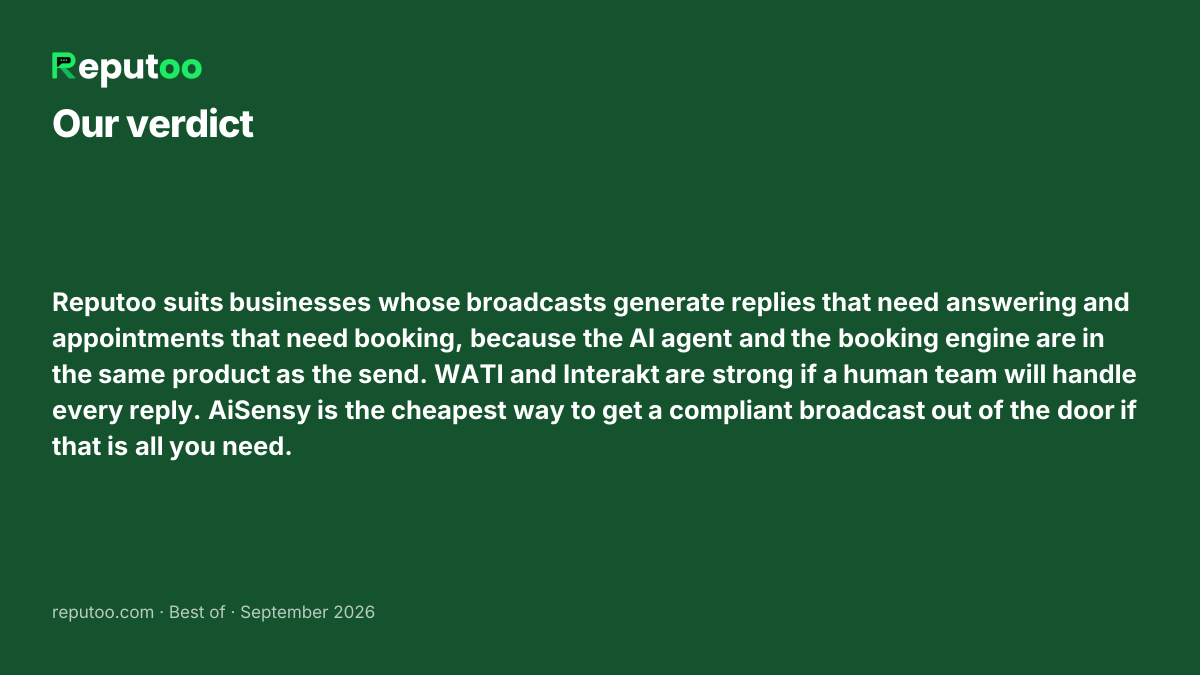
Where Reputoo fitsReputoo suits businesses whose broadcasts generate replies that need answering and appointments that need booking, because the AI agent and the booking engine are in the same product as the send.

Reputoo publishes this comparison and is one of the products listed. Competitor details are taken from each vendor’s own public pricing and product pages.

Side-by-Side Comparison

ToolBroadcast CampaignsTemplate ManagerAI RepliesBooks From ChatRevenue AttributionPricing

Reputoo

PUBLISHER

Published plans — see the Reputoo pricing page

WATI

Basic botLimited

Per-seat subscription plus Meta’s per-conversation charges

AiSensy

Basic botLimited

Flat monthly plans with unlimited seats, plus Meta conversation charges

Interakt

Basic botOrder-level

Tiered subscription plus Meta conversation charges

Gallabox

Flow botLimited

Tiered subscription with seat limits, plus Meta conversation charges

Twilio

API onlyAPI only

Pure usage-based, per message and per conversation

Detailed Reviews

#1 ReputooBest Pick

Broadcast, then an AI agent that handles the replies

Pros

  • Broadcast, AI chat, bookings and voice in one product — the reply to a campaign gets answered and booked without a handoff
  • Revenue attribution ties bookings and orders back to the specific broadcast that caused them
  • Waitlist and deposits mean a slot booked off a broadcast survives a cancellation
  • 36 languages, so one campaign list can be segmented by the language each contact actually replies in

Cons

  • Launched 2024 — a shorter track record than WATI or Interakt
  • Some advanced visual workflow building is still on the roadmap

#2 WATI

Broadcast plus a strong shared team inbox

Pros

  • Mature broadcast and template tooling
  • The team inbox is genuinely good if humans answer replies
  • Large partner and integration ecosystem

Cons

  • No appointment booking engine — a reply asking for a slot needs another product
  • No voice channel
  • Seat-based pricing gets expensive as the team answering replies grows

Pricing: Per-seat subscription plus Meta’s per-conversation charges

#3 AiSensy

Low-cost broadcast built for Indian SMBs

Pros

  • Among the cheapest routes to compliant broadcasting
  • Unlimited agent seats on most plans
  • Very fast to get a first campaign out

Cons

  • Automation depth drops off quickly past simple flows
  • No booking engine and no voice agent
  • Attribution stops at delivery and click, not revenue

Pricing: Flat monthly plans with unlimited seats, plus Meta conversation charges

#4 Interakt

Broadcast with commerce catalogue tooling

Pros

  • Good product catalogue and order flows for retail
  • Clean campaign reporting
  • Solid Shopify connection

Cons

  • Service-business features such as staff schedules and deposits are absent
  • No voice channel
  • AI replies are template-driven rather than conversational

Pricing: Tiered subscription plus Meta conversation charges

#5 Gallabox

Broadcast with a drag-and-drop flow builder

Pros

  • Approachable no-code flow builder
  • Decent CRM-style contact management
  • Good WhatsApp commerce support

Cons

  • No native appointment booking with real staff calendars
  • No outbound or inbound voice
  • Reporting is engagement-focused rather than revenue-focused

Pricing: Tiered subscription with seat limits, plus Meta conversation charges

#6 Twilio

Broadcast as an API you build on top of

Pros

  • Maximum flexibility for engineering teams
  • Multi-channel from one API
  • Scales to very high volume

Cons

  • There is no campaign UI — a non-technical marketer cannot run a broadcast unaided
  • Everything above the send is yours to build and maintain
  • Total cost of ownership is developer time, not the invoice
Pricing: Pure usage-based, per message and per conversation

Why We Recommend

Where Reputoo fits

1

A broadcast is a demand spike. Reputoo is built around the assumption that the spike generates replies, and the AI agent answers them in the same thread the campaign went out on.

2

Bookings happen inside the conversation. When a broadcast about open slots produces “do you have Saturday?”, the agent checks the real staff calendar and books it.

3

Attribution runs to revenue, not to opens. Each campaign carries its bookings and order value, so a broadcast can be judged on what it earned.

4

Deposits and a waitlist protect the slots a campaign fills, which is where most promotional booking revenue quietly leaks back out.

5

36 languages on the same contact list — a campaign to a mixed list can answer each reply in the language it arrives in.

6

One platform covers broadcast, chat, bookings and voice, so the tool count stays at one as the use case grows.

See Reputoo pricing

No credit card required · Setup in 5 minutes · Cancel anytime

Our Verdict

Reputoo suits businesses whose broadcasts generate replies that need answering and appointments that need booking, because the AI agent and the booking engine are in the same product as the send. WATI and Interakt are strong if a human team will handle every reply. AiSensy is the cheapest way to get a compliant broadcast out of the door if that is all you need.

#2

WATI

Broadcast plus a strong shared team inbox

#3

AiSensy

Low-cost broadcast built for Indian SMBs

Broadcast software, bulk sender, blast tool — one category, four names

It is worth clearing up the vocabulary first, because it costs people money. WhatsApp broadcast software, WhatsApp bulk message sender, mass messaging tool and WhatsApp blast software all describe the same thing: software that sends one message to many customers at once. Vendors pick whichever phrase their market searches for, and the words carry no technical distinction whatsoever.

Where the words do matter is the split they hide. Search for a bulk WhatsApp sender and roughly half the results are desktop apps and browser extensions that drive WhatsApp Web through automation. Search for broadcast software and you mostly get platforms on the official WhatsApp Business Platform. Same promise, entirely different consequence — the first category gets numbers banned, the second does not.

So ignore the label a vendor uses and ask the only question that separates them: are you an official WhatsApp Business Platform provider, and will my number be registered with Meta? Everything on this page answers yes, which is why they all deal with template approval and per-conversation charges. A tool that needs neither is not sending on the official API, whatever it calls itself.

One more piece of vocabulary: the broadcast list inside the free WhatsApp Business app is a different thing again. It caps at 256 recipients, only reaches people who have saved your number, and reports nothing. That limitation is what sends most businesses looking for software in the first place.

What actually separates broadcast tools

On the official WhatsApp Business Platform, the send itself is close to a commodity. Every tool on this page submits your template to Meta for approval, waits for the verdict, then dispatches to a list against the same rate limits and the same messaging tier your number has earned. Two platforms sending the same approved template to the same 5,000 contacts will produce near-identical delivery numbers, because Meta, not the vendor, is doing the delivering.

So the send is not the product. The product is the ninety seconds afterwards, when a fraction of those 5,000 people reply at once. A 2% reply rate on a modest list is a hundred simultaneous conversations, and that is the moment a broadcast tool either earns its subscription or turns into a queue your staff cannot clear before the offer expires.

That is the axis this list is built on. Every tool here is marked on whether replies get answered automatically, whether a reply asking for an appointment can actually become one without a human retyping it into another system, and whether the resulting revenue is traceable back to the campaign that caused it.

Broadcast limits, template approval and the rules nobody can opt out of

Anything running on the official API works inside Meta’s messaging limits, which start conservative for a new number and step up as the number sends good-quality traffic that people do not block. No vendor can raise that ceiling for you. What a good tool can do is warm the number sensibly, keep quality rating visible, and stop you from torching a fresh number with an oversized first campaign.

Template approval is the other unavoidable gate. Marketing templates go to Meta for review and can be rejected for being too promotional, too vague, or badly formatted. The practical difference between platforms is how fast you find out and how easy it is to iterate — a template manager that shows rejection reasons and lets you resubmit a variant in a minute is worth more than one that simply reports failure.

Opt-out handling is not optional either. Every marketing broadcast needs a clear way out, and blocks and reports feed straight back into the quality rating that governs how much you can send tomorrow. Treat the unsubscribe path as a deliverability feature rather than a legal checkbox and your list stays sendable for longer.

Tools that automate the consumer app are not on this list

There is a whole category of cheap “WhatsApp bulk sender” software that drives WhatsApp Web or the consumer app through automation rather than connecting to the official Business Platform. It is cheaper, it needs no template approval, and it works — right up until the number is banned, which is a matter of when rather than whether.

Nothing in this comparison does that. Every platform listed here sends through the official WhatsApp Business Platform, which is why they all deal with templates and per-conversation charges. If you are weighing an unofficial tool against these, the question to ask is what your business loses on the day the number carrying your entire customer list stops working.

It is a yes-or-no question worth putting to any vendor directly before you buy: are you an official WhatsApp Business Platform provider, and is my number registered with Meta?

How to pick from this list

If your broadcasts are informational — order updates, delivery notices, reminders — and replies are rare, the cheapest compliant sender wins, and AiSensy is hard to argue with on cost.

If your broadcasts create conversations that a human team is staffed to answer, WATI’s inbox is the strongest reason on this page to choose it, and Interakt is the better pick if those conversations are about products in a catalogue.

If your broadcasts are meant to fill a calendar — a promotion on quiet weekday slots, a recall campaign, a seasonal offer at a clinic or salon — then the reply is a booking request, and the gap between the tools that can close it in the thread and the tools that cannot is the whole decision. That is where Reputoo is built to sit.

Frequently Asked Questions

What is the best WhatsApp broadcast software in 2026?

It depends on what the broadcast is for. For pure low-cost compliant sending, AiSensy is the value pick. For broadcasts a human support team will answer, WATI’s inbox is the strongest on this list. For broadcasts intended to fill appointments or drive orders, Reputoo is the fit, because the AI agent answers the replies and books directly against real staff calendars instead of handing the conversation to another tool. All six send through the official WhatsApp Business Platform.

What is the best WhatsApp bulk message sender?

The same six tools on this page, since bulk message sender and broadcast software describe one category. AiSensy is the cheapest official option, Wati the strongest for human-answered replies, Reputoo the fit when replies should be answered and booked automatically. Avoid the free desktop and browser-extension senders entirely — they automate WhatsApp Web rather than the official API, and numbers using them get banned.

Is a WhatsApp blast the same as a WhatsApp broadcast?

Yes. Blast, broadcast, bulk send and mass message are interchangeable words for sending one message to many recipients at once, and no vendor means anything technically different by them. The distinction that matters is not the word but the pipe: whether the tool sends through the official WhatsApp Business Platform, with approved templates and per-conversation charges, or automates the consumer app and puts your number at risk.

How many contacts can I broadcast to on WhatsApp at once?

That is set by Meta, not by the software. Your number sits in a messaging tier — commonly starting at 1,000 unique customers in a rolling 24 hours for a new number — and the tier increases automatically as you send quality traffic that people do not block or report. Any vendor promising unlimited broadcasting on the official API is describing the queue, not the delivery. Choose a tool that shows your current tier and quality rating clearly.

Is WhatsApp broadcast software free?

The software sometimes has a free tier; the messages never are. Meta charges per conversation and that cost passes to you regardless of platform. Free plans generally cap contacts or campaigns and exclude the automation that makes broadcasting useful. Be especially careful with free bulk senders that automate WhatsApp Web — those avoid the cost by avoiding the official API, and get numbers banned.

Do I need my own WhatsApp Business API number?

Yes, and it should be yours rather than the vendor’s. A number registered to your own Meta Business account can be migrated to another provider if you switch. A number that belongs to the platform cannot, which turns a routine tool change into losing the number your customers already have saved. Ask any vendor who owns the WABA before signing, and see /how-to/get-whatsapp-business-api for the setup path.

How do I stop broadcasts from getting my number blocked?

Send to people who opted in, give an obvious way out in every marketing message, and keep frequency low enough that the offer still feels relevant. Blocks and reports drive your quality rating, and a rating that drops takes your messaging limit down with it. Segment before you send — a smaller list that is actually interested protects the number better than a large one that is not.

What is the difference between a WhatsApp broadcast and a WhatsApp campaign?

In practice vendors use the words interchangeably, but broadcast usually means one template sent once to a list, while campaign implies a sequence — a send, then follow-ups conditioned on who replied, opened or bought. If you only ever need the former, most tools on this list are equivalent. The differences show up in the follow-up, which is where automation depth and reply handling start to matter.

Want to see how Reputoo compares?

Put an AI agent on your WhatsApp and your phone line — it answers, books and follows up.