Updated September 2026 · 6 tools reviewed

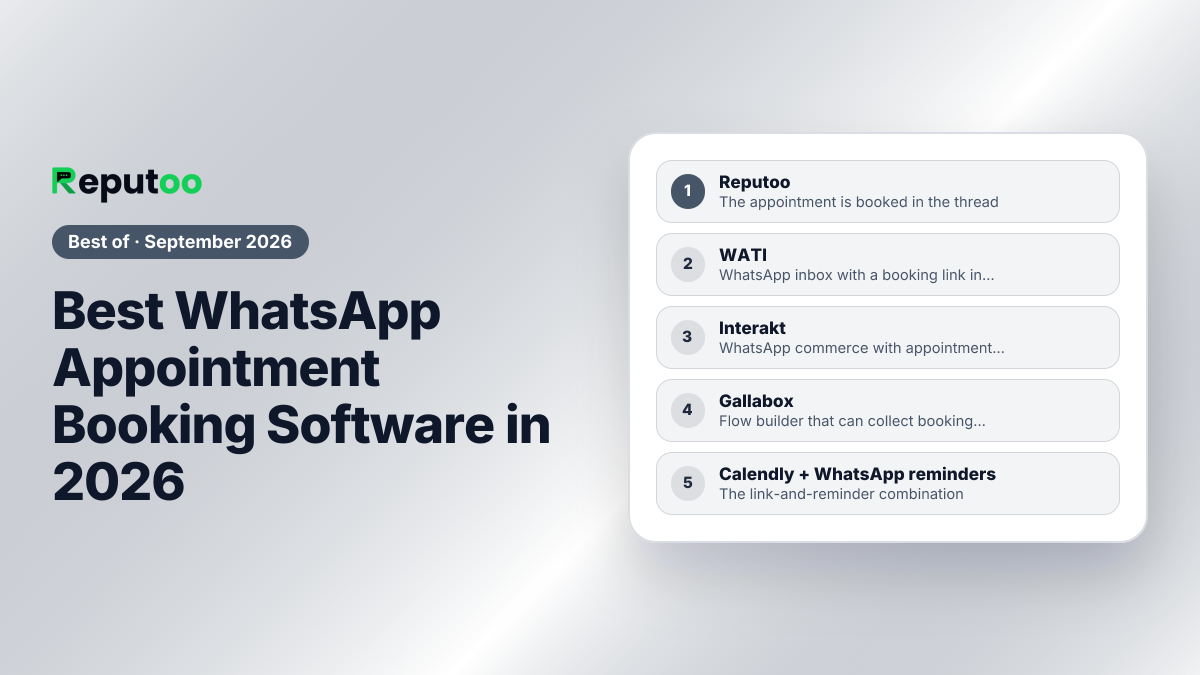
Best WhatsApp Appointment Booking Software in 2026

Almost every WhatsApp tool claims appointment booking. For most it means sending a link and hoping. The distinction that matters is whether the slot gets booked without the customer leaving the chat. Updated September 2026.

Where Reputoo fitsReputoo is the fit when the booking has to complete inside the WhatsApp thread against real staff calendars.

Reputoo publishes this comparison and is one of the products listed. Competitor details are taken from each vendor’s own public pricing and product pages.

Side-by-Side Comparison

ToolBooks Inside the ChatReal Staff CalendarsDeposits in ChatReschedule by ReplyWaitlist Auto-FillPricing

Reputoo

PUBLISHER

Published plans — see the Reputoo pricing page

WATI

Human handles it

Per-seat subscription plus Meta conversation charges

Interakt

Human handles it

Tiered subscription plus Meta conversation charges

Gallabox

Human handles it

Tiered subscription with seat limits, plus Meta conversation charges

Calendly + WhatsApp reminders

On the Calendly page

Calendly per seat, plus whatever sends the WhatsApp messages

Fresha

Manual

Free core software, monetised via payments and marketplace

Detailed Reviews

#1 ReputooBest Pick

The appointment is booked in the thread

Pros

  • The AI agent reads live staff availability and completes the booking inside WhatsApp — no link, no form, no drop-off
  • Deposits collected in the same conversation, and the confirmation arrives in the thread the customer already has
  • Rescheduling and cancellation work by reply, which is how customers actually try to do it
  • Waitlist auto-fill messages the next person the moment a slot frees up, without anyone having to notice
  • Two-way Google Calendar sync keeps the thread and the team’s own calendars in agreement, both directions

Cons

  • No salon operations suite — stock, payroll and POS still live elsewhere
  • Launched 2024, so newer than the WhatsApp incumbents on this list

#2 WATI

WhatsApp inbox with a booking link in the flow

Pros

  • Excellent shared inbox for the conversations the bot cannot finish
  • Reliable reminder templates
  • Broad integration ecosystem

Cons

  • No native booking engine — bookings mean redirecting to an external tool
  • No deposit collection inside the chat
  • Staff-level availability is not modelled

Pricing: Per-seat subscription plus Meta conversation charges

#3 Interakt

WhatsApp commerce with appointment flows bolted on

Pros

  • Good catalogue and order handling for retail
  • Clean campaign and reminder tooling
  • Straightforward for Indian SMBs

Cons

  • Appointment support is a flow, not a scheduling engine
  • No staff calendars, no deposits, no waitlist
  • Weak for multi-service, multi-staff businesses

Pricing: Tiered subscription plus Meta conversation charges

#4 Gallabox

Flow builder that can collect booking details

Pros

  • Easy visual flows for gathering a booking request
  • Decent CRM-style contact records
  • Fair SMB pricing

Cons

  • Collects a request rather than making a booking — a human confirms it
  • No calendar of its own
  • No payments in the conversation

Pricing: Tiered subscription with seat limits, plus Meta conversation charges

#5 Calendly + WhatsApp reminders

The link-and-reminder combination

Pros

  • Cheap and quick to assemble
  • Calendly’s scheduling itself is excellent
  • Familiar to most customers

Cons

  • The customer must leave WhatsApp to book, which is exactly where the drop-off happens
  • Two subscriptions and an integration to keep alive
  • No waitlist, no chat-native rescheduling

Pricing: Calendly per seat, plus whatever sends the WhatsApp messages

#6 Fresha

Salon booking with WhatsApp notifications

Pros

  • Genuinely strong salon scheduling and operations
  • Free to run the core product
  • Good client records

Cons

  • WhatsApp is a notification channel, not a booking channel
  • Customers cannot book conversationally
  • Beauty and wellness specific

Pricing: Free core software, monetised via payments and marketplace

Why We Recommend

Where Reputoo fits

1

The booking finishes where the conversation started. Nobody is sent to a link, so nobody is lost at the link.

2

Availability comes from real staff calendars with service durations, so what the agent offers is what can actually be worked.

3

Deposits are taken in the thread, turning a soft agreement into a commitment before the customer puts the phone down.

4

Reschedules and cancellations happen by reply — the way customers already attempt them — and the calendar updates itself.

5

The waitlist fills gaps automatically, which is where the revenue from cancellations is normally lost.

6

The same agent answers the phone, so a customer who calls after messaging is not asked to repeat themselves.

See Reputoo pricing

No credit card required · Setup in 5 minutes · Cancel anytime

Our Verdict

Reputoo is the fit when the booking has to complete inside the WhatsApp thread against real staff calendars. WATI and Interakt are reasonable if you are content to send a scheduling link and have a human handle exceptions. Calendly with a WhatsApp reminder integration is the cheapest workable combination if your volume is low.

#2

WATI

WhatsApp inbox with a booking link in the flow

#3

Interakt

WhatsApp commerce with appointment flows bolted on

The link is where the bookings go missing

Most WhatsApp platforms answer the question “can it book appointments?” with a booking link. The bot recognises the intent, sends a URL, and the customer taps through to a scheduling page. It works, and it is far better than nothing, but it introduces a step that costs you customers.

Consider what the step actually asks. The customer is in a chat, on a phone, often doing something else. They now have to open a browser, wait for a page, scan a grid of times, choose one, fill in their name, email and phone — details WhatsApp already knows about them — and submit. Every one of those is an opportunity to be interrupted and not come back.

A booking that completes in the thread asks for none of it. The agent already has the phone number, asks what service and roughly when, offers two or three real times in a sentence, and confirms. The gap between those two experiences is the entire argument for chat-native booking, and it is why the first column of the table on this page is the one worth reading closely.

What chat-native booking has to get right

Real staff calendars, not a shared one. If two stylists offer different services with different durations, an agent booking against a single calendar will hand your team a schedule they cannot work. Ask specifically how per-staff availability and per-service duration are modelled.

Slot locking. Two customers messaging at once will be offered the same time unless the system holds it while a conversation finishes. Without a lock you get double-bookings, and they surface at the worst possible moment.

Rescheduling by reply. When a customer types “can we move it to Friday?” three days later, that should just work in the existing thread. Many tools handle the initial booking and then send a link again for changes, which reintroduces exactly the friction you paid to remove.

The 24-hour window. Outside a customer-initiated conversation, WhatsApp requires an approved template to reopen contact. Reminders, waitlist offers and confirmations all need to be template-shaped and pre-approved, so check the vendor has that handled rather than discovering it after your first cancellation.

Deposits, no-shows and the arithmetic of a held slot

Appointment businesses do not lose money on marketing, they lose it on capacity that was reserved and not used. A no-show is worse than an empty slot, because an empty slot could have been sold and a no-show could not.

Reminders reduce no-shows somewhat. Deposits reduce them substantially, because the customer with money committed either turns up or cancels early enough that the time can be resold. Taking that deposit inside the chat rather than on a separate payment page is the difference between most customers paying it and most customers meaning to.

The third piece is the waitlist. A cancellation that arrives at 8am for a 2pm appointment is refillable if someone offers it immediately, and lost if nobody does. Automating that offer converts your cancellation rate from a loss into a redistribution, and it is the feature businesses most often report as the one they did not expect to matter.

Choosing sensibly

Low volume, simple service, one person’s diary: Calendly plus a reminder integration is cheap and entirely adequate. Do not over-buy.

Retail or commerce where appointments are occasional rather than core: Interakt or Gallabox will cover the conversation, and a human can confirm the handful of bookings that arise.

Appointments as the business — clinics, salons, spas, consultancies, service centres — where the calendar is the revenue: the booking has to complete in the chat, against real staff availability, with a deposit and a waitlist behind it. That is a smaller set of tools than the category’s marketing suggests.

Frequently Asked Questions

What is the best WhatsApp appointment booking software in 2026?

For bookings that must complete inside the chat against real staff calendars, with deposits and a waitlist, Reputoo is the fit on this list. WATI and Interakt are reasonable if you are content to send a scheduling link and have a human handle the exceptions. Calendly plus a WhatsApp reminder integration is the cheapest workable option at low volume. The deciding question is whether your customers finish the booking or abandon it at the link.

Can customers book an appointment directly in WhatsApp?

Yes, with software that has its own booking engine. The agent reads live availability, offers real times conversationally, writes the appointment and confirms — all in the thread, with no browser and no form. Tools without a booking engine send a link instead, which works but loses a share of customers at the tap-through. Check which of the two a vendor is actually offering, because both get described as WhatsApp booking.

Can I take a deposit for an appointment over WhatsApp?

Yes. Payment links can be sent in the thread and, on platforms that support it, the booking is only confirmed once the deposit clears. This is the most effective no-show control available to an appointment business — considerably more effective than additional reminders — because it converts a stated intention into a commitment at the moment the customer is most willing to make one.

How do WhatsApp appointment reminders work with Meta’s 24-hour rule?

Free-form messages are only allowed within 24 hours of the customer’s last message. Outside that window you need a pre-approved template, which is what reminders, confirmations and waitlist offers use. These are utility-category templates and are approved routinely, but they must exist before you need them — so confirm your platform ships an approved reminder template set rather than expecting you to write and submit them yourself.

Does WhatsApp booking work for a salon with several staff?

Only if the software models per-staff availability and per-service duration. A stylist doing colour for three hours and another doing a trim for twenty minutes cannot share one calendar without producing a schedule that does not work in practice. Ask to see a demo booked against a specific named staff member, and check what happens when a customer asks for a person who is fully booked.

Will customers actually use WhatsApp to book instead of calling?

Most already try. The reason bookings arrive by phone is usually that WhatsApp goes unanswered for hours, so customers learn that calling is faster. When the message gets an immediate, useful reply, the channel mix shifts quickly — and the customers who move are disproportionately the ones who would not have called at all, because they were messaging at ten in the evening.

Want to see how Reputoo compares?

Put an AI agent on your WhatsApp and your phone line — it answers, books and follows up.