
WhatsApp Marketing Best Practices for E-commerce: How to Send Better Messages and Drive More Sales
WhatsApp can be one of the most powerful channels for e-commerce, but only if you use it correctly. Sending too many messages, using weak targeting, or treating WhatsApp like spam can hurt results fast. That is why following WhatsApp marketing best practices for e-commerce matters so much.
A strong WhatsApp strategy helps you recover abandoned carts, send better promotions, improve customer support, and build stronger relationships with buyers. The goal is not just to send messages. The goal is to send the right message to the right person at the right time.
When done well, WhatsApp can become one of the most effective channels in your marketing mix.
On this page (19 sections)
- 1.Why WhatsApp Marketing Needs Best Practices
- 2.Best Practices for WhatsApp Marketing
- 3.Common WhatsApp Marketing Mistakes
- 4.How to Build a Strong WhatsApp Strategy
- 5.Why Reputoo Helps with Best Practices
- 6.The Rules Every WhatsApp Campaign Must Follow
- 7.What WhatsApp Messages Cost, by Category
- 8.A 90-Day WhatsApp Plan for an Online Store
- 9.The Numbers Worth Tracking
- 10.A Message-Writing Checklist
- 11.How Often Is Too Often?
- 12.WhatsApp Alongside Email and SMS
- 13.Collecting Opt-ins the Right Way
- 14.Protecting Your Number’s Quality Rating
- 15.A Weekly WhatsApp Routine
- 16.Learning From Customer Replies
- 17.Start Small, Then Scale
- 18.Frequently Asked Questions
- 19.Final Thoughts
Why WhatsApp Marketing Needs Best Practices
Unlike some marketing channels, WhatsApp feels personal. Customers expect messages that are relevant, useful, and timely. If you send poor-quality messages, people may ignore your brand or disengage.
Best practices matter because they help you:
- Improve engagement
- Reduce message fatigue
- Increase conversions
- Build trust with customers
- Get better results from automation
For e-commerce brands, good WhatsApp marketing is about balancing scale with relevance.
Best Practices for WhatsApp Marketing
Here are the most important best practices to follow.
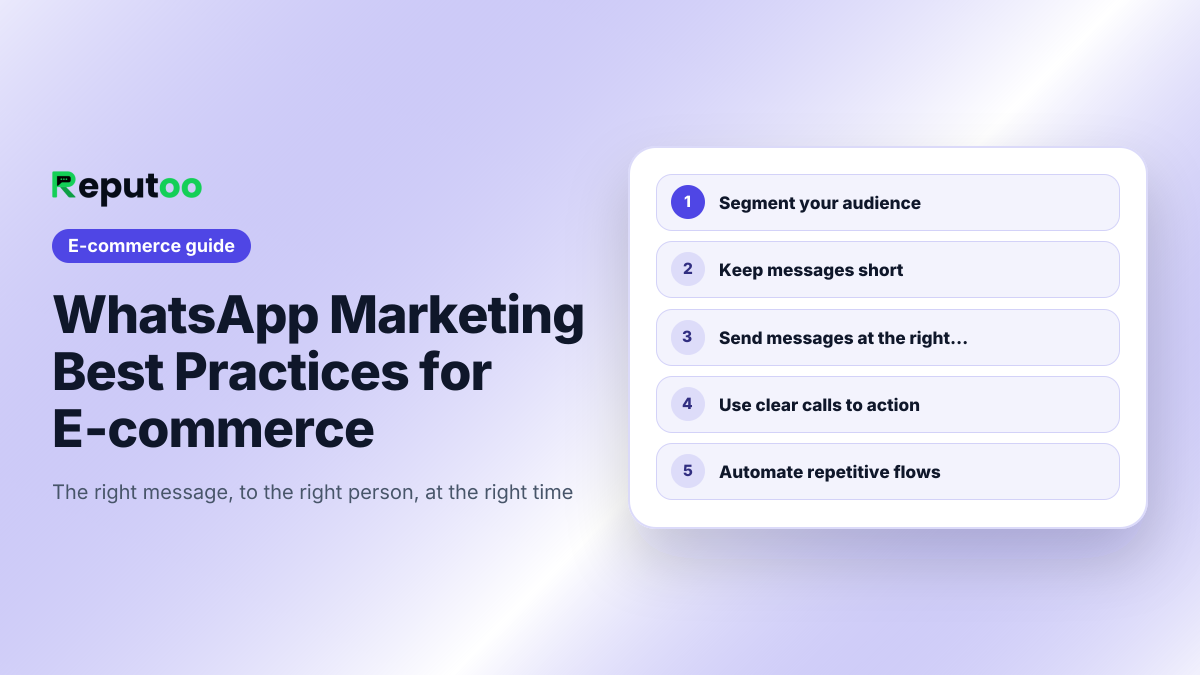
1. Segment your audience
Do not send every message to everyone. Group customers by behavior, purchase history, or engagement level so the message feels relevant.
2. Keep messages short
WhatsApp users prefer quick, direct communication. Long messages are harder to read and less effective.
3. Send messages at the right time
Timing matters. A cart reminder should be sent soon after abandonment, while a re-engagement message should go to inactive customers at the right interval.
4. Use clear calls to action
Tell the customer exactly what to do next. Make the next step easy.
5. Automate repetitive flows
Use automation for cart recovery, order updates, and follow-ups so your team can focus on higher-value tasks.
6. Avoid over-messaging
Too many messages can cause fatigue and reduce trust. Send only what is useful.
7. Personalize when possible
Use names, product details, or behavior-based messaging to make the interaction feel more human.
8. Track performance
Measure clicks, replies, conversions, and recoveries so you know what works.
Common WhatsApp Marketing Mistakes
A lot of brands get poor results because they make avoidable mistakes.
Avoid these:
- Sending generic messages
- Ignoring segmentation
- Overusing promotions
- Sending too many follow-ups
- Not measuring results
- Using unclear or weak CTAs
The best campaigns are thoughtful and relevant, not just frequent.
How to Build a Strong WhatsApp Strategy
If you are just getting started, keep things simple.
Start with:
- One clear goal, such as cart recovery or repeat sales
- One audience segment
- One message flow
- One CTA
- One performance metric
Once that works, expand into more campaigns and more segments.
This helps you build a system without overwhelming your team.
Why Reputoo Helps with Best Practices
Reputoo helps e-commerce brands apply WhatsApp best practices with automation, segmentation, and campaign management in one place.
With Reputoo, you can:
- Segment your audience
- Automate follow-up flows
- Send targeted broadcasts
- Track campaign performance
- Improve customer communication across the funnel
That makes it easier to follow best practices consistently instead of trying to manage everything manually.
The Rules Every WhatsApp Campaign Must Follow
Best practices make campaigns work better. These rules decide whether they run at all:
- Opt-in. Message only customers who agreed to hear from you on WhatsApp. Collect it where the number is typed — checkout, a form, a click-to-WhatsApp ad — and keep it separate for order updates and for offers. In India, the DPDP Act, 2023 expects consent with a clear purpose.
- Approved templates. Any message you start outside the 24-hour window must be a template Meta has approved, filed in the right category.
- An easy way out. Every marketing message needs a way to stop — a button or a reply keyword — and it has to be honoured.
- Quality rating. When people block or report your messages, Meta lowers your number’s quality rating, which can cap how many customers you can reach in a day.
None of this needs DLT registration in India; that applies to SMS, not WhatsApp.
What WhatsApp Messages Cost, by Category
Meta charges per delivered template message, by category and by the customer’s country. On the October 1, 2026 rate card, for an Indian number, before 18% GST:
- Marketing — offers, launches, cart reminders, win-backs: ₹0.8631 per message.
- Utility — order confirmations, shipping and delivery updates: ₹0.115 per message.
- Replies inside the 24-hour window after a customer messages you: charged at the utility rate since 1 October 2026.
Two practical consequences. Keep promotions out of order updates, or Meta can move the template to marketing. And segment before you broadcast — sending to the people likely to buy is both more effective and cheaper. Run your volumes in the WhatsApp API cost calculator; Reputoo adds no markup to Meta’s rate.
A 90-Day WhatsApp Plan for an Online Store
The “start with one goal” advice above, turned into a calendar:
- Days 1–30: the automatic basics. Connect your store and switch on WhatsApp order updates and abandoned cart recovery. Add the WhatsApp opt-in at checkout. Measure recovered carts.
- Days 31–60: first campaigns. Build three segments — recent buyers, repeat buyers, inactive — using WhatsApp audience segmentation. Send one broadcast campaign to each, and compare clicks and orders.
- Days 61–90: retention and team. Turn on a re-engagement sequence for inactive customers, and move replies into a WhatsApp team inbox so nothing waits.
At each stage, keep only what moved a number, and change one thing at a time so you know what caused the change.
The Numbers Worth Tracking
“Track performance” is easier with a short list. For each flow or campaign, watch:
- Delivered and read — whether the message reached people at all. A low delivery rate usually means old numbers or missing opt-ins.
- Replied and clicked — whether it interested them.
- Orders and revenue — whether it paid off. For cart recovery, count recovered checkouts; for campaigns, orders from the link.
- Opt-outs and blocks — the early warning that you are sending too much or to the wrong people.
- Cost per order — Meta charges for the campaign divided by the orders it produced.
Reputoo shows delivered, read, replied, clicked and failed for every campaign. Put cost per order next to your ad cost per order, and you will know quickly where WhatsApp is your cheapest channel.
For how these pieces fit into one platform, see WhatsApp marketing software for e-commerce and WhatsApp automation for e-commerce; Shopify stores can start with the Shopify WhatsApp integration guide.
A Message-Writing Checklist
Before any campaign or automated message goes live, run it through these questions:
- Can the customer tell who it is from in the first line?
- Is there exactly one thing to do next?
- Does it fit on a phone screen without scrolling?
- Is every price, date and offer correct — and will you honour it?
- Would the customer expect to hear from you about this?
- Is there an easy way to stop receiving offers?
If any answer is no, fix it before sending. Meta reviews the template once; your customers review every message.
How Often Is Too Often?
There is no number that suits every store, but there are useful limits:
- Automated messages triggered by what the customer did — cart reminders, order updates — do not count against your marketing rhythm, as long as each flow stays short.
- Promotional broadcasts to the same customer: start at about one a week at most, and fewer for small or low-repeat catalogues.
- Meta’s own limit: Meta caps how many marketing messages a person receives from businesses, and may hold back yours if they have had many recently.
Watch opt-outs and blocks after each campaign. If they rise, send less, not more.
WhatsApp Alongside Email and SMS
WhatsApp does not replace your other channels; it does a different job:
- WhatsApp for messages that need to be seen quickly or invite a reply: cart reminders, order updates, offers to engaged customers, support.
- Email for long content: invoices, newsletters, detailed guides.
- SMS for customers without WhatsApp and for one-time passwords.
Decide which channel owns each message, so a customer does not get the same reminder three times.
Collecting Opt-ins the Right Way
Every best practice depends on having customers who agreed to hear from you. The best places to ask:
- Checkout — a clearly worded checkbox next to the phone number field.
- Click-to-WhatsApp ads — the customer starts the conversation, which is the clearest signal of interest.
- Your website — a WhatsApp button or widget, with a line explaining what they will receive.
- In the parcel — a QR code that opens a chat with your store.
Say what they will get — order updates, offers or both — and let them choose. A smaller list of people who said yes performs better than a large list of people who were never asked.
Protecting Your Number’s Quality Rating
Meta gives every WhatsApp Business number a quality rating based on how customers react to its messages. When many people block or report you, the rating falls, and Meta can limit how many customers you can message each day. The habits in this guide — segmenting, keeping messages short, not over-sending, honouring opt-outs — are also the habits that protect the rating. Check it after every large campaign. If it drops, pause promotions, look at which message caused the blocks, and send to smaller, more engaged segments until it recovers.
A Weekly WhatsApp Routine
Best practices only work if someone keeps doing them. A simple weekly routine for a small team:
- Monday: check last week’s campaigns — delivered, read, clicked, orders, opt-outs.
- Tuesday: review automated flows — cart recovery rate, order update questions still coming in.
- Wednesday: plan and schedule this week’s one campaign for one segment.
- Thursday: read through inbox labels and fix the most common question at its source.
- Friday: clean up — merge duplicate tags, move long-silent contacts to updates-only.
Learning From Customer Replies
WhatsApp has an advantage no other marketing channel has: customers reply in their own words. Read those replies regularly. Questions after a campaign show what the message left unclear. Complaints after an order update show where delivery promises slip. Requests for products you do not stock show what to add next. Tag the most common themes in the inbox, and once a month turn the top three into changes — a clearer message, a better product page, a new segment. Over time, the conversations themselves become your best marketing research.
Start Small, Then Scale
The stores that get the most from WhatsApp rarely launch everything at once. They switch on order updates and cart recovery, watch the numbers for a few weeks, then add one campaign for one segment, and only then build re-engagement and a shared inbox. Each step is small enough to measure and simple enough to undo. Follow the same order and you will know exactly which part of your WhatsApp marketing is paying for itself, and which part needs work.
Frequently Asked Questions
What are WhatsApp marketing best practices for e-commerce?
They are the best ways to send relevant, timely, and effective messages that improve engagement and sales.
Should I segment my WhatsApp audience?
Yes. Segmentation is one of the most important best practices.
How often should I send WhatsApp marketing messages?
Only as often as needed. Too many messages can cause fatigue.
Can WhatsApp automation improve marketing?
Yes. Automation helps you send timely and consistent messages at scale.
Does Reputoo help with WhatsApp best practices?
Yes. Reputoo helps brands segment audiences, automate flows, and track results.
Final Thoughts
WhatsApp marketing can be incredibly effective for e-commerce, but only if you use it with intention. By following best practices like segmentation, timing, and clear messaging, you can improve engagement and drive more sales.
If you want WhatsApp to become a real growth channel for your store, start with the basics and build from there.
Improve Your WhatsApp Marketing with Reputoo
1,000+ businesses onboarded · Member of NVIDIA Inception · Official WhatsApp Business API, no per-message markup.