WhatsApp Re-engagement Campaigns: How to Win Back Inactive Customers and Increase Repeat Sales
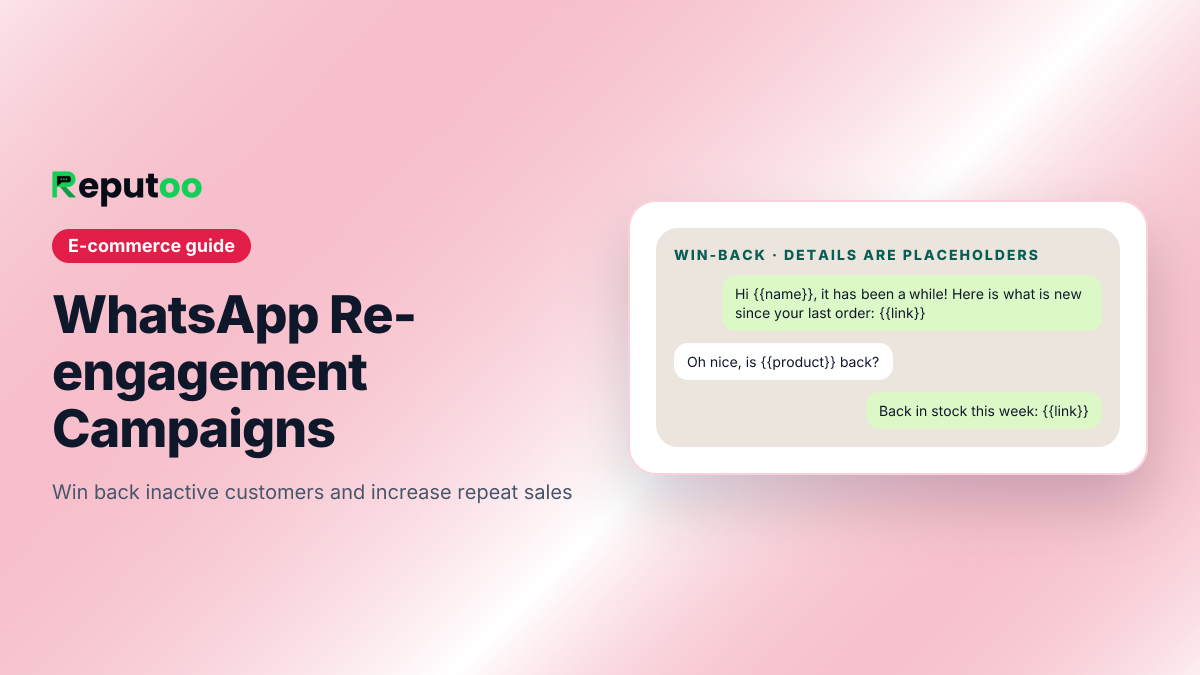
Every e-commerce brand has customers who stop buying. Some purchase once and disappear. Others browse products but never return. Some may have bought before but have not engaged with your brand in months. That is where WhatsApp re-engagement campaigns come in.
Re-engagement campaigns help you bring inactive customers back into the buying journey. Instead of spending all your effort on new customer acquisition, you can reconnect with people who already know your brand. Since they are already familiar with you, they are often easier to convert than brand-new prospects.
WhatsApp is a strong channel for this because messages are direct, personal, and often seen quickly. With the right offer and the right timing, a re-engagement message can remind a customer why they bought from you in the first place.
On this page (19 sections)
- 1.What Are WhatsApp Re-engagement Campaigns?
- 2.Why Re-engagement Matters for E-commerce
- 3.Best Use Cases for WhatsApp Re-engagement Campaigns
- 4.How to Build a WhatsApp Re-engagement Campaign
- 5.Benefits of WhatsApp Re-engagement Campaigns
- 6.Why Reputoo Helps with Re-engagement
- 7.Best Practices for WhatsApp Re-engagement
- 8.Common Mistakes to Avoid
- 9.When Is a Customer “Inactive”?
- 10.A Three-Message Win-Back Sequence
- 11.What a Win-Back Campaign Costs
- 12.Automating Re-engagement in Reputoo
- 13.Choosing an Offer Without Training Customers to Wait
- 14.When to Stop Messaging a Customer
- 15.Measuring a Win-Back Campaign
- 16.Win-Back Message Examples
- 17.Consent Still Applies to Old Customers
- 18.FAQs
- 19.Final Thoughts
What Are WhatsApp Re-engagement Campaigns?
WhatsApp re-engagement campaigns are messages sent to customers who have become inactive or stopped responding. The goal is to reintroduce your brand, regain attention, and encourage another purchase or interaction.
These campaigns can be used for:
- Inactive customers
- Past buyers who have not returned
- Subscribers who stopped opening messages
- Shoppers who haven’t engaged in a while
- Customers who need a new offer or reminder
The idea is to restart the relationship with a message that feels relevant and valuable.
Why Re-engagement Matters for E-commerce
It is often cheaper to reactivate a past customer than to acquire a brand-new one. That makes re-engagement one of the most efficient growth strategies for e-commerce.
Here’s why it matters:
- Past customers already know your brand
- They are easier to convert than cold audiences
- You can increase lifetime value
- You can reduce dependency on paid ads
- You can recover more revenue from existing contacts
If a customer has already shown interest before, a smart WhatsApp message may be all it takes to bring them back.
Best Use Cases for WhatsApp Re-engagement Campaigns
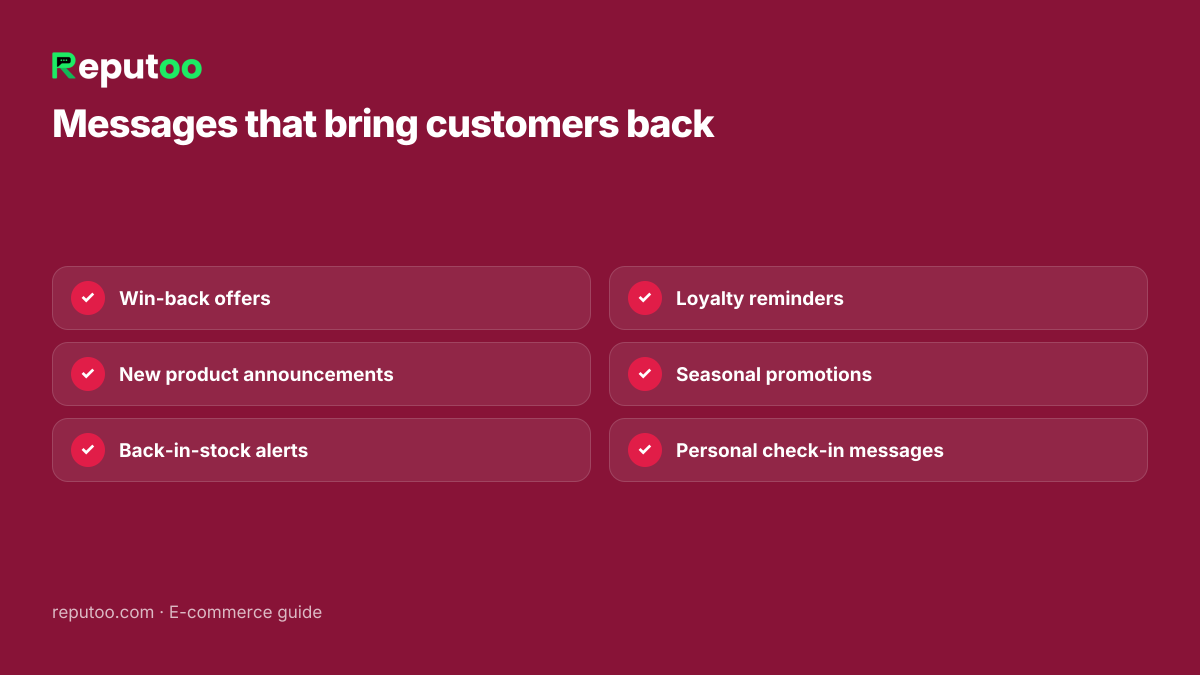
There are several types of messages that work well for reactivation.
1. Win-back offers
A special discount or incentive can bring inactive buyers back.
2. New product announcements
Sometimes customers just need a reason to come back and browse again.
3. Back-in-stock alerts
If they liked a product before, they may purchase once it returns.
4. Loyalty reminders
Remind customers about rewards, perks, or repeat-purchase benefits.
5. Seasonal promotions
A timely offer can create a reason to re-engage.
6. Personal check-in messages
In some cases, a simple “we miss you” style message can reopen the conversation.
The best campaigns are simple, relevant, and timely.
How to Build a WhatsApp Re-engagement Campaign
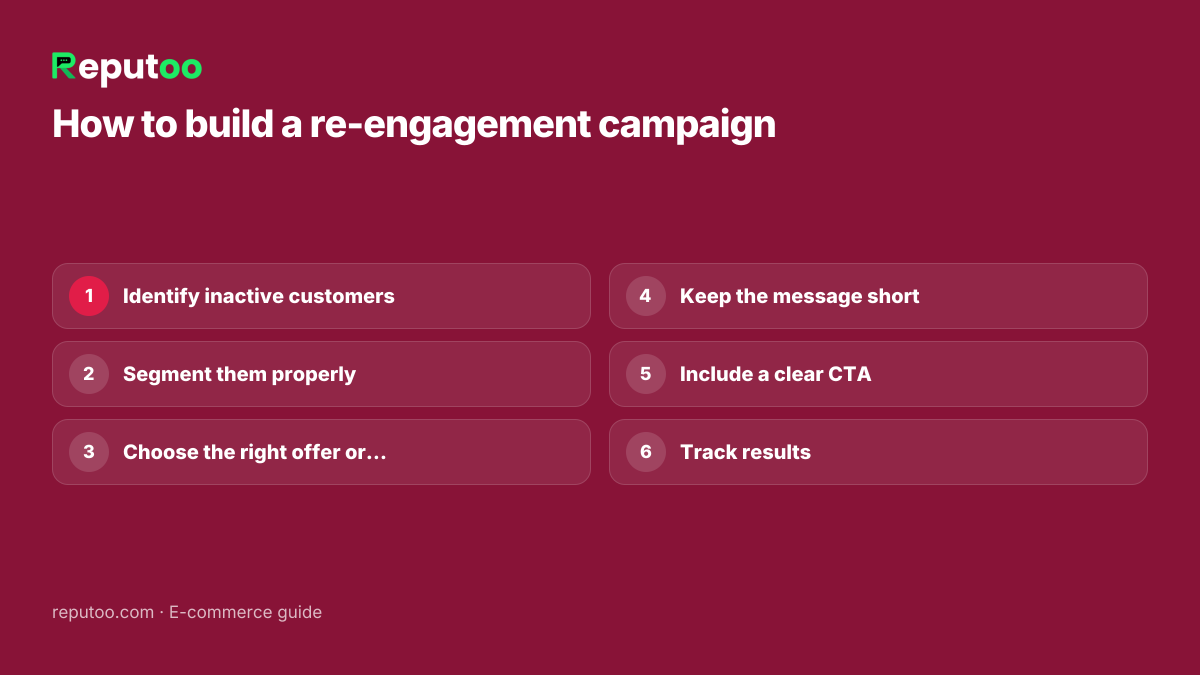
A good re-engagement flow is usually built in a few steps.
1. Identify inactive customers
Choose customers who have not purchased or engaged in a set period.
2. Segment them properly
Not all inactive customers are the same. Some are recent buyers, others are long-term dormant contacts.
3. Choose the right offer or message angle
You might use a discount, product update, new launch, or helpful reminder.
4. Keep the message short
The goal is to get attention quickly.
5. Include a clear CTA
Tell the customer exactly what to do next.
6. Track results
Measure who re-engages and which campaign style works best.
Benefits of WhatsApp Re-engagement Campaigns
Re-engagement campaigns can help e-commerce brands in several ways.
Increase repeat purchases
You can turn inactive customers into active ones again.
Improve retention
A simple message can extend the customer relationship.
Recover lost revenue
Past buyers may be easier to convert than new leads.
Reduce ad dependency
You are making better use of the audience you already have.
Strengthen brand recall
A timely message can bring your store back top of mind.
Why Reputoo Helps with Re-engagement
Reputoo helps e-commerce brands segment contacts and run WhatsApp re-engagement campaigns without adding complexity.
With Reputoo, you can:
- Identify inactive customers
- Send targeted follow-up messages
- Run win-back campaigns
- Automate reactivation flows
- Track campaign performance
This makes it easier to keep your customer list active and valuable over time.
Best Practices for WhatsApp Re-engagement
If you want better results, follow these best practices:
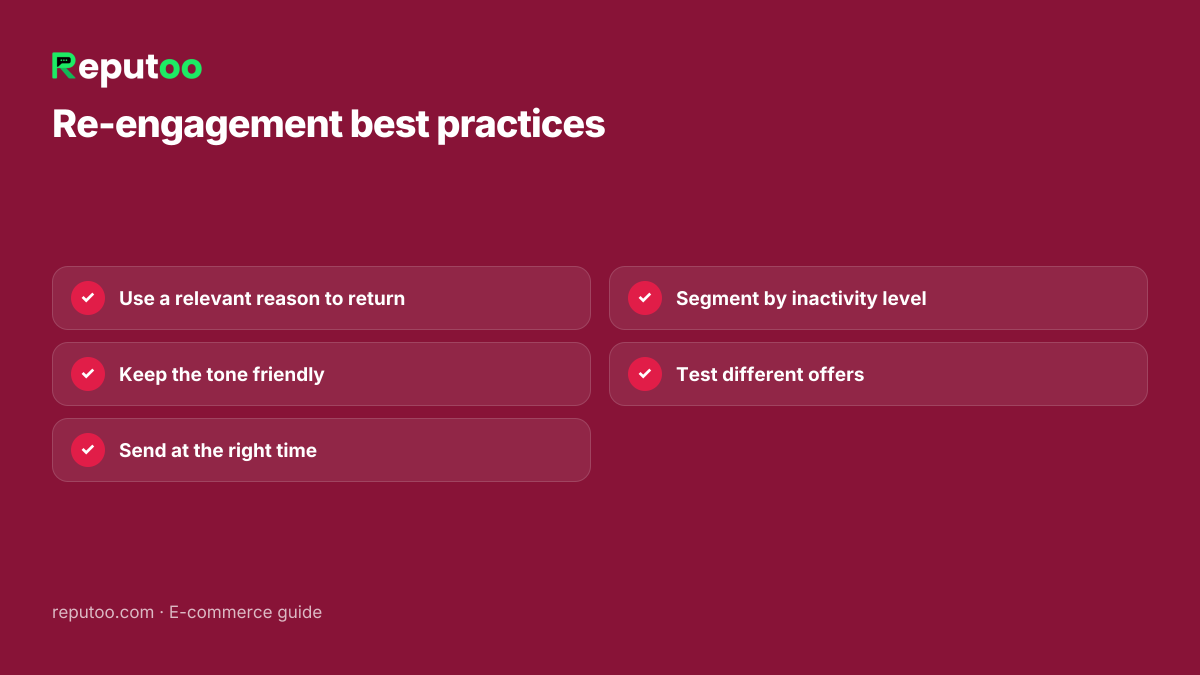
Use a relevant reason to return
Customers need a reason to reconnect.
Keep the tone friendly
Do not sound aggressive or desperate.
Send at the right time
If someone just bought recently, they may not need a win-back message yet.
Segment by inactivity level
A customer inactive for 30 days may need a different message than one inactive for 6 months.
Test different offers
Sometimes a discount works best, and sometimes product updates or reminders work better.
Common Mistakes to Avoid
Re-engagement campaigns can fail when they feel too generic or too sales-heavy.
Avoid these mistakes:
- Sending the same message to everyone
- Using too much urgency
- Offering discounts too early
- Ignoring segment timing
- Not tracking response rates
The message should feel helpful, not pushy.
When Is a Customer “Inactive”?
There is no single answer — it depends on how often people normally buy from you. A useful rule is to take your typical gap between two orders and call a customer inactive once they pass about twice that gap:
- Consumables (coffee, pet food, skincare refills): typical repeat gap 30–45 days → inactive at around 60–90 days.
- Fashion and lifestyle: repeat gap often 3–4 months → inactive at around 6 months.
- Durable goods (electronics, furniture): repeat gap of a year or more → re-engage with accessories and care products, not the main item.
Look up the real gap in your own order data before you set the rule. Then split the inactive group by how long they have been away — the owner’s 30-day and 6-month example above is exactly that split.
A Three-Message Win-Back Sequence
A short sequence usually beats a single message. Here is one that works for most stores, with {{placeholders}} for your details:
- Day 0 — remind, don’t discount. “Hi {{name}}, it has been a while! Here is what is new since your last order: {{link}}.”
- Day 4 — something useful. A restock of the product they bought, a new size or colour, or a care tip. Still no discount.
- Day 10 — the offer. Only now, and only to those who did not act: a time-limited code. “{{discount}} on your next order, valid till {{date}}.”
Stop the sequence the moment someone buys or replies. Customers who did nothing after all three messages should rest for a few months — sending more mostly earns blocks.
What a Win-Back Campaign Costs
Win-back messages are marketing messages in Meta’s categories. On the October 1, 2026 rate card, each delivered one to an Indian number costs ₹0.8631, before 18% GST.
For 2,000 inactive customers and the three-message sequence above, the worst case is 6,000 × ₹0.8631 = ₹5,179. The real figure is lower: messages stop when customers return, undelivered messages are not charged, and Meta may hold back marketing messages to people who have received many recently.
Compare that with your average order value. If a handful of past customers order again, the campaign has paid for itself — usually far more cheaply than winning a new customer through ads. Try your own numbers in the WhatsApp API cost calculator.
Automating Re-engagement in Reputoo
Re-engagement works best when it runs on its own rather than as a quarterly clean-up. In Reputoo:
- Find the inactive. Filter contacts by when they were last seen and save it as a segment that recounts itself — see WhatsApp audience segmentation.
- Let the win-back run daily. The win-back automation checks for customers who have gone quiet and sends the next step of the sequence, including Shopify stores’ lapsed buyers.
- Bring them back with stock. Back-in-stock alerts go to the people who asked for that product.
- Read the results. Each campaign shows delivered, read, replied and clicked, so you can see which angle — reminder, new arrival or discount — actually brings people back.
For customers who drifted away after a bad experience, the AI customer recovery bot handles the conversation one to one.
Pair re-engagement with WhatsApp broadcast campaigns for launches, and see WhatsApp marketing software for e-commerce for the rest of the toolkit.
Choosing an Offer Without Training Customers to Wait
Discounts bring people back, but used every time they teach customers to stop buying at full price and wait for the next code. A few ways to avoid that:
- Lead with something other than price. New arrivals, a restock or a useful tip often work as well for recently inactive customers.
- Save discounts for the long-inactive. Someone gone for six months may need a reason; someone gone for six weeks often just needs a reminder.
- Make it personal and time-limited. A one-time code for that customer, valid for a week, is different from a sitewide sale.
- Try non-discount incentives. Free shipping, a free sample or loyalty points cost less than a percentage off.
When to Stop Messaging a Customer
Some customers will not come back, and that is fine. Continuing to message people who never respond lowers your read rates, wastes marketing charges and raises the chance of blocks, which hurts your number’s quality rating for everyone else.
Set a simple rule: if a customer has not read or replied to your last few campaigns and has not bought in a long time, move them to an updates-only list. They still get order messages if they buy again, but no more promotions. Your active list stays smaller, healthier and cheaper to message.
Measuring a Win-Back Campaign
The headline number is simple: how many inactive customers placed an order within a few weeks of the campaign. Two more numbers make it honest. First, compare against a small group from the same segment that did not get the messages — some customers would have come back anyway. Second, look at what happened afterwards: did returning customers order again at full price, or only with a code? A win-back that brings people back for one discounted order and then loses them again has moved revenue forward, not grown it. Track cost per returning customer — Meta charges for the sequence divided by customers who ordered — and compare it with what you pay to win a new customer through ads.
Win-Back Message Examples
Three short examples, with {{placeholders}} for your details:
- The restock: “Hi {{name}}, {{product}} is back in stock — the one you bought in {{month}}. Reorder here: {{link}}.”
- The new arrival: “Hi {{name}}, we just launched {{collection}}. We think you will like it: {{link}}.”
- The offer: “Hi {{name}}, here is {{discount}} on your next order, just for you, valid till {{date}}: {{link}}.”
Consent Still Applies to Old Customers
A past purchase is not permission to send promotions forever. Re-engagement messages are marketing, so they should only go to customers who opted in to offers on WhatsApp, and every message needs an easy way to stop. Customers who only agreed to order updates should not receive win-back campaigns. Checking this before you send keeps you within Meta’s rules and India’s DPDP Act, 2023 — and protects your number from the blocks that come with unwanted messages.
FAQs
What are WhatsApp re-engagement campaigns?
They are messages sent to inactive customers or subscribers to bring them back into the buying journey.
Are re-engagement campaigns useful for e-commerce?
Yes. They help recover revenue and increase repeat purchases.
What should I say in a win-back message?
Keep it short, friendly, and relevant. Give the customer a reason to return.
Can I automate re-engagement campaigns on WhatsApp?
Yes. Platforms like Reputoo can help automate these workflows.
Should I use discounts in re-engagement campaigns?
Sometimes. Discounts can work, but they should be used strategically.
Final Thoughts
WhatsApp re-engagement campaigns are one of the best ways to revive inactive customers and increase repeat sales. Since these people already know your brand, a well-timed message can bring them back faster than starting from scratch.
If you want to improve retention and get more value from your existing audience, re-engagement campaigns should be part of your WhatsApp strategy.
Win Back Customers with Reputoo
1,000+ businesses onboarded · Member of NVIDIA Inception · Official WhatsApp Business API, no per-message markup.