
WhatsApp Business API for clothing stores: setup, rules and real costs
The WhatsApp Business app works for a clothing store with one phone and one person answering it. Once reminders, confirmations and replies need to go out without someone typing them — or more than one person needs to answer the same number — you need the WhatsApp Business API. This guide covers what Meta asks for, how setup works, and what clothing stores actually pay per message.
Fact-checked against Meta's WhatsApp rate card and vendors' own pricing pages
Key takeaways
- A boutique sells on WhatsApp the way it sells in store: photos, sizes, a quick answer and a personal touch.
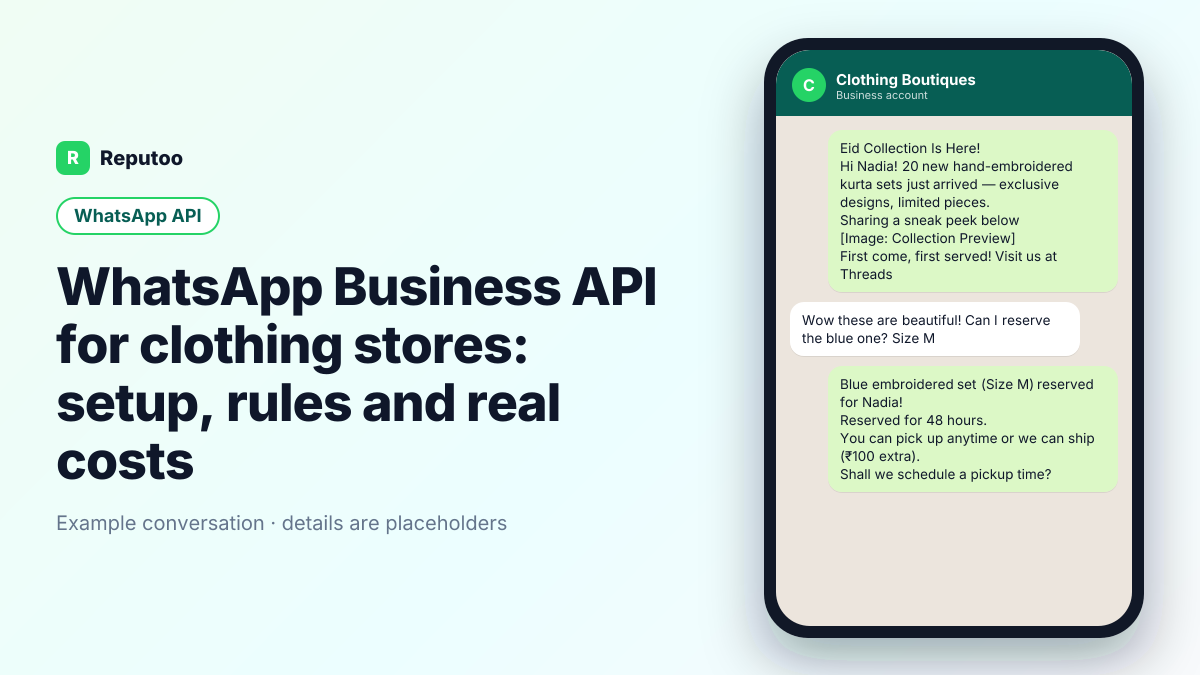
- New arrivals shared with the right customers, with real photos, are the core of boutique selling.
- Custom orders, alterations and stitching need written details and dates, which the chat keeps.
- Stock and size availability must be accurate before a customer is told "yes, it's available".
On this page (25 sections)
- 1.Why clothing stores outgrow the WhatsApp Business app
- 2.What a clothing store needs before applying
- 3.Setting it up for your clothing store, step by step
- 4.The messages a boutique sends
- 5.Selling from photos
- 6.Which messages a clothing store sends — and what each costs
- 7.Custom orders, stitching and alterations
- 8.Stock accuracy
- 9.Keeping a clothing store's number in good standing
- 10.Video calls and virtual shopping
- 11.Returns and exchanges
- 12.Why boutiques outgrow the WhatsApp app
- 13.A 30-day rollout for a boutique
- 14.Saved measurements
- 15.Out-of-town customers
- 16.The festive rush
- 17.Templates Meta approves for a boutique
- 18.Payments and advances
- 19.Photos and consent
- 20.Video walkthroughs of pieces
- 21.Why a shared inbox matters in a boutique
- 22.After hours
- 23.Loyalty for regulars
- 24.Several stores
- 25.Frequently asked questions
1.Why clothing stores outgrow the WhatsApp Business app
The app is fine until these start happening to a clothing store:
- New arrivals reach only a fraction of customers.
- Loyal customers shop elsewhere between visits. Your best customer hasn't visited in 60 days. Not because they don't love you — they just forgot you had new stock.
- Custom order status communicated by manual calls. Customers call to check if their altered kurta is ready. WhatsApp automated updates end these calls.
The app cannot send on a trigger, share one number across staff, or read your records. The API can. And customers keep asking the same things: customers ask whether a piece is in their size, for more photos, about alterations, and whether a new collection has arrived.
2.What a clothing store needs before applying
- A verified Meta Business account in the clothing store's legal name, backed by a registration, GST or utility document.
- A number not active on the WhatsApp app — your current one works once it is removed from the app.
- A display name matching the business, and a website or public page Meta can check.
- Opt-in from every customer you message first. Billing at the counter and first online orders — boutique customers often want to hear about new arrivals.
3.Setting it up for your clothing store, step by step
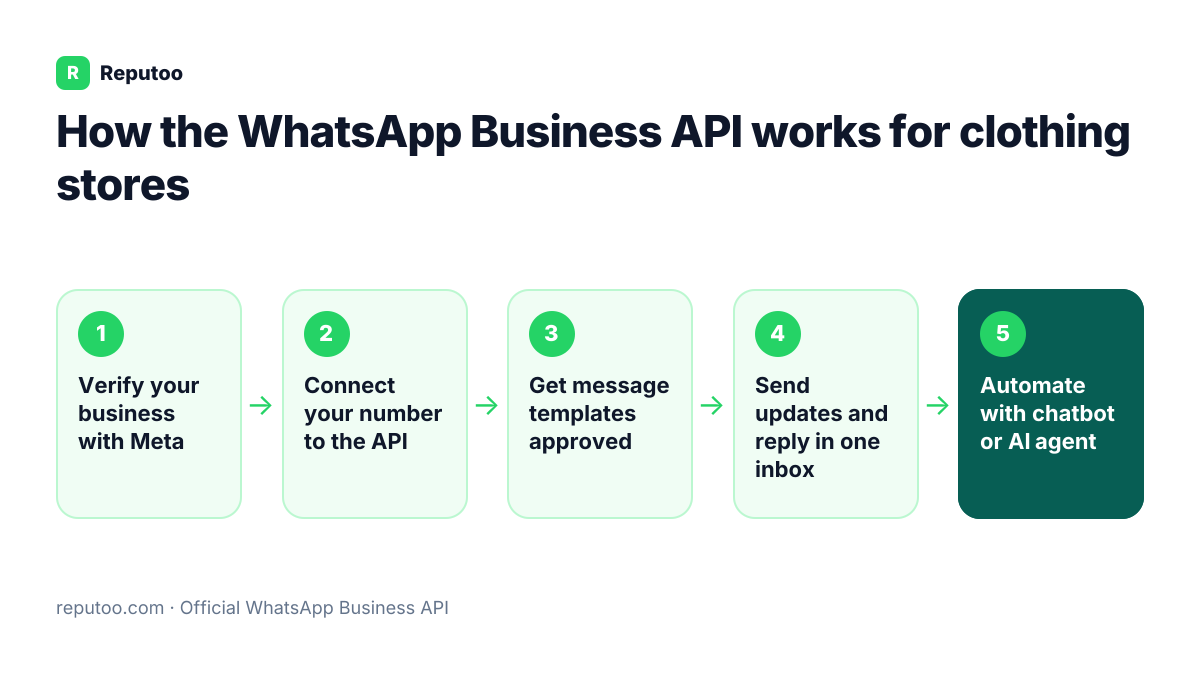
- Connect the number through Meta's embedded signup inside Reputoo, and submit business verification — you can start sending within Meta's starting limit while it is reviewed.
- Get your first templates approved for the 2 routine messages listed below; anything outside a customer's 24-hour reply window must be a template.
- Wire the triggers to your records. What to connect: A retail POS or online store with inventory; size availability is what makes stock replies accurate.
- Put staff on one multi-agent inbox, with conversations assigned so two people never answer the same customer.
4.The messages a boutique sends
| Message | When | Meta category |
|---|---|---|
| Order or reservation confirmed, with photos | At purchase | Utility |
| Alteration or stitching ready for trial | When ready | Utility |
| Delivery or pickup details | On dispatch | Utility |
| Exchange or return update | As it moves | Utility |
| New arrivals, festive and wedding collections | When collections land | Marketing |
| Private preview, sale for regulars | A few times a season | Marketing |
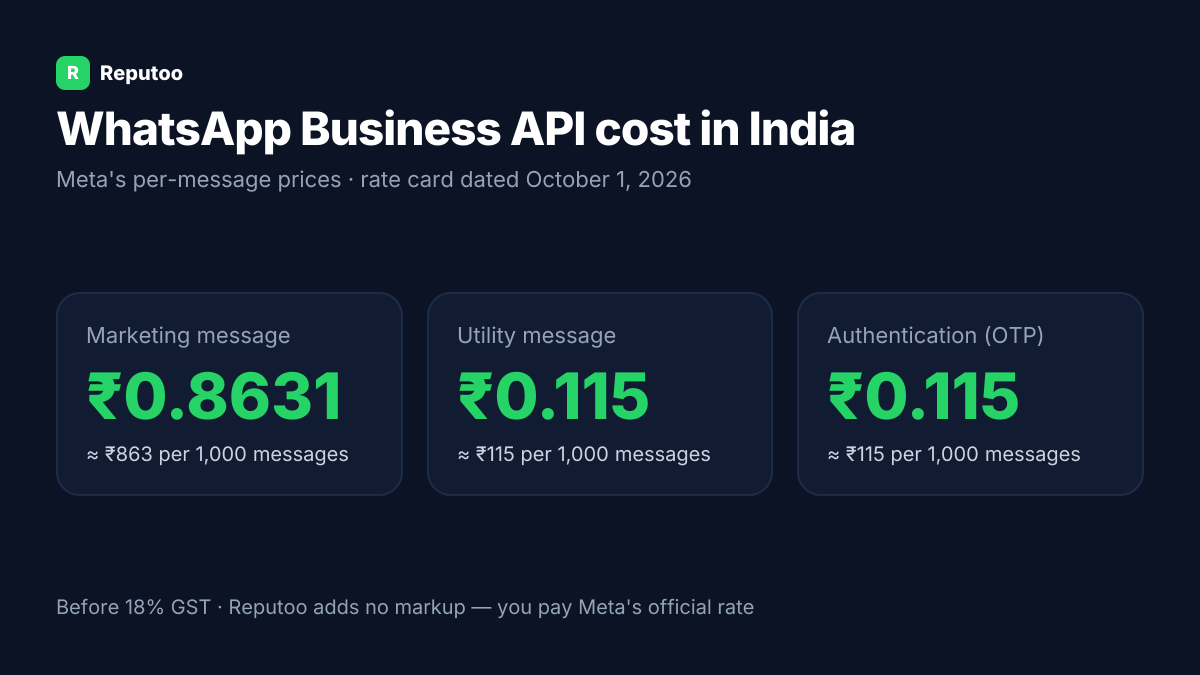
A boutique with 40 orders and alterations a week sends a few hundred utility messages a month — well under ₹100 in Meta fees on the October 1, 2026 India rate card. New-arrival messages cost ₹0.8631 each; a collection shared with 1,000 opted-in customers costs ₹863.
5.Selling from photos
Customers who follow a boutique want to see new pieces the day they arrive. Photos on a model or a hanger, the fabric up close, the sizes available and the price — sent in the chat or as a WhatsApp catalogue — sell pieces before they reach the rail. A customer who replies "I'll take the green one in M" can have it reserved, paid by link, and shipped or held for pickup in minutes.
6.Which messages a clothing store sends — and what each costs
Meta charges per delivered template message, and the price depends on the category. For clothing stores, the day-to-day messages sort like this:
- New stock arrives → broadcast to loyal customers — marketing
- Reservation management via WhatsApp — utility
- Custom order status updates automated — utility
- Festival campaign broadcast 2 weeks before — marketing
Timing matters as much as category. New-arrival messages when stock lands, and reminders before festive and wedding seasons when people shop ahead.
A service reply answers a customer who wrote first; from 1 October 2026 Meta charges those at the utility rate. Utility messages (confirmations, reminders, status updates) cost a fraction of marketing messages, so keep them strictly transactional — a discount line inside a reminder makes Meta classify the whole template as marketing.
| Market | Utility message | Marketing message |
|---|---|---|
| India | ₹0.115 | ₹0.8631 |
| United States | $0.0034 | $0.0250 |
| United Kingdom | $0.0220 | $0.0635 |
| UAE | $0.0157 | $0.0576 |
Meta list rates, October 1, 2026. India in INR, plus 18% GST.
7.Custom orders, stitching and alterations
Many boutiques make to measure: blouses, lehengas, suits, alterations. The chat keeps the details in writing — measurements, fabric choice, design reference photos, the trial date, the delivery date and the advance paid. A "ready for trial" message and a reminder before the event date mean nothing is late for the wedding.
8.Stock accuracy
"Is this available in L?" is the question a boutique answers most. If stock lives in a POS or store platform, answers can come from it; if it lives in someone's memory, check before replying. Telling a customer a piece is available and then finding it sold is worse than a slower, accurate answer.
9.Keeping a clothing store's number in good standing
Meta rates every number on how customers react. For clothing stores, the risk is usually messaging the whole contact list about something only some of them asked for. Send reminders only to people with a booking or order, promotions only to people who opted in to them, and never use a bulk-sender tool on the ordinary app — that is the route to a banned number. The full list of what Meta checks is in our WhatsApp Business API guide.
10.Video calls and virtual shopping
Customers in other cities or too busy to visit can shop by video call — a staff member shows pieces on a mannequin or hanger, the customer chooses, pays by link and gets delivery. Book these calls in the chat like any appointment.
11.Returns and exchanges
A clear exchange policy, written in the order confirmation — within how many days, with tags, not on custom pieces or sale items if that is your rule — prevents arguments. Exchanges requested in the chat with a photo can be approved and the replacement reserved before the customer comes in.
12.Why boutiques outgrow the WhatsApp app
Many boutiques sell from the owner's phone, and it works until orders, alterations and enquiries pile up in one person's chats. The API puts every conversation on the boutique's number in a shared inbox, so staff can reply with photos and stock, and the customer history stays with the business.
13.A 30-day rollout for a boutique
- Week 1: move to the API; get order, ready-for-trial and delivery templates approved; set up the catalogue.
- Week 2: reply to all enquiries from the shared inbox with photos and stock.
- Week 3: custom orders and alterations tracked with dates and reminders.
- Week 4: the first new-arrivals message to customers who opted in.
14.Saved measurements
Stitching customers come back for the next outfit, and asking for measurements again is tedious for them. Keep measurements on the customer's record — with their permission — so the next order starts with "same measurements as your last blouse?". Treat measurements as private: only the tailor and the customer see them.
15.Out-of-town customers
Customers who found the boutique on Instagram or on holiday may live in another city. WhatsApp is how they shop: photos and videos of pieces, a video call if needed, payment by link, and delivery with tracking. A clear shipping and exchange policy for outstation orders, stated in the confirmation, avoids disputes.
16.The festive rush
In the weeks before a big festival, enquiries multiply and stitching slots fill. Tell customers the last date to order for delivery before the festival, and stop taking orders you cannot finish in time. Honest cut-offs keep customers; missed festival deadlines lose them for good.
17.Templates Meta approves for a boutique
Keep order, trial and delivery templates factual — the item, the date, the amount, the pickup or tracking. Keep new-arrival photos and offers in separate marketing templates, sent only to customers who opted in.
18.Payments and advances
Custom orders usually take an advance, with the balance at trial or delivery. Payment links for each, with receipts in the chat, keep the record clear. For outstation orders, full payment before dispatch is common; state it up front.
19.Photos and consent
Photos of customers in your outfits sell beautifully — only with their permission. Ask at delivery, record the answer, and never share a customer's photo in a broadcast without it.
20.Video walkthroughs of pieces
A ten-second video of a lehenga moving, or a kurta held against the light to show the weave, answers questions photos cannot. WhatsApp carries short videos easily; staff can record them on the shop floor and send them straight to the customer who asked.
22.After hours
Customers browse boutique Instagram late at night and message to ask about a piece. An automatic reply with the catalogue link and a promise to confirm stock in the morning — or a chatbot that answers from stock data — keeps the enquiry from going cold.
23.Loyalty for regulars
Boutique regulars buy every season. A simple loyalty record — points or a thank-you gift after a set spend — tracked on the customer's profile and mentioned in their order confirmation, rewards them without a discount on every piece.
24.Several stores
Boutiques with more than one store usually give each its own number, with stock visible across stores so a piece missing in one can be sent from another. Customers message the store they know; the owner sees everything.
25.Frequently asked questions
Can a clothing store keep its existing WhatsApp number on the API?
Yes. Delete the number from the WhatsApp or WhatsApp Business app first, then register it on the API. Existing chat history on the phone does not transfer, so export anything you need before switching.
How much does the WhatsApp Business API cost for clothing stores?
Two parts: Meta's per-message charge (in India ₹0.115 per utility message and ₹0.8631 per marketing message, plus GST, on the October 1, 2026 rate card) and the platform plan. Reputoo does not add a markup per message; plan prices are on the pricing page.
Can a boutique sell clothes on WhatsApp?
Yes — photos, sizes and prices in chat or a WhatsApp catalogue, reservation and payment by link, and delivery or pickup. Many boutique customers prefer it to a website.
How can boutiques track stitching and alteration orders on WhatsApp?
By keeping measurements, designs, trial and delivery dates and the advance in the chat, with "ready for trial" messages and reminders before the event date.
How much do boutique order messages cost?
Order and alteration updates are utility messages at ₹0.115 each on Meta's October 1, 2026 India rate card; new-arrival campaigns are marketing at ₹0.8631. Reputoo adds no per-message markup.
Can boutiques ship to customers in other cities?
Yes — photos, videos or a video call, payment by link and delivery with tracking, with shipping and exchange rules stated before payment.
How do I sell new clothing collections via WhatsApp?
Use Reputoo's WhatsApp Broadcast to send new arrival photos to your full customer list. Each customer receives it as a personal WhatsApp from your boutique — far more likely to be seen than an Instagram post.
Can customers reserve clothing items via WhatsApp?
Yes. Customer replies to your broadcast to reserve a specific item. Reputoo holds the item in a queue, sends a confirmation, and follows up with a payment link. No manual tracking needed.
Written by Riya · Reputoo
Riyawrites Reputoo's guides on the WhatsApp Business API, chatbots and voice AI for Indian businesses. Prices are checked against Meta's published rate card (25 September 2026); competitor details come from each vendor's own site.
Set up WhatsApp Business API for your business
1,000+ businesses onboarded · Member of NVIDIA Inception · Official WhatsApp Business API, no per-message markup.