WhatsApp AI Agent

A WhatsApp AI agent for your marketing agency: what it does and where it stops

A chatbot follows the paths you draw. An AI agent reads what the customer actually wrote, looks up your marketing agency's own information, and takes the next step — books, updates, follows up. This is what that looks like for marketing agencies, and how to keep it honest.

Riya · ReputooUpdated 25 September 202610 min read

✓ Fact-checked against Meta’s WhatsApp rate card and vendors’ own pricing pages

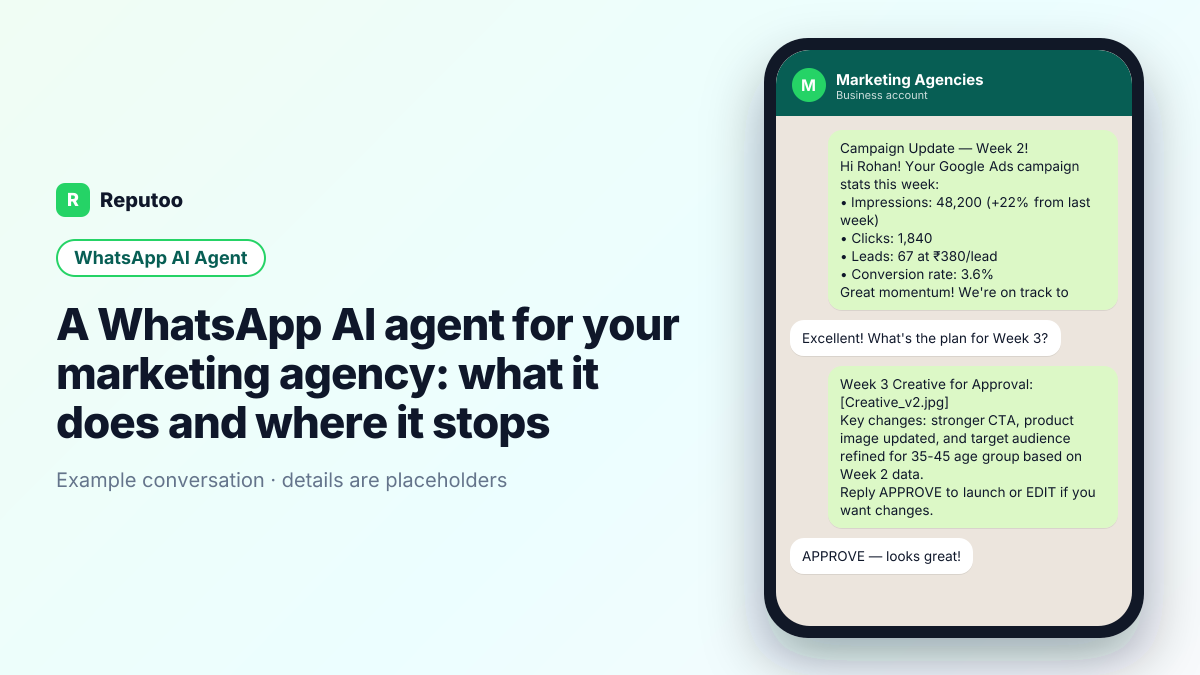
Example WhatsApp conversation for marketing agencies — WhatsApp AI agent
An example WhatsApp AI agent conversation for marketing agencies. Names and details are placeholders.
Key takeaways
  1. 01The AI agent qualifies leads, shares matching case studies and books discovery calls.
  2. 02For clients, it answers routine delivery questions from the client's record.
  3. 03Scope, pricing, strategy and complaints stay with the account lead.
  4. 04It prepares a brief so the discovery call starts with the prospect's goals.
On this page · 33 chapters
  1. 01 · What people ask, and what the agent can answer
  2. 02 · Jobs to give the agent
  3. 03 · The knowledge base for an agency
  4. 04 · How it learns your business
  5. 05 · Building the brief
  6. 06 · Where marketing agencies should keep a person in the loop
  7. 07 · Chat and phone, one agent
  8. 08 · Client questions between meetings
  9. 09 · Explaining without promising
  10. 10 · Confidentiality
  11. 11 · Access requests
  12. 12 · Payments
  13. 13 · Languages
  14. 14 · Handovers
  15. 15 · Reading the conversations
  16. 16 · After hours
  17. 17 · Setting it up
  18. 18 · Tone
  19. 19 · Proposal questions
  20. 20 · Routing to the right person
  21. 21 · Content calendar changes
  22. 22 · Website support requests
  23. 23 · Discovery-call preparation
  24. 24 · What it will not do
  25. 25 · Measuring
  26. 26 · Referrals and applicants
  27. 27 · Reports clients do not understand
  28. 28 · Busy weeks
  29. 29 · Discovery-call no-shows
  30. 30 · Multiple brands per client
  31. 31 · Clients who prefer a person
  32. 32 · Following up after the call
  33. 33 · Frequently asked questions
Chapter 01

What people ask, and what the agent can answer

QuestionAgent answers?What it needs
Do you do SEO for clinics?YesService pages and industries served
What does a social media retainer include?YesService sheets
Can I see work for a restaurant?YesApproved case studies
When is my report due?YesClient record
Can you guarantee first page on Google?No — explains why and offers a callYour policy on promises
Can you lower the retainer this month?No — account leadThe account lead
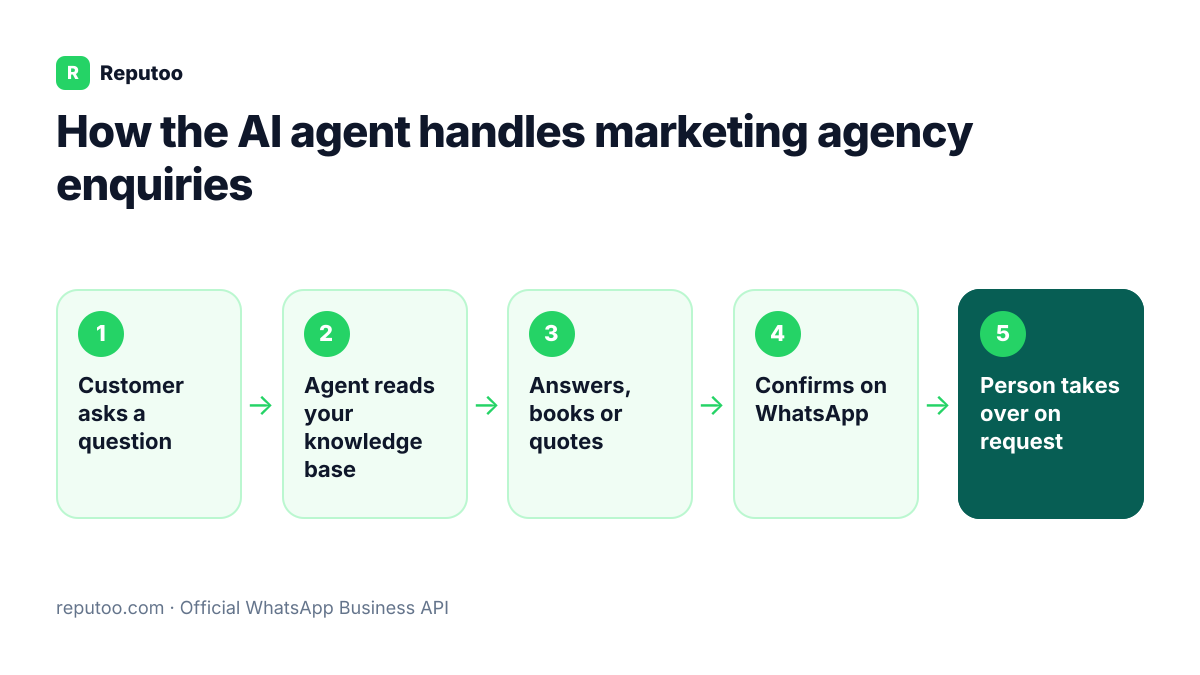
How the AI agent handles marketing agency enquiries: Customer asks a question, Agent reads your knowledge base, Answers, books or quotes, Confirms on WhatsApp, Person takes over on request
How the AI agent handles marketing agency enquiries
Chapter 02

Jobs to give the agent

Start with what customers ask. Prospects ask about services, pricing and past work; clients ask for reports, approvals and campaign status. An agent answers all of that from your own information. Then give it the work marketing agencies repeat every day:

  1. Weekly campaign performance update on WhatsApp — Key metrics (leads, costs, conversions) sent every Monday morning with commentary.
  2. Creative approvals via WhatsApp — same day — Creative shared via WhatsApp with APPROVE/EDIT button. Approval cycle drops from 4 days to 4 hours.
  3. Monthly report notification with WhatsApp summary — End of month: WhatsApp summary of key wins + link to full report.
  4. Retainer renewal + upsell discussion prompt — 45 days before retainer renewal, WhatsApp: "Ready to review results and plan the next quarter?"

The agent runs these on WhatsApp in the customer's language, day and night, and writes what it did back to the contact record so staff see the full history.

Chapter 03

The knowledge base for an agency

  1. Services — what each includes, what the client provides, starting prices if you publish them.
  2. Case studies — only those clients approved for sharing.
  3. Process — onboarding, approvals, reporting, billing dates.
  4. Onboarding guides — how to grant access on each platform.
  5. Policies — contract terms, notice periods, what you do not promise.
Chapter 04

How it learns your business

An AI agent is only as accurate as what you give it. On Reputoo it answers from your knowledge base — pages crawled from your website, documents and price lists you upload, and policies you write down — rather than from general knowledge. Two rules keep it right:

  • If it is not in the knowledge base, the agent says it will check and hands over, rather than guessing.
  • Prices, timings and policies live in one place. Update the source and the agent's answers change with it.

It also needs to see the records your marketing agency already keeps — what to connect: A CRM for leads and a project tool for client work; conversations should land on the right client record.

Chapter 05

Building the brief

"We run three restaurants in Pune, want more weekday orders, tried boosting posts, budget is modest" — the agent turns that into a brief with the business, the goal, what was tried and the budget range, suggests the services that fit, and books a call. The strategist opens the call with ideas instead of a questionnaire.

Chapter 06

Where marketing agencies should keep a person in the loop

These are the moments customers remember, and they are worth a human:

  • Client anxiety when they don't hear from you.
  • Creative approvals by email take days. Ad creative needs client approval. Email sent Monday. Reminder Wednesday. Approved Friday. Campaign delayed by half a week.
  • Monthly reports shared on email, never read. You prepared a detailed 20-page performance report. Client never opened it. Shared as PDF on WhatsApp — they'll look at it.

The agent can open each of these conversations and collect the details; a person should close anything involving a complaint, an exception to policy, or money that has not been agreed. Handover goes to the shared inbox with the full conversation attached.

Chapter 07

Chat and phone, one agent

The same agent that answers on WhatsApp can answer your marketing agency's phone line as Vajra, Reputoo's voice agent, so a customer who calls gets the same answers as one who messages. It speaks 36 languages and switches to the caller's.

Chapter 08

Client questions between meetings

Clients ask for invoice copies, report dates, calendar links and who is covering while their account manager is away. The agent answers from the client's record and the process documents, and passes anything about strategy or performance to the account lead.

Chapter 09

Explaining without promising

Prospects ask how long SEO takes or whether ads will work for them. The agent explains the process and what influences results in general terms, and is instructed never to promise rankings, leads or returns.

Chapter 10

Confidentiality

An agency often serves competitors in the same industry. The agent never mentions one client's plans, results or details to another, and shares only case studies approved for public use.

Chapter 11

Access requests

When a new client asks how to give access, the agent sends the right guide for each platform and warns against sharing passwords or codes in chat. If a client sends a password anyway, it advises them to change it and passes the conversation to the account manager.

Chapter 12

Payments

The agent resends invoices and payment links and confirms receipts. It never asks for card numbers, PINs or OTPs, and billing disputes go to the account lead.

Chapter 13

Languages

The agent replies in the prospect's language, which helps agencies serving local businesses across regions.

Chapter 14

Handovers

Custom quotes, scope changes, complaints, renewals and cancellations go to the account lead with the conversation summarised. The agent tells the client when to expect a reply.

Chapter 15

Reading the conversations

A month of lead conversations shows which services and industries are asking, what budgets look like and where prospects hesitate — useful for packaging services and writing your website.

Chapter 16

After hours

Business owners research agencies at night. The agent qualifies them, shares case studies and books a discovery call for the next day, so the lead is not cold by morning.

Chapter 17

Setting it up

Load service sheets, approved case studies, process and billing documents, and onboarding guides. Connect the calendars of the people who take discovery calls. Read conversations daily for the first week and correct anything it answered poorly.

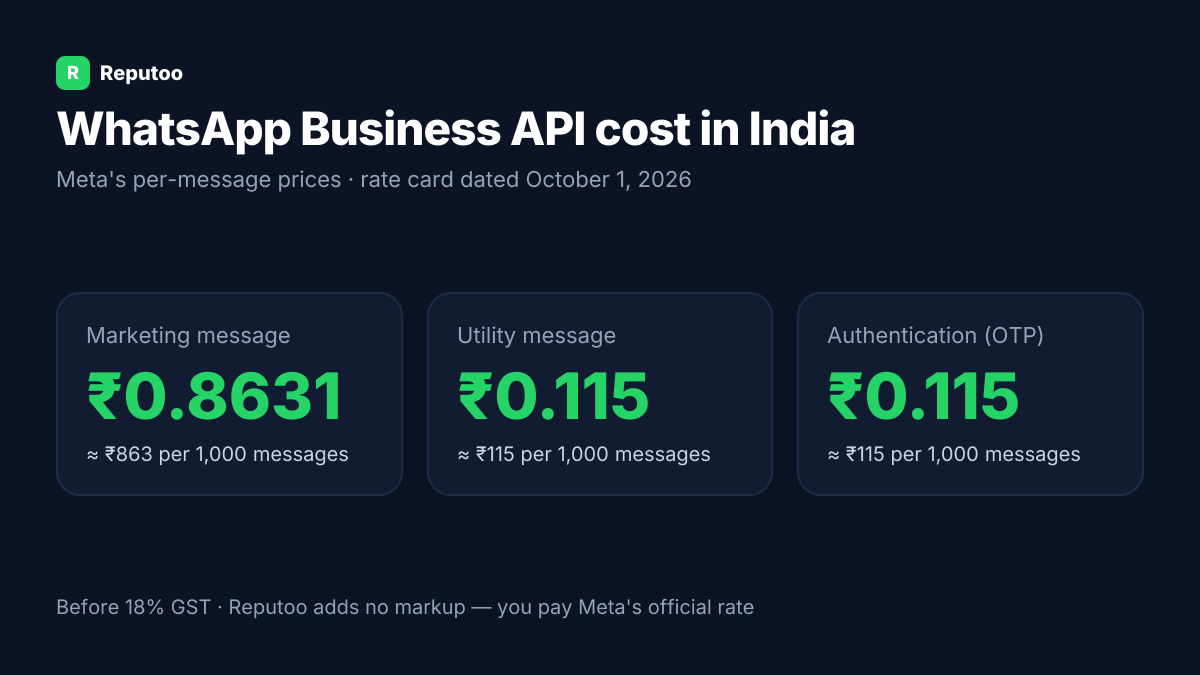
WhatsApp Business API cost in India: marketing ₹0.8631, utility ₹0.115 per message (Meta rate card, October 1, 2026)
Meta's per-message prices in India (rate card dated October 1, 2026), before GST. Reputoo adds no markup.
Chapter 18

Tone

Tell the agent how your agency sounds — direct, friendly, consultative — and keep it consistent with your website and proposals. Prospects notice when the chat feels like a different company from the pitch.

Chapter 19

Proposal questions

After a proposal is sent, prospects ask what a line item means or when work would start. The agent answers from the proposal and your process documents, and passes any request to change price or scope to the person who wrote it. It never revises a proposal on its own.

Chapter 20

Routing to the right person

An agency has strategists, account managers, designers and developers. The agent recognises existing clients and routes them to their account manager, sends new leads to whoever handles new business for that service, and passes technical website issues to the developer on duty, with a summary each time.

Chapter 21

Content calendar changes

When a client asks to move a post or swap an image, the agent records the request against their calendar and tells them when the account manager will confirm. It does not change scheduled content itself.

Chapter 22

Website support requests

Clients whose websites you maintain report problems — a broken form, a page not loading. The agent collects the page link, what happened and a screenshot, marks urgent issues for the developer on duty, and tells the client what happens next.

Chapter 23

Discovery-call preparation

After booking the call, the agent asks for the prospect's website, social pages and any reports they want to share, and adds them to the brief. It sends the meeting link and a reminder an hour before, so the strategist starts prepared and the prospect turns up.

Chapter 24

What it will not do

The agent does not quote custom prices, change scope, promise results, discuss one client with another, or offer discounts. When a question falls outside what it was given, it says so and passes the conversation to the right person with a summary.

Chapter 25

Measuring

Compare leads answered out of hours, discovery calls booked, and routine client questions answered without an account manager, before and after launch.

Chapter 26

Referrals and applicants

The agent asks every new lead how they heard about you and records the referring client so the team can thank them. Job applicants and freelancers are thanked, told where to send their portfolio, and kept out of the lead pipeline.

Chapter 27

Reports clients do not understand

Clients sometimes ask what a term in their report means — reach, impressions, cost per lead. The agent explains the term in plain language from your glossary. Questions about why a number went up or down go to the account manager, who knows the context.

Chapter 28

Busy weeks

During pitches and launches, the agent keeps routine conversations moving and batches everything that needs a person into one summary for the end of the day.

Chapter 29

Discovery-call no-shows

When a prospect misses a discovery call, the agent sends a friendly message offering two new slots. It follows up once more if there is no reply, then leaves the lead for the team to decide on — it never keeps chasing.

Chapter 30

Multiple brands per client

Some clients run several brands or locations with you. The agent asks which brand a question is about and answers from that brand's record, so reports and calendars never get mixed up.

Chapter 31

Clients who prefer a person

Some clients want every message to reach their account manager. The agent can recognise their numbers and step aside entirely, or answer only simple questions such as invoice copies and pass everything else on at once — whichever the client prefers.

Chapter 32

Following up after the call

After a discovery call, the agent can send the prospect the next steps the strategist recorded and a link to the proposal once it is ready, keeping momentum without anyone writing the same summary twice.

Chapter 33

Frequently asked questions

What is the difference between a WhatsApp chatbot and an AI agent?

A chatbot follows menus and flows you define. An AI agent understands free-form messages, answers from your own knowledge base, and can take actions such as booking or updating a record. Most businesses run both: flows for fixed tasks, the agent for everything else.

Can an AI agent make mistakes with my marketing agency's customers?

Yes, which is why it should answer only from your knowledge base and hand over when it does not know. Review conversations in the first weeks and add missing answers to the knowledge base as you find them.

Will the AI agent promise rankings or results?

No. It explains the process in general terms and books a call with a strategist to discuss goals.

Can the AI agent share case studies?

Only the ones clients approved for sharing, matched to the prospect's industry and service.

What if a client sends a password in chat?

The agent advises them to change it, explains how to grant access properly, and alerts the account manager.

Can the AI agent change a proposal?

No. It answers questions from the proposal and passes changes to the person who wrote it.

Can the AI agent explain report terms to clients?

Yes, from your glossary. Questions about why results changed go to the account manager.

Can I get client creative approvals via WhatsApp?

Yes. Send the creative via WhatsApp with APPROVE/EDIT as reply options. Approval happens in hours vs the 3-4 day email cycle. Faster approvals = faster campaign launches = better results = happier clients.

Can I manage new client onboarding via WhatsApp?

Yes. New client onboarding sequence: contract signed → welcome message → brand assets checklist → first week timeline → kickoff call reminder. All automated, all via WhatsApp. New clients feel organised from Day 1.

Written by Riya · Reputoo. Riya writes Reputoo’s guides on the WhatsApp Business API, chatbots and voice AI for Indian businesses. Prices are checked against Meta’s published rate card (25 September 2026); competitor details come from each vendor’s own site.

← Back to all articles
Put it to work

Set up WhatsApp AI agent for your business.

1,000+ businesses onboarded · Member of NVIDIA Inception · Official WhatsApp Business API, no per-message markup.

Get the details on WhatsAppNo payment needed. We will message you on WhatsApp.
+91
By sending, you agree to be contacted on WhatsApp. Prefer to write first? Message us