Run it on WhatsApp with ReputooOfficial WhatsApp Business API · plans from ₹999 a monthBook a DemoStart for FREE
WhatsApp AI Agent
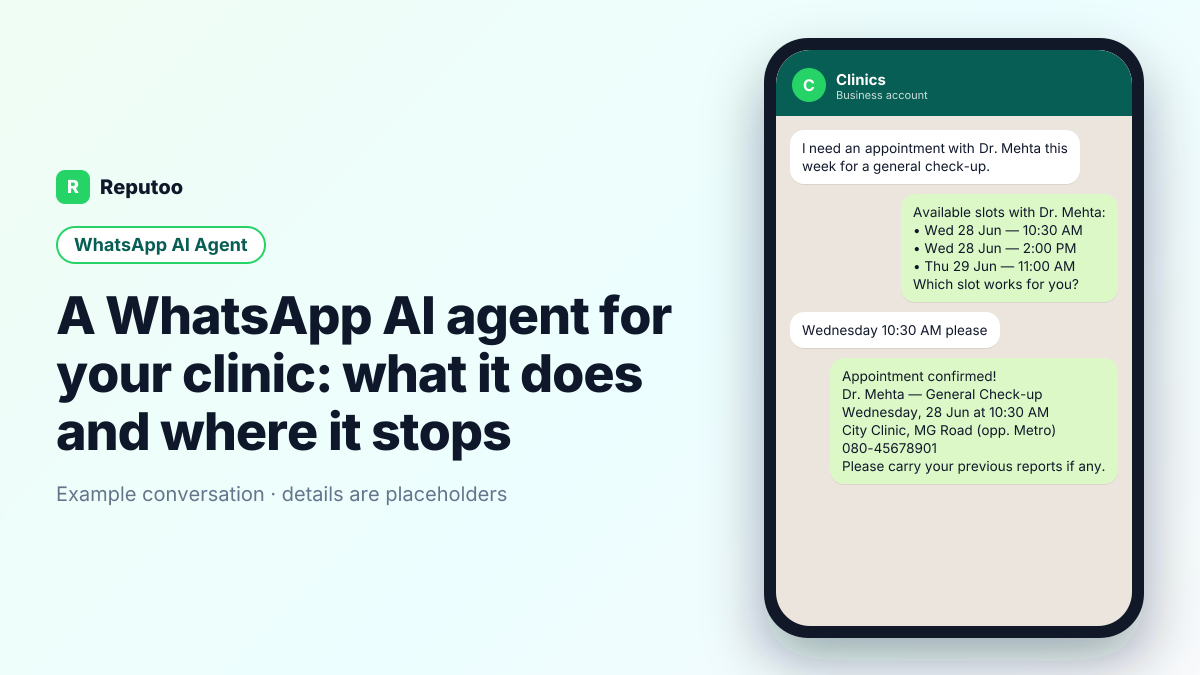
A WhatsApp AI agent for your clinic: what it does and where it stops
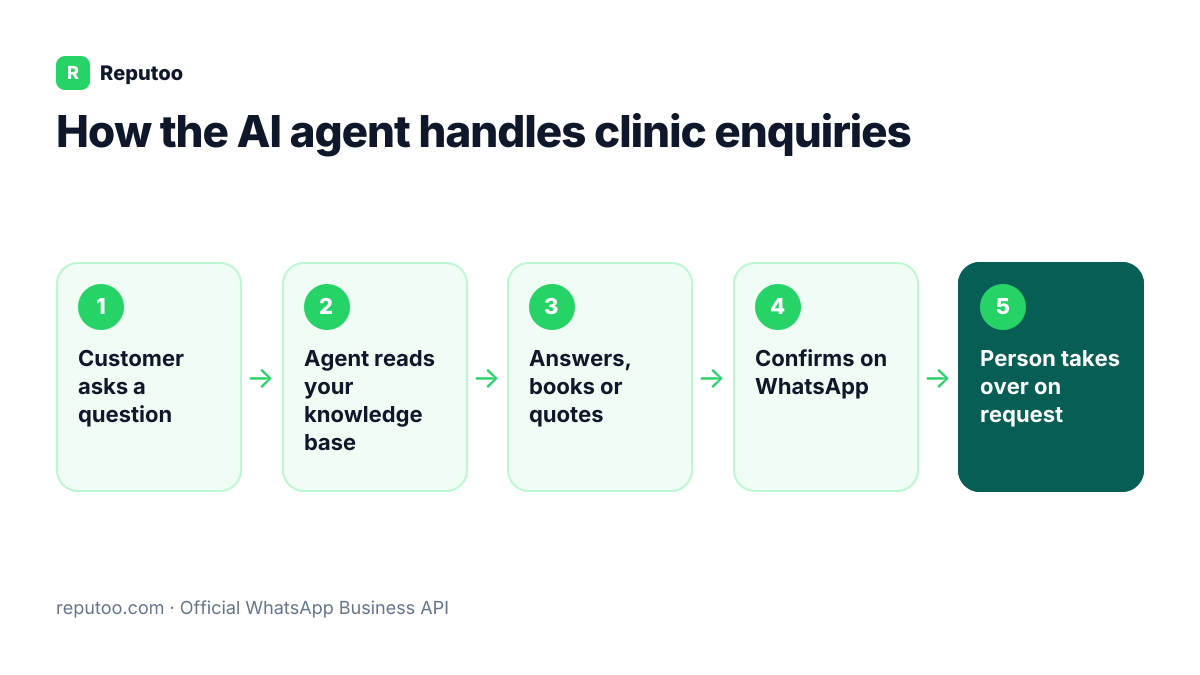
A chatbot follows the paths you draw. An AI agent reads what the customer actually wrote, looks up your clinic's own information, and takes the next step — books, updates, follows up. This is what that looks like for clinics, and how to keep it honest.
RRiya · ReputooUpdated 25 September 202610 min read
✓ Fact-checked against Meta’s WhatsApp rate card and vendors’ own pricing pages
Start with what customers ask. Patients ask which doctor is available, clinic timings, consultation fees, whether reports are ready, and how to reschedule. An agent answers all of that from your own information. Then give it the work clinics repeat every day:
Patient books via WhatsApp 24/7 — Bot shows doctor availability and confirms appointment — no calls, no waiting on hold.
Reminder + confirmation sent automatically — 24hr WhatsApp reminder with one-tap confirm or reschedule. Doctor's slot never wasted.
Post-visit follow-up on Day 7 — 7 days after visit, automated check-in: "How are you feeling? Any questions?" with re-booking prompt.
Follow-up check after visit — Automated check-in two hours after the appointment, with care instructions attached.
The agent runs these on WhatsApp in the customer's language, day and night, and writes what it did back to the contact record so staff see the full history.
Chapter 03
The knowledge base for a clinic
Doctors — names, specialities, qualifications you publish, days and hours, languages spoken.
Services and fees — consultations, procedures, lab tests, packages.
Insurance — insurers and TPAs you work with, and what patients should bring.
Preparation instructions your doctors have written — fasting for tests, what to bring for a first visit.
The fixed replies for symptoms and emergencies, approved by a doctor.
Chapter 04
How it learns your business
An AI agent is only as accurate as what you give it. On Reputoo it answers from your knowledge base — pages crawled from your website, documents and price lists you upload, and policies you write down — rather than from general knowledge. Two rules keep it right:
If it is not in the knowledge base, the agent says it will check and hands over, rather than guessing.
Prices, timings and policies live in one place. Update the source and the agent's answers change with it.
It also needs to see the records your clinic already keeps — what to connect: A clinic or hospital management system with doctor schedules; bookings made on WhatsApp need to land there.
Chapter 05
The clinical boundary
An AI agent is fluent enough to sound like it knows medicine. That is exactly why its instructions must be explicit: it does not diagnose, does not suggest medicines or doses, does not interpret reports, and does not reassure about symptoms. When a message describes a symptom, it sends the approved reply and hands the conversation to clinical staff. If a message suggests an emergency — chest pain, difficulty breathing, severe bleeding, unconsciousness — it tells the patient to call emergency services or go to the nearest emergency department immediately, before anything else.
Chapter 06
Matching patients to the right doctor
"I need someone for my knee" or "a lady doctor for my mother" are administrative requests the agent handles well: it finds the doctors who match by speciality, gender or language, shows their next open slots, and books. It should not decide which speciality a symptom needs beyond the obvious; when in doubt it books a general physician and notes the patient's words for the doctor.
Chapter 07
Where clinics should keep a person in the loop
These are the moments customers remember, and they are worth a human:
Staff on phone all day booking appointments. Your receptionist spends 3 hours daily taking appointment calls — time that could go to actual patient care.
20-30% of patients don't show up. An empty consultation slot at 11 AM — the patient forgot, no one reminded them. Doctor's time wasted.
Post-visit follow-up never happens. Patient visited for high BP check. Nobody followed up in 2 weeks. They went to a different clinic next time.
The agent can open each of these conversations and collect the details; a person should close anything involving a complaint, an exception to policy, or money that has not been agreed. Handover goes to the shared inbox with the full conversation attached.
Chapter 08
Chat and phone, one agent
The same agent that answers on WhatsApp can answer your clinic's phone line as Vajra, Reputoo's voice agent, so a customer who calls gets the same answers as one who messages. It speaks 36 languages and switches to the caller's.
Chapter 09
Reports, prescriptions and identity
Before sharing anything from a patient's record, the agent checks the request comes from the registered number, or confirms identity with details you choose (patient ID and date of birth). Requests on behalf of someone else need that person's recorded consent. When in doubt, it hands over to reception. It never reads out or summarises the content of a report.
Chapter 10
Insurance and billing questions
Patients ask whether a procedure is covered, how to claim, and why a bill is higher than expected. The agent explains which insurers and TPAs you work with and what documents are needed, and hands specific coverage or billing disputes to the billing desk with the details attached. It does not promise coverage; that is the insurer's decision.
Chapter 11
Tone for a clinic
Patients who message a clinic are often anxious. Instruct the agent to be calm, clear and brief, to avoid jargon, and never to minimise a concern. Every reply should end with a clear next step — a booking, a time someone will reply, or the emergency instruction. Read a week of its conversations with a doctor and adjust its instructions together.
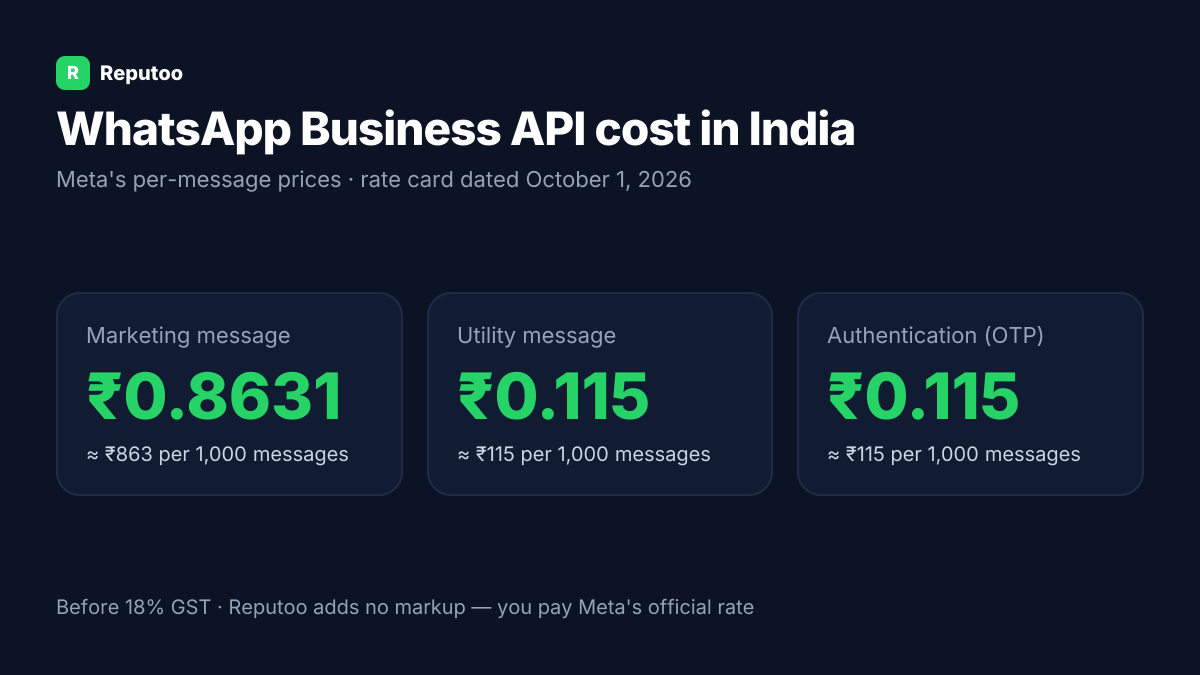
Meta's per-message prices in India (rate card dated October 1, 2026), before GST. Reputoo adds no markup.
Chapter 12
The first two weeks
Load doctors, schedules, fees and practical details; have a doctor approve the fixed replies.
Turn the agent on after hours first; review every conversation each morning with the clinical lead.
Add missing administrative answers the same day.
Move to all-day once the clinical boundary has held without exception.
Chapter 13
Lab tests and preparation
"Do I need to fast for a lipid profile?" is a question the agent can answer — but only from the preparation instructions your doctors have written into the knowledge base, word for word. It books the test, sends the instructions, and, if you offer it, schedules a home sample collection. If a patient asks something the instructions do not cover, it hands over rather than improvising.
Chapter 14
Teleconsultation bookings
For clinics that offer video consultations, the agent can explain which kinds of visit suit a video call under your policy, book the slot with the right doctor, send the fee link and the joining link, and remind the patient before. It does not decide whether a patient's problem is suitable for video beyond the policy you gave it; when unsure, it books an in-person visit.
Chapter 15
Handing over
Clinical handovers go to clinical staff with the patient's name, age, words and any photos, and a note if the message sounded urgent. Administrative handovers — billing, complaints, insurance — go to reception or the billing desk. The agent tells the patient who will reply and roughly when, and repeats the emergency instruction if there is any doubt.
Chapter 16
Languages
The agent replies in the patient's language across 36 languages, including mixed Hindi and English. The fixed symptom and emergency replies should exist in each language your patients use, approved by someone clinically qualified and fluent. Everything else it translates naturally.
Chapter 17
Reading the conversations
A month of conversations shows what patients struggle with: finding the right doctor, understanding fees, reaching someone after hours, getting reports. Those are fixable operational problems. Review them monthly with the clinic manager and the clinical lead, and change the schedules, the fee list or the instructions accordingly.
Chapter 18
Payments and receipts
The agent sends payment links for consultations, tests and packages, confirms when payment arrives, and sends receipts for insurance claims. It explains how cashless and reimbursement claims work in general, and hands specific disputes to billing with the details attached. It never asks for card numbers, PINs or OTPs.
Chapter 19
Privacy rules in the agent's instructions
Write the privacy rules into the agent's instructions in plain words: never confirm whether someone is a patient; never share appointment details or reports except with the patient or someone with recorded consent; never read out a medical record; hand over when identity is in doubt. Patients notice when a clinic's assistant is careful, and trust it more for it.
Chapter 20
Holidays and doctor leave
When a doctor is on leave, the agent should know before patients do: it offers another doctor of the same speciality or the first date after the leave, and moves existing bookings with a message to each patient. Holiday hours and the emergency instruction are updated in one place before every holiday.
Chapter 21
After hours
At night the agent books appointments for the coming days and answers administrative questions. Anything clinical gets the approved reply, with the emergency instruction first, and is queued for the morning with the time it arrived. The patient is told when someone will read it.
Chapter 22
Frequently asked questions
What is the difference between a WhatsApp chatbot and an AI agent?
A chatbot follows menus and flows you define. An AI agent understands free-form messages, answers from your own knowledge base, and can take actions such as booking or updating a record. Most businesses run both: flows for fixed tasks, the agent for everything else.
Can an AI agent make mistakes with my clinic's customers?
Yes, which is why it should answer only from your knowledge base and hand over when it does not know. Review conversations in the first weeks and add missing answers to the knowledge base as you find them.
Can an AI agent give medical advice to clinic patients?
No. It answers administrative questions and books appointments. Messages describing symptoms get a doctor-approved reply and go to clinical staff, and anything that sounds like an emergency is told to call emergency services immediately.
Can the AI agent tell a patient their report results?
It can say a report is ready and, with identity confirmed and consent recorded, share the document. It never interprets or summarises results — that stays with the doctor.
Does the AI agent help patients choose a doctor?
Yes, by speciality, gender, language and availability. When the right speciality is unclear, it books a general physician and passes on the patient's words.
Can the AI agent book lab tests and home sample collection?
Yes. It books the test, sends the preparation instructions your doctors wrote, and schedules home collection where you offer it. Questions about what a test means go to clinical staff.
Will the AI agent reply to patients in their own language?
Yes, across 36 languages including mixed Hindi and English. The fixed symptom and emergency replies should be written in each language your patients use and approved by a clinician.
What happens when a doctor is on leave?
The agent offers another doctor of the same speciality or the first date after the leave, and patients with existing bookings are messaged to move them.
Can I send post-visit follow-ups to patients?
Yes. Set up automated follow-ups — 3 days post-visit check-in, medication reminder, or 6-month recall for chronic condition patients. All via WhatsApp, all automated.
Is patient communication on WhatsApp compliant?
WhatsApp Business API (used by Reputoo) uses end-to-end encryption. Always obtain patient consent before sending WhatsApp messages. Reputoo handles opt-in collection automatically.
R
Written by Riya · Reputoo. Riya writes Reputoo’s guides on the WhatsApp Business API, chatbots and voice AI for Indian businesses. Prices are checked against Meta’s published rate card (25 September 2026); competitor details come from each vendor’s own site.