Run it on WhatsApp with ReputooOfficial WhatsApp Business API · plans from ₹999 a monthBook a DemoStart for FREE
WhatsApp AI Agent
A WhatsApp AI agent for your cloud kitchen: what it does and where it stops
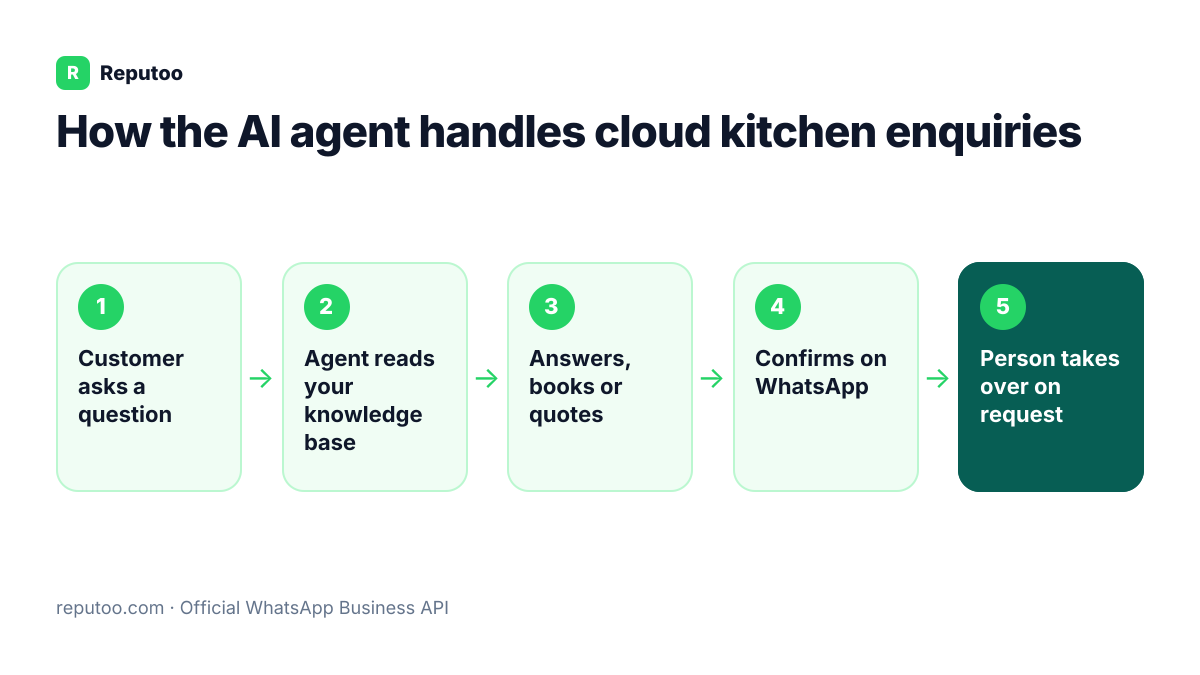
A chatbot follows the paths you draw. An AI agent reads what the customer actually wrote, looks up your cloud kitchen's own information, and takes the next step — books, updates, follows up. This is what that looks like for cloud kitchens, and how to keep it honest.
RRiya · ReputooUpdated 25 September 202610 min read
✓ Fact-checked against Meta’s WhatsApp rate card and vendors’ own pricing pages
Start with what customers ask. Customers ask where their order is, whether an item is available today, whether you deliver to their area, and why the order they got differs from the one they placed. An agent answers all of that from your own information. Then give it the work cloud kitchens repeat every day:
Customer orders directly on WhatsApp — Bot takes the order, generates invoice, and collects payment — zero commission.
Live delivery updates sent automatically — Order confirmed, out for delivery, and delivered — each update sent on WhatsApp.
Post-delivery re-order prompt — After delivery, an automated thank-you with a one-tap re-order link.
Win-back for 7-day inactive customers — Customers who haven't ordered in 7 days get a personalised re-order offer.
The agent runs these on WhatsApp in the customer's language, day and night, and writes what it did back to the contact record so staff see the full history.
Chapter 03
The knowledge base for a cloud kitchen
Menus per brand with prices, portions, spice levels and allergen tags.
Delivery area and times, charges and minimum order.
Hours and last orders per brand.
Customisation rules — what the kitchen can and cannot change.
Policies — refunds, missing items, cancellations.
Chapter 04
How it learns your business
An AI agent is only as accurate as what you give it. On Reputoo it answers from your knowledge base — pages crawled from your website, documents and price lists you upload, and policies you write down — rather than from general knowledge. Two rules keep it right:
If it is not in the knowledge base, the agent says it will check and hands over, rather than guessing.
Prices, timings and policies live in one place. Update the source and the agent's answers change with it.
It also needs to see the records your cloud kitchen already keeps — what to connect: aggregator dashboards plus a kitchen display or POS; direct WhatsApp orders should land in the same queue as everything else.
Chapter 05
Orders in natural language
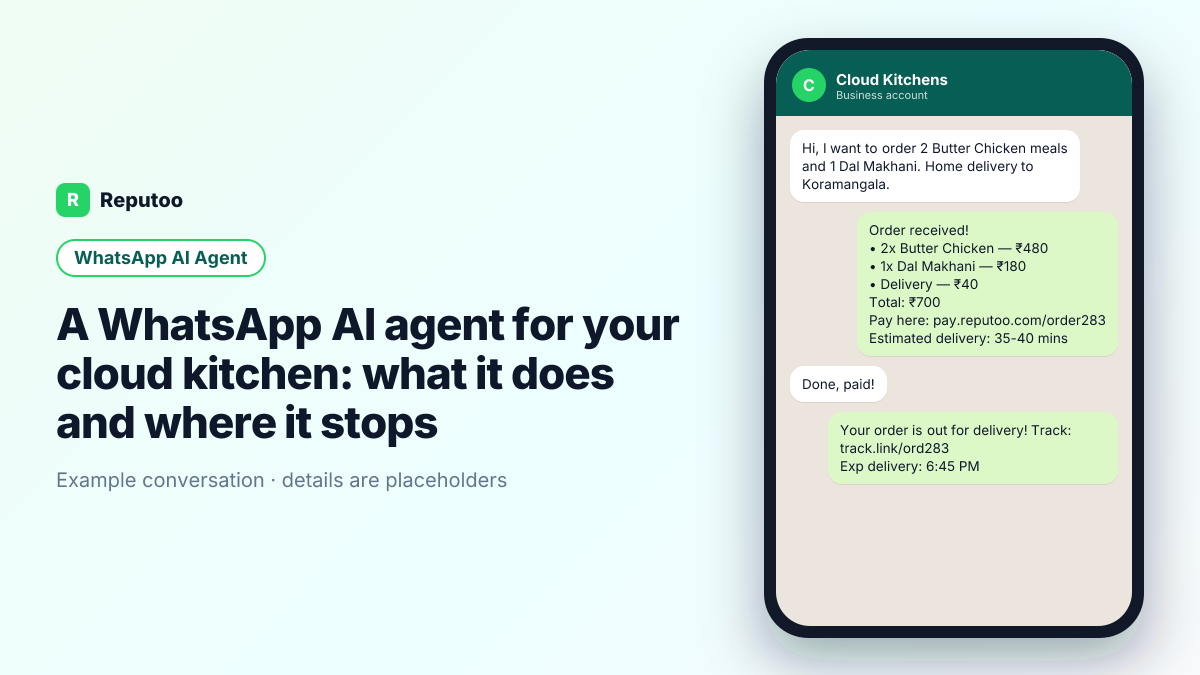
"Two chicken biryanis, one extra spicy, a raita and a Coke, same address as last time" — the agent maps it to the menu, applies the customisation, confirms the total and time, and sends it to the kitchen.
Chapter 06
Where cloud kitchens should keep a person in the loop
These are the moments customers remember, and they are worth a human:
Zomato/Swiggy commissions eat your margin.
Customers order once, platforms own them. Zomato knows your customers. You don't. They can recommend competitors on your next order.
Repeat orders leak to the aggregator. A customer who ordered direct last week orders through Zomato this week, because nothing reminded them you exist.
The agent can open each of these conversations and collect the details; a person should close anything involving a complaint, an exception to policy, or money that has not been agreed. Handover goes to the shared inbox with the full conversation attached.
Chapter 07
Chat and phone, one agent
The same agent that answers on WhatsApp can answer your cloud kitchen's phone line as Vajra, Reputoo's voice agent, so a customer who calls gets the same answers as one who messages. It speaks 36 languages and switches to the caller's.
Chapter 08
Recommending dishes
"What's good for four people under ₹1,000?" — the agent suggests combos from the menu within budget. It never invents dishes or prices.
Chapter 09
Complaints
The agent apologises, collects the order and a photo, and hands to staff. It never decides refunds or credits.
Chapter 10
Payments
It sends payment links and confirms payments. Payment failures go to staff. It never asks for card numbers, PINs or OTPs.
Chapter 11
Languages
The agent replies in the customer's language across 36 languages and understands dish names as customers say them.
Chapter 12
The first two weeks
Load menus with tags, delivery rules and policies.
Start with regulars and reorders.
Review conversations daily and add dish names it misses.
Open it to all direct customers.
Chapter 13
Meal plans
The agent explains meal plans — menu, days, price, pause and skip rules — enrols customers with a payment link, and handles skips, pauses and address changes. Renewals are reminded before the plan ends.
Chapter 14
Bulk orders
For office and party orders, the agent collects the date, time, headcount, dishes and address, suggests platters from the menu, and hands to the manager to confirm the final price and timing.
Chapter 15
Delivery-area questions
The agent checks whether an address is in the delivery area and gives an honest time. Outside the area, it suggests pickup or the aggregator where you are listed.
Chapter 16
Busy-time honesty
During the dinner rush the agent gives longer, accurate times based on the kitchen's queue, and can stop taking orders if the kitchen pauses. Customers forgive a longer wait they were told about.
Chapter 17
Making it sound like your brand
Each virtual brand can have its own voice — a biryani brand warm and generous, a salad brand crisp and light. Set the agent's tone per brand number, and read conversations weekly.
Chapter 18
Reading the conversations
A month of conversations shows which dishes people ask for that you do not make, which customisations are common, and when orders peak. Those shape the menu and the staffing of each shift.
Chapter 19
Privacy
The agent shares order and address details only with the customer on record, never with another caller.
Chapter 20
Pickup orders
For customers nearby, the agent offers pickup with a ready time and directions to the pickup window, without a delivery charge.
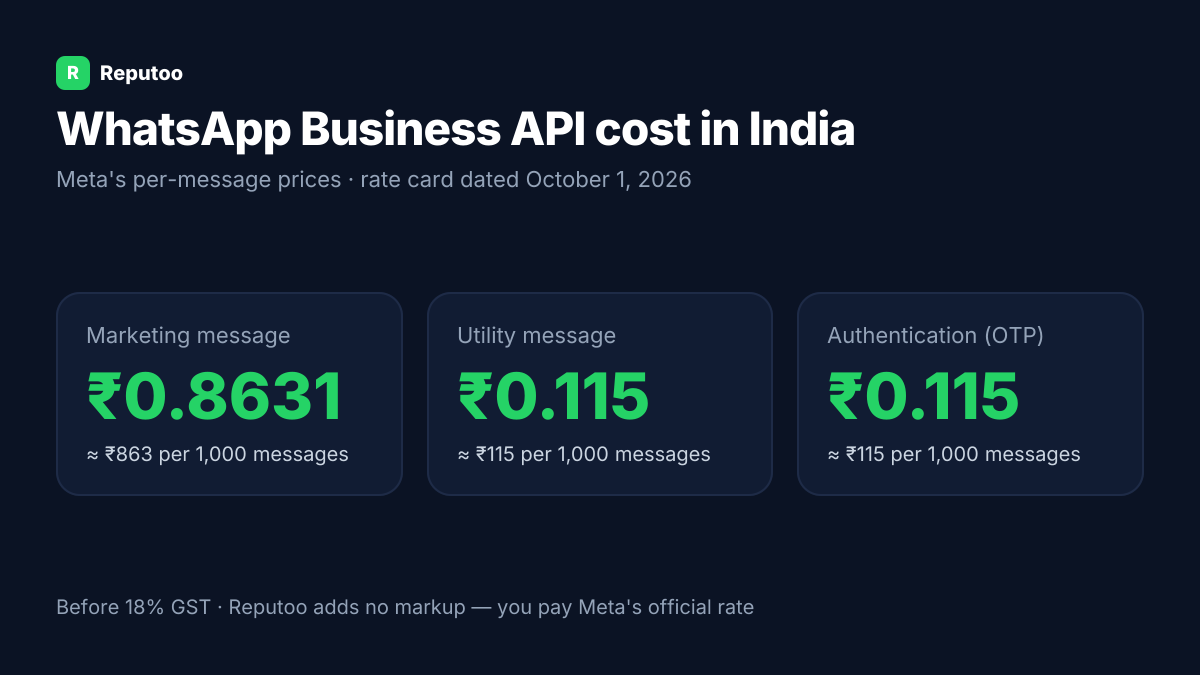
Meta's per-message prices in India (rate card dated October 1, 2026), before GST. Reputoo adds no markup.
Chapter 21
Cross-brand orders
When a customer asks one brand for another brand's dish from the same kitchen, the agent can take both in one order if your system allows, or share the other brand's link. Customers get what they want; the kitchen keeps the order.
Chapter 22
Hygiene and licence questions
The agent answers factually from what you have written — licence number, how vegetarian and non-vegetarian items are handled, packaging — and passes anything else to the manager.
Chapter 23
After-delivery check
After delivery the agent asks how the meal was and handles the reply — thanks for good feedback, an apology and handover with a photo request for problems.
Chapter 24
Loyalty for direct customers
The agent tells direct customers their loyalty balance, applies rewards to orders, and explains the rules. It never creates rewards outside the rules.
Chapter 25
Kitchen pauses and last orders
When the kitchen pauses orders or reaches last orders, the agent stops taking orders and says when ordering resumes, rather than accepting food the kitchen cannot make.
Chapter 26
Menu changes
New dishes, removals and price changes are updated once; the agent's answers change with them. It tells customers asking for a removed dish what replaced it.
Chapter 27
Handovers
Complaints, refunds, severe allergy questions and bulk orders go to staff with the order and the customer's words, and the agent says when a reply will come — within minutes for food issues.
Chapter 28
Late-night orders
For late-night kitchens, the agent takes orders at any hour the kitchen is open, and after closing tells customers exactly when ordering opens again.
Chapter 29
Addresses and landmarks
The agent asks for a landmark or location pin when an address looks incomplete, saves it, and reuses it next time — fewer lost riders, hotter food.
Chapter 30
Customisation limits
The agent accepts only customisations the kitchen can make, and declines others politely before the order is placed. Customers prefer an honest no to a promise the kitchen breaks.
Chapter 31
Office orders and invoices
For office customers, the agent takes team orders, suggests packages, and sends GST invoices in the company's name, or adds the order to the monthly account.
Chapter 32
Tone
Food ordering should feel quick and friendly. Keep the agent's replies short, confirm exactly what was ordered, and save longer conversations for complaints, where the customer needs to feel heard.
Chapter 33
Lunch pre-orders
The agent takes lunch pre-orders in the morning until the cut-off, confirms the delivery time, and adds them to the kitchen's plan. Office regulars can set a recurring order and change it by message.
Chapter 34
Group orders
For group orders, the agent takes everyone's choices from the organiser — "three veg biryanis, two chicken, one without onion" — reads them back, and sends tracking to the organiser.
Chapter 35
Payments and refunds
The agent sends payment links and confirms payments. Refunds for missing items are approved by staff and then processed; the agent tells the customer when to expect them. It never asks for card numbers, PINs or OTPs.
Chapter 36
Reorders from history
"Same as Friday" is enough for the agent: it finds Friday's order, confirms items, address and total in one message, and sends it to the kitchen.
Chapter 37
Weekly review
Read the agent's handovers and misunderstood orders weekly with the kitchen lead. Add dish names, customisations and delivery areas it missed; accuracy improves every week.
Chapter 38
Delivery instructions
The agent saves instructions like "leave at the gate" or "call on arrival" with the address and adds them to the rider's ticket, so the rider does not need to call the customer or the kitchen.
Chapter 39
Frequently asked questions
What is the difference between a WhatsApp chatbot and an AI agent?
A chatbot follows menus and flows you define. An AI agent understands free-form messages, answers from your own knowledge base, and can take actions such as booking or updating a record. Most businesses run both: flows for fixed tasks, the agent for everything else.
Can an AI agent make mistakes with my cloud kitchen's customers?
Yes, which is why it should answer only from your knowledge base and hand over when it does not know. Review conversations in the first weeks and add missing answers to the knowledge base as you find them.
Can an AI agent take food orders in free text?
Yes. It maps the customer's words to the menu, applies customisation, confirms the total and time, and sends the order to the kitchen.
Does the AI agent handle allergy questions?
It answers from allergen tags; severe allergies are confirmed by a person because shared kitchens cannot always rule out cross-contamination.
Can the agent track a delivery?
Yes, from the order status, including the rider's name and estimated time.
Can the AI agent take bulk party orders?
It collects the details and suggests platters, then hands to the manager to confirm price and timing.
Does the agent speak the customer's language?
Yes, across 36 languages, and it understands dish names as customers say them.
What does the AI agent do when the kitchen is overloaded?
If the kitchen pauses orders, the agent stops taking them and tells customers when ordering resumes.
Can the AI agent send GST invoices to offices?
Yes, in the company's name with each order or monthly for credit accounts.
Can the AI agent reorder my last meal?
Yes — say "same as last time" and it confirms the items, address and total in one message.
How do I get customers ordering direct instead of through Zomato?
Every delivery customer becomes a WhatsApp contact you own. Weekly offers, live order updates and win-back messages go out on your own channel, so repeat orders stop carrying an aggregator commission.
Can I send offers to my past customers?
Yes. Build your direct customer list from WhatsApp orders and send broadcast campaigns — new dishes, weekend combos, loyalty offers — with zero platform involvement.
R
Written by Riya · Reputoo. Riya writes Reputoo’s guides on the WhatsApp Business API, chatbots and voice AI for Indian businesses. Prices are checked against Meta’s published rate card (25 September 2026); competitor details come from each vendor’s own site.