
WhatsApp Marketing Software for Healthcare: How to Improve Patient Communication and Appointment Management
Healthcare providers need fast, reliable, and clear communication with patients. From appointment reminders to follow-up messages, every conversation matters. If patients miss appointments or fail to follow instructions, it can affect outcomes, schedules, and operations. That is why WhatsApp marketing software for healthcare has become such a useful tool.
WhatsApp gives clinics, hospitals, dental practices, and wellness providers a direct and familiar way to communicate with patients. Instead of relying only on email or phone calls, healthcare teams can send reminders, updates, and follow-up messages in a channel patients actually check. This can improve attendance, reduce no-shows, and make communication easier for staff.
For healthcare businesses, the goal is not just promotion. It is better service, better coordination, and a better patient experience.
On this page (19 sections)
- 1.What Is WhatsApp Marketing Software for Healthcare?
- 2.Why Healthcare Providers Use WhatsApp
- 3.Best Use Cases for Healthcare WhatsApp Marketing
- 4.Benefits of WhatsApp Marketing in Healthcare
- 5.What to Include in a Healthcare WhatsApp Message
- 6.Why Reputoo Helps Healthcare Teams
- 7.Best Practices for Healthcare WhatsApp Communication
- 8.Common Mistakes to Avoid
- 9.The Appointment Flow, From Booking to Rebooking
- 10.What Healthcare WhatsApp Messages Cost
- 11.Patient Privacy and Consent
- 12.Promoting Medical Services Within the Rules
- 13.Telemedicine and WhatsApp
- 14.Measuring the Effect on Your Clinic
- 15.Example Messages for a Clinic
- 16.Choosing a WhatsApp Platform for a Clinic
- 17.One Number for Several Doctors or Branches
- 18.FAQs
- 19.Final Thoughts
What Is WhatsApp Marketing Software for Healthcare?
WhatsApp marketing software for healthcare is a platform that helps medical providers send automated and manual WhatsApp messages to patients. These messages can include appointment reminders, follow-ups, service updates, and support communication.
It can be used for:
- Appointment reminders
- Booking confirmations
- Follow-up instructions
- Patient check-ins
- Service updates
- Communication for clinics and wellness centers
The goal is to make patient communication faster, more reliable, and easier to manage.
Why Healthcare Providers Use WhatsApp
Healthcare is a communication-heavy industry. Patients often need reminders, instructions, and updates before and after care. Missed communication can lead to missed appointments, confusion, or poor follow-through.
WhatsApp helps because:
- Messages are usually seen quickly
- Communication feels personal and direct
- Patients can reply easily
- Reminders can be automated
- Staff save time on repetitive follow-ups
This makes WhatsApp especially useful for clinics, dentists, specialists, and wellness centers that need consistent communication.
Best Use Cases for Healthcare WhatsApp Marketing
Healthcare providers can use WhatsApp in several important ways.
1. Appointment reminders
Reduce no-shows by reminding patients before their visit.
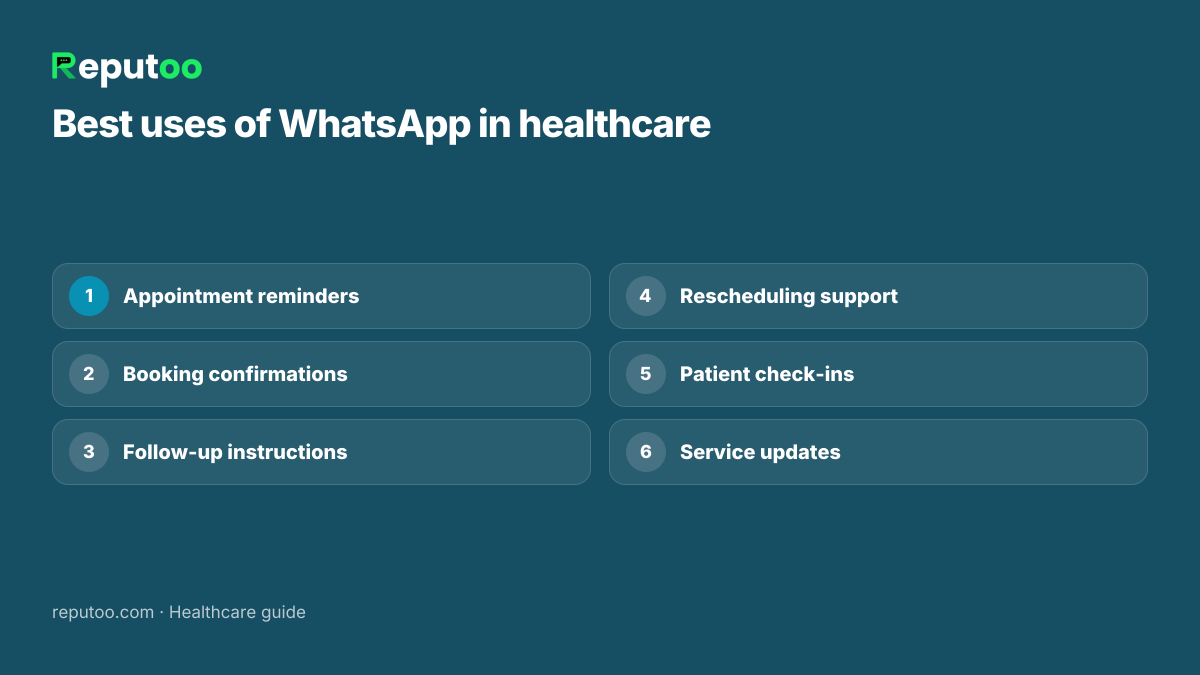
2. Booking confirmations
Confirm appointments immediately after scheduling.
3. Follow-up instructions
Send care instructions after treatment or consultation.
4. Rescheduling support
Make it easier for patients to change appointments if needed.
5. Patient check-ins
Follow up after visits to confirm recovery or next steps.
6. Service updates
Share changes in hours, availability, or clinic operations.
These use cases improve communication without adding too much manual work for staff.
Benefits of WhatsApp Marketing in Healthcare
A good WhatsApp communication system can help healthcare organizations in several ways.
Fewer missed appointments
Automated reminders help patients remember their scheduled visits.
Better patient engagement
Patients feel more informed and supported.
Faster communication
Important messages reach patients quickly.
Less admin work
Staff spend less time making repetitive calls or sending manual messages.
Better patient experience
Clear and timely communication improves trust and satisfaction.
What to Include in a Healthcare WhatsApp Message
Healthcare messages should be clear, respectful, and useful.
A good message should include:
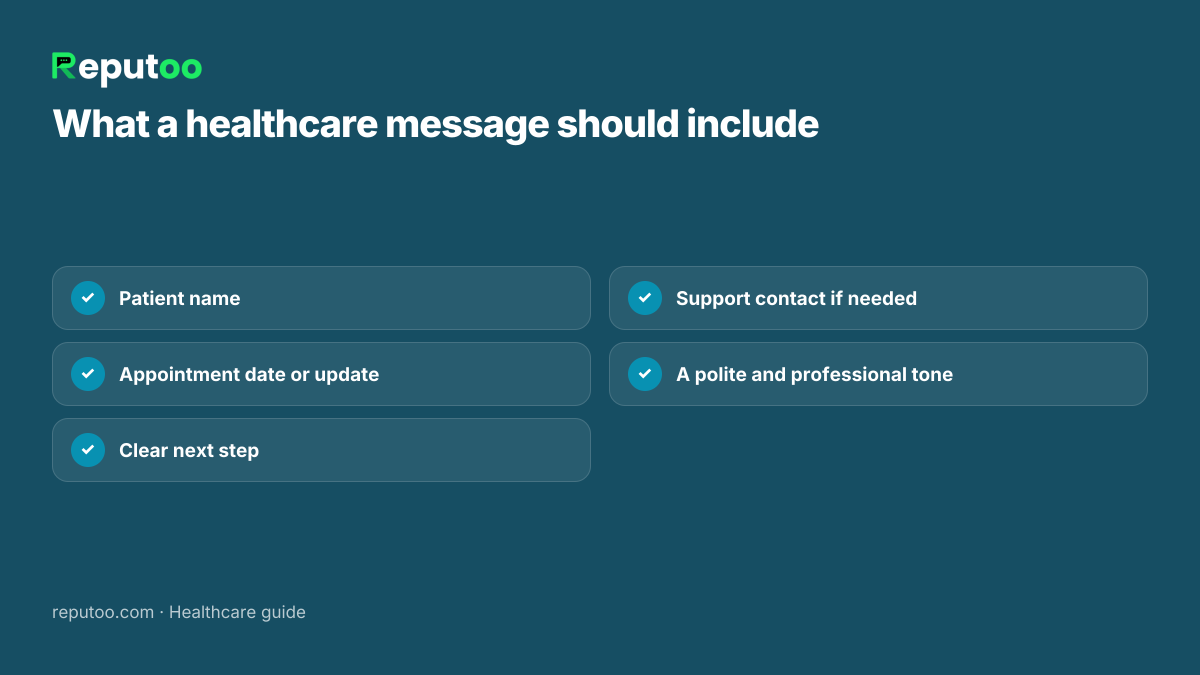
- Patient name
- Appointment date or update
- Clear next step
- Support contact if needed
- A polite and professional tone
Keep messages short and easy to understand.
Why Reputoo Helps Healthcare Teams
Reputoo helps healthcare providers manage WhatsApp communication more efficiently with automation and message workflows.
With Reputoo, healthcare teams can:
- Send automated appointment reminders
- Follow up with patients after visits
- Improve communication consistency
- Reduce manual admin work
- Manage patient messaging in one platform
That makes it easier to keep patients informed without overloading the team.
Best Practices for Healthcare WhatsApp Communication
If you want to use WhatsApp effectively in healthcare, follow these best practices:
Be clear and professional
Messages should feel helpful and respectful.
Keep it short
Patients should understand the message quickly.
Automate the repetitive parts
Use automation for reminders and confirmations.
Respect privacy
Only send communication that is appropriate and necessary.
Make it easy to respond
Patients should know how to reply or ask for help.
Common Mistakes to Avoid
Healthcare messaging should be handled carefully.
Avoid these mistakes:
- Sending unclear messages
- Being too casual
- Over-messaging patients
- Forgetting follow-up timing
- Making messages too long
The goal is to help patients, not overwhelm them.
The Appointment Flow, From Booking to Rebooking
Most of the communication a clinic needs can run on its own once appointments live in one system. On Reputoo the flow looks like this:
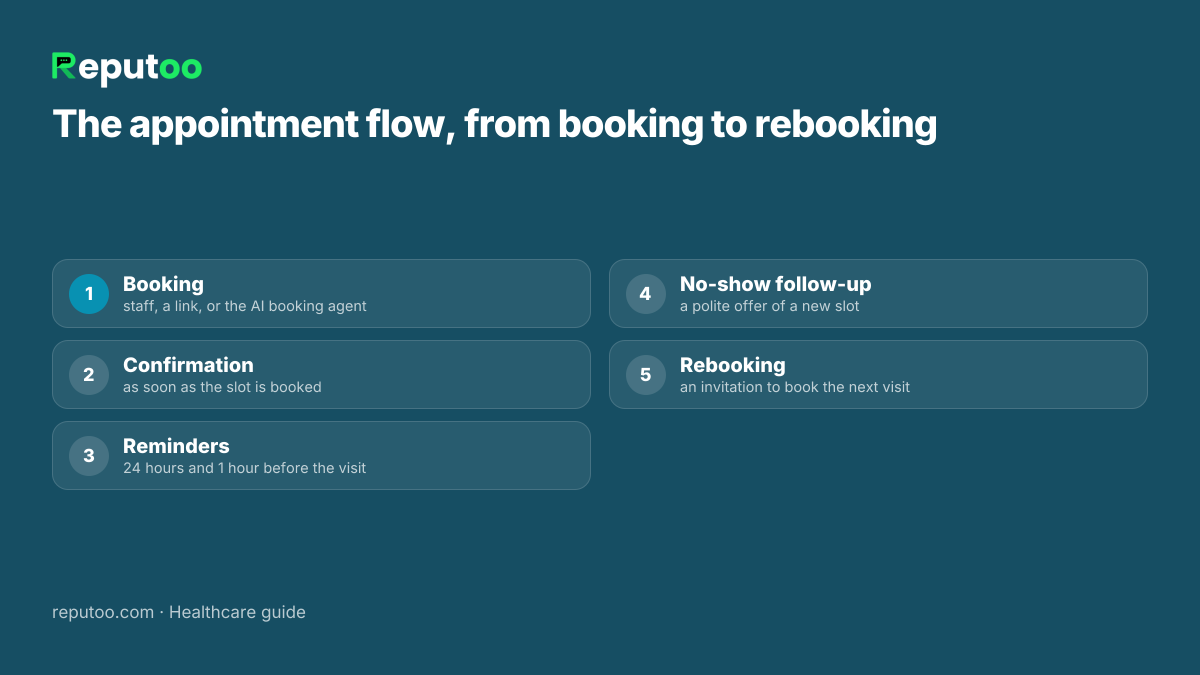
- Booking. Patients book through your staff, a link, or an AI booking agent that answers on WhatsApp at any hour and offers only the slots that are actually free. Appointments sync with Google Calendar.
- Confirmation. The patient gets a WhatsApp confirmation with the doctor, date, time and address as soon as the slot is booked.
- Reminders. A reminder goes out 24 hours before the visit and another 1 hour before. Patients can reply to reschedule instead of simply not turning up.
- No-show follow-up. If a patient misses the appointment, a polite message offers a new slot.
- Rebooking. For treatments with a natural next visit — a dental cleaning, a physiotherapy course, a follow-up consultation — a message invites the patient to book the next one.
Staff only step in when a patient replies with something that needs a person, and those replies land in one shared inbox instead of on the reception phone.
What Healthcare WhatsApp Messages Cost
Meta charges per delivered template message, by category. Appointment confirmations, reminders and rescheduling messages are utility messages: they are about an appointment the patient made. Announcements of a new service or a health camp are marketing. On the October 1, 2026 rate card, a message to an Indian number costs ₹0.115 for utility and ₹0.8631 for marketing, before 18% GST.
A clinic with 600 appointments a month that sends a confirmation and two reminders per appointment sends 1,800 utility messages: 1,800 × ₹0.115 = ₹207 a month in Meta charges. Compare that with the cost of a single empty consultation slot. When a patient replies, your answers inside the 24-hour window are charged at the utility rate since 1 October 2026. Run your own numbers in the WhatsApp API cost calculator; Reputoo adds no markup to Meta’s rate.
Patient Privacy and Consent
Health information is among the most sensitive data a business holds, so a few rules matter more here than anywhere else:
- Ask first. Get the patient’s agreement to receive appointment messages on WhatsApp — at registration, on the booking form or when they first message you — and keep it separate from consent for promotional messages. India’s Digital Personal Data Protection Act, 2023 expects consent with a clear purpose.
- Keep clinical detail out of templates. A reminder needs the doctor, date, time and place, not the diagnosis or the test being done. If a report must be shared, send it in a private conversation the patient started, or as a secure link.
- Check the number. A reminder sent to the wrong person can reveal that someone is seeing a particular specialist. Confirm the number at registration.
- Control staff access. Give each team member their own login, so every message can be traced, and remove access when someone leaves.
- Make stopping easy. Patients should be able to opt out of non-essential messages at any time.
Promoting Medical Services Within the Rules
The word “marketing” needs care in healthcare. In India, doctors’ advertising is regulated by the medical council’s code of ethics, which restricts self-promotion and soliciting patients. Check the National Medical Commission’s current guidance before planning promotional campaigns, and keep promotional messages to factual information: timings, new services, a visiting specialist, a health camp, a change of address.
WhatsApp has its own limits too. Meta’s commerce policy does not allow selling prescription drugs over WhatsApp, and every marketing template goes through Meta’s review. Avoid cure claims, before-and-after promises and patient testimonials in templates — they are the content most likely to be rejected, and the most likely to cause trouble later.
In practice, most of what helps a clinic on WhatsApp is not promotion at all. Reminders, follow-ups and quick answers are service, and they are where the results come from.
Telemedicine and WhatsApp
India’s Telemedicine Practice Guidelines (March 2020) allow registered medical practitioners to consult with patients over chat-based applications, and they name WhatsApp among them. The guidelines also set out what the practitioner must do: identify the patient, use professional judgement about whether a remote consultation is appropriate, and keep records of the consultation.
If your practice offers follow-up consultations over WhatsApp, a business number with a team inbox keeps those records in one place, instead of on a doctor’s personal phone.
Measuring the Effect on Your Clinic
Before switching anything on, write down three numbers for the last month: the share of appointments that were no-shows, the number of calls reception made to confirm or remind patients, and the share of patients who booked a follow-up visit. Check the same three numbers a month after reminders and follow-ups start. If no-shows fall and follow-up bookings rise, the system is paying for itself; if not, read the patients’ replies to see what is missing from the messages.
For more detail by speciality, see WhatsApp for clinics, dental clinics and hospitals.
Example Messages for a Clinic
Five templates most clinics need, with {{placeholders}} for the details:
- Confirmation: “Hi {{patient name}}, your appointment with {{doctor}} is confirmed for {{date}} at {{time}}, {{clinic address}}. Reply here if you need to change it.”
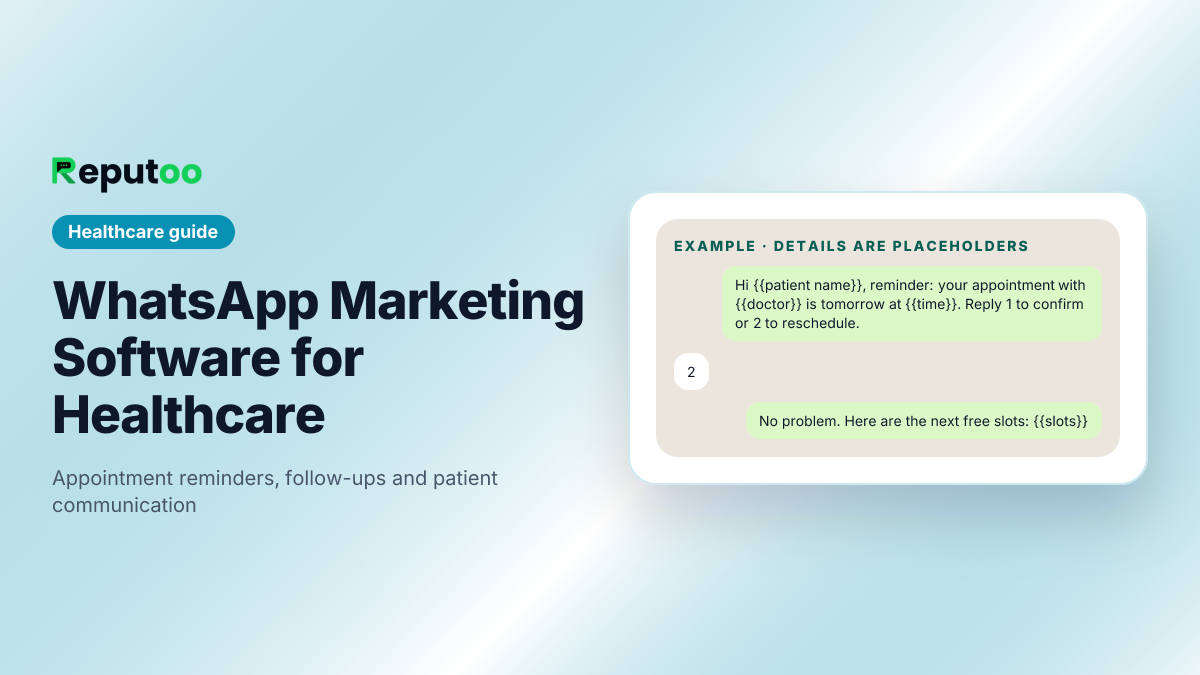
- Reminder: “Reminder: your appointment with {{doctor}} is tomorrow at {{time}}. Reply 1 to confirm or 2 to reschedule.”
- Preparation: “For your visit on {{date}}, please bring {{documents}} and arrive 10 minutes early.”
- Follow-up: “Hi {{patient name}}, {{doctor}} has asked us to check how you are feeling after your visit. Reply here if you have any questions.”
- Next visit: “It is time to book your next {{treatment}} appointment. Choose a slot here: {{link}}.”
Each one names the doctor and the next step, and none of them mentions a diagnosis.
Choosing a WhatsApp Platform for a Clinic
When you compare platforms, check the things that matter in a medical setting rather than the length of the feature list:
- Official WhatsApp Business API, so the number belongs to the clinic and several staff can use it.
- Appointment-aware reminders that change automatically when an appointment is moved or cancelled.
- Calendar sync, so the WhatsApp booking flow and the doctors’ calendars never disagree.
- A shared inbox with individual logins, so patient conversations do not live on a personal phone.
- Templates in your patients’ languages.
- Clear pricing that shows Meta’s charges separately from the platform’s fee.
A short trial with your own reminders and a week of real appointments will tell you more than any demo.
One Number for Several Doctors or Branches
Multi-doctor clinics and chains face a choice: one WhatsApp number for everything, or one per branch. Most start with one number, so patients only save one contact, and route conversations inside the inbox — by doctor, by department or by branch — using tags and assignment rules. A separate number per branch makes sense once branches run as separate businesses with their own reception teams. Either way, the reminders should always name the right doctor and the right address, because a patient who goes to the wrong branch is a no-show too.
FAQs
What is WhatsApp marketing software for healthcare?
It is software that helps healthcare providers send patient reminders, follow-ups, and communication through WhatsApp.
Can WhatsApp be used for appointment reminders?
Yes. It is one of the strongest use cases for healthcare messaging.
Is WhatsApp good for patient communication?
Yes. It is fast, direct, and easy for patients to use.
Can healthcare teams automate WhatsApp messages?
Yes. Platforms like Reputoo can help automate reminders and follow-ups.
Is WhatsApp suitable for clinics and dental practices?
Yes. It works well for clinics, dentists, and other patient-based services.
Final Thoughts
WhatsApp marketing software for healthcare is a practical way to improve patient communication, reduce no-shows, and make scheduling easier. It helps healthcare teams stay connected with patients in a faster and more reliable way.
If your clinic or healthcare practice wants better communication without more manual work, WhatsApp should be part of your system.
Improve Patient Communication with Reputoo
1,000+ businesses onboarded · Member of NVIDIA Inception · Official WhatsApp Business API, no per-message markup.